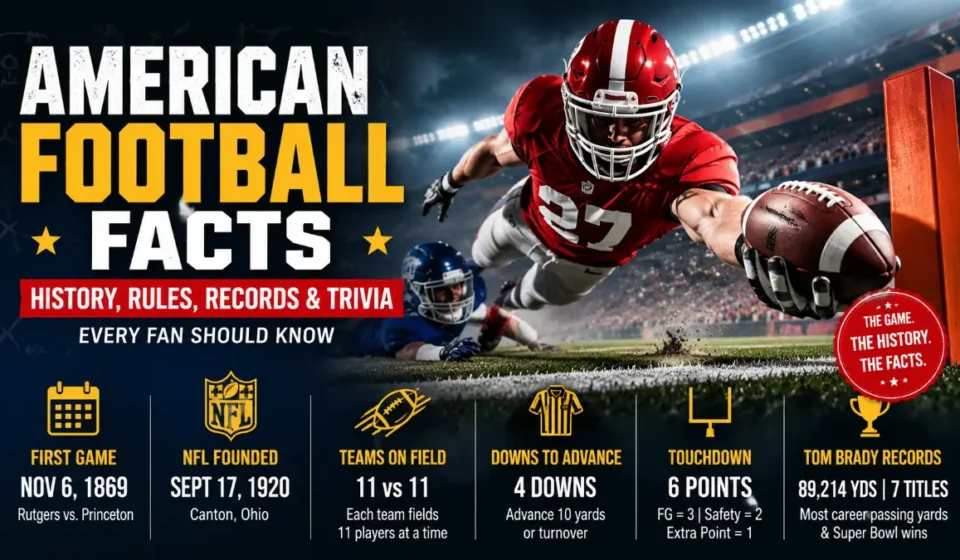

American football facts Ask a first-time viewer why a team just punted on 4th down instead of trying to score, and you’ll usually get a confused shrug. These American football facts exist for exactly that reason: once the logic behind downs, scoring, and possession clicks, the entire sport starts to make sense. This guide walks through the game from the ground up, covering the American football facts every fan should know about its objective, its history, its rulebook, and the records that still stand as benchmarks for greatness.
What the Objective Actually Is
Two teams of 11 players compete to move a ball into the opposing end zone more effectively than their opponent, using a combination of running and passing plays while a defense tries to stop them. Among the most fundamental American football facts is that the game is built around discrete plays rather than continuous action.
The playing field sets the physical boundaries for that contest. It stretches 100 yards between the two goal lines, with a 10-yard end zone on either end, bringing the total length to 120 yards. Games are broken into four 15-minute quarters, 60 minutes of total playing time, separated by a 13-minute halftime as defined in the official NFL rulebook.
Key American Football Facts About Field and Game Structure
| Element | Specification |
| Players per side (on field) | 11 |
| Field length (goal line to goal line) | 100 yards |
| End zone depth | 10 yards each |
| Quarter length | 15 minutes |
| Total regulation time | 60 minutes |
| Halftime length | 13 minutes |
| Active roster (NFL) | 53 players |
Unlike continuous sports such as soccer or rugby, football is built around discrete plays. Each snap is a fresh attempt, stopped and restarted, which is exactly why the sport can pack so many strategic decisions, substitutions, and specialized players into a single game.
From Rugby Scrums to a Distinct American Sport
Some of the most fascinating American football facts come from how far removed the modern game is from its origins. Football didn’t appear fully formed. It grew out of college matches that borrowed heavily from soccer and rugby, gradually shedding those influences until it became something entirely its own.
The earliest known contest took place on November 6, 1869, between Rutgers and Princeton, a game Rutgers won 6-4 under rules closer to soccer than modern football: 25 players per side, no passing, and scoring built around kicking rather than carrying the ball. Seven years later, in 1876, delegates from Harvard, Yale, Princeton, and Columbia met at the Massasoit Convention and adopted rugby-style rules, setting up the next major shift.
That shift came from one man. Walter Camp, playing and later coaching at Yale through the 1880s, introduced the line of scrimmage, the down-and-distance system, and a reduction from 15 to 11 players per team. Those three changes are the reason football today looks nothing like its rugby ancestor. Professional play followed not long after: in 1892, William “Pudge” Heffelfinger became the first documented paid player, earning $500 for a single game with the Allegheny Athletic Association.
One more reform reshaped the sport for good. In 1906, the forward pass was legalized, a direct response to a string of serious injuries and deaths in college football that had drawn public criticism, including pressure from President Theodore Roosevelt. That single rule change is what eventually made passing offenses, and by extension the modern NFL, possible.
The league itself arrived in 1920, when representatives from teams across Ohio, Indiana, Illinois, and New York gathered at a car dealership in Canton, Ohio, to form the American Professional Football Association. It became the National Football League two years later, in June 1922, with Jim Thorpe serving as its first president while playing. Of the ten founding franchises, only the Chicago Cardinals (now the Arizona Cardinals) and the Decatur Staleys (now the Chicago Bears) still exist today.
How Downs, Scoring, and Overtime Work
The rulebook can look intimidating, but nearly everything in a broadcast traces back to two ideas: gaining yardage and scoring points. These American football facts about the rulebook explain both.
The Down System
Offenses get four downs, individual play attempts, to advance the ball 10 yards. Reaching that mark resets the count for a fresh set of four downs, commonly shown on a broadcast as “1st and 10.” Falling short after four downs typically leads to one of three decisions on 4th down: punting to improve field position, attempting a field goal, or going for it directly, a call that depends on field position, the score, and time remaining.
Read More: Best Bread for Avocado Toast
Scoring Breakdown
| Score type | Point value | Requirement |
| Touchdown | 6 | Ball crosses into the opponent’s end zone during a live play |
| Extra point | 1 | Kick attempt following a touchdown |
| Two-point conversion | 2 | Offensive play from the 2-yard line, run instead of an extra-point kick |
| Field goal | 3 | Kick sails through the opponent’s uprights during live play |
| Safety | 2 | Defense is credited when the offense is responsible for the ball becoming dead in its own end zone |
What Happens When the Score Is Tied
If regulation ends level, the game moves to overtime. Starting with the 2025 season, the NFL aligned its regular-season and postseason overtime formats so that both teams get a chance to possess the ball, regardless of what happens on the opening drive, unless that drive ends in a defensive score such as an interception or fumble returned for a touchdown. Regular-season overtime is capped at 10 minutes and can still end in a tie, while postseason overtime continues in 15-minute periods until a winner is decided.
The Three Units That Make Up a Team
Every player belongs to one of three groups, and understanding their jobs is one of the more practical American football facts for new viewers, since it makes it far easier to follow why certain players take the field on certain plays.
The offense is led by the quarterback, who throws passes and directs the play, supported by running backs who carry the ball, wide receivers and tight ends who catch passes, and an offensive line that blocks to protect the quarterback and open running room. The defense mirrors that structure: the defensive line pressures the quarterback and stops runs at the point of contact, linebackers cover both the run and short passes, and cornerbacks and safeties defend against passing plays deeper down the field. Special teams handle all kicking situations, with kickers responsible for field goals and extra points, punters kicking the ball away on 4th down, and return specialists trying to gain yardage on kickoffs and punts.
Losing Possession: Turnovers and Penalties
Two things can cut a promising drive short, and both come up constantly during a broadcast. These are among the American football facts that trip up newer fans most often.
A turnover shifts possession to the defense before the offense runs out of downs. This happens through an interception, when a defender catches a forward pass meant for an offensive player, or a fumble, when a ball carrier loses control and the opposing team recovers it. A turnover on downs is different: it occurs when the offense simply fails to gain the required 10 yards within four attempts.
Penalties are self-inflicted setbacks rather than possession changes. A false start happens when an offensive player moves illegally before the snap, while offside penalizes a defender who’s illegally positioned before the ball is snapped. Holding covers illegally restraining an opponent who isn’t the ball carrier, pass interference applies to illegal contact that prevents a catch, delay of game results from failing to snap the ball before the play clock expires, and roughing the passer punishes illegal hits on the quarterback after a throw.
Records That Still Define the Sport
Some of the most cited American football facts revolve around individual and team records, many of which have shifted as passing offenses have taken over the modern game, while others have proven remarkably durable.
Tom Brady owns the NFL’s career passing records, with 89,214 yards and 649 touchdowns across 23 seasons between 2000 and 2022. He also holds the record for most Super Bowl titles by a player, with seven, six won with the New England Patriots and one with the Tampa Bay Buccaneers. Behind him on the all-time passing yardage list sit Drew Brees (80,358 yards) and Peyton Manning (71,940 yards).
At the franchise level, the Patriots and Pittsburgh Steelers are tied for the most Super Bowl titles, with six apiece, out of the 20 different franchises that have won at least one championship since the modern Super Bowl era began following the 1966 season.
Super Bowl history has produced some notable extremes. Super Bowl XXIX, a 49-26 win for the San Francisco 49ers over the San Diego Chargers, remains the highest-scoring Super Bowl by combined points, with 75 total. Separately, the 49ers also hold the record for the largest margin of victory, a 45-point rout of the Denver Broncos (55-10) in Super Bowl XXIV. On the other end, the Patriots’ 13-3 win over the Los Angeles Rams in 2019 stands as the lowest-scoring Super Bowl.
The biggest comeback in the game’s history belongs to Super Bowl LI, where New England erased a 25-point deficit to beat the Atlanta Falcons 34-28 in overtime, the first Super Bowl ever decided that way. It wasn’t the last: Super Bowl LVIII, played in February 2024, also went to overtime, with the Kansas City Chiefs edging the San Francisco 49ers 25-22.
How the College Game Compares
The NFL gets most of the media attention, but American football is played at multiple levels, and college football in particular shares the same foundation with a few notable differences. Comparing levels of play surfaces a few more useful American football facts for anyone who follows both.
| Category | NFL | College football (NCAA) |
| Competition level | Professional | University |
| Objective | Score more than the opponent | Same |
| Downs required | 4 downs for 10 yards | 4 downs for 10 yards |
| Rulebook | NFL Official Playing Rules | NCAA Football Rules |
| Overtime | Both teams get a possession opportunity (2025 rules) | Alternating possessions starting at the opponent’s 25-yard line |
| Active roster | 53 players | Varies by division |
The core mechanics, downs, scoring values, and field dimensions, stay consistent across levels, which is why fans can move between watching college Saturdays and NFL Sundays without relearning the sport from scratch.
American Football Facts Even Longtime Fans Get Wrong
A handful of small details trip up even experienced viewers, and these American football facts are worth double-checking before repeating them.
- The Vince Lombardi Trophy, awarded to the Super Bowl champion, is remade from scratch by Tiffany & Co. every year rather than being handed down between winners; each champion keeps its trophy permanently.
- A regulation football must weigh between 14 and 15 ounces and measure roughly 11 inches long, exact dimensions set by league rules rather than tradition.
- Jerry Rice holds the NFL’s career records for receiving yards and touchdown receptions, marks that have stood since his retirement in 2004, even as passing volume across the league has increased.
- The Super Bowl halftime show runs far longer than a standard NFL halftime, often stretching to 20-30 minutes, compared with the usual 13-minute intermission during the regular season.
Frequently Asked Questions
Why do teams have four downs instead of a different number?
The four-down system dates back to Walter Camp’s 1880s reforms, which replaced rugby’s continuous play with a structured series of attempts to move the ball. Four downs strikes a balance between giving the offense a fair chance to advance and forcing meaningful strategic decisions, particularly on 4th down.
What are some of the most useful American football facts for a total beginner?
Focus on three things first: the objective (advance the ball into the end zone), the down system (four tries to gain 10 yards), and the scoring values (touchdown, field goal, safety). Once those three concepts are clear, most in-game decisions, like punting or attempting a two-point conversion, become far easier to follow.
Does college football use the same scoring system as the NFL?
Yes, the point values for touchdowns, field goals, extra points, and safeties are identical between the NFL and NCAA football. The main differences appear in overtime procedures, clock management rules, and roster regulations rather than in how points are scored.
Why did the forward pass take so long to become legal?
Football’s early rulebook was built around rugby-style running plays, which led to dangerous mass-formation tactics and a wave of serious injuries in the early 1900s. The forward pass was legalized in 1906 specifically to open up the field and reduce the violent collisions those formations produced.
What’s the actual difference between a fumble and an interception?
A fumble occurs when a ball carrier loses control of the ball during a play, and either team can recover it. An interception is specific to passing plays: a defender catches a forward pass that was intended for an offensive receiver, immediately turning the ball over to the defense.
Why does a safety benefit the scoring team beyond just two points?
After a safety is scored, the team that gave up the points must kick the ball back to the scoring team, effectively handing over both points and improved field position in the same play. That combination makes safeties disproportionately valuable compared to their point total alone.
How often does a Super Bowl actually go to overtime?
Overtime has decided a Super Bowl twice: first in Super Bowl LI (2017), when New England beat Atlanta after a 25-point comeback, and again in Super Bowl LVIII (2024), when Kansas City beat San Francisco 25-22. Both instances remain rare relative to the total number of Super Bowls played.
What changed about NFL overtime in 2025?
Before 2025, only the postseason guaranteed both teams a possession in overtime regardless of what happened on the opening drive. The rule change extended that same format to the regular season, so both regular-season and postseason overtime now follow the same principle, aside from the regular season’s shorter 10-minute period and tie-game possibility.
Are downs and yardage rules the same at every level of football?
The basic four-downs-for-10-yards structure is shared across the NFL, college, and most organized levels of the sport. Differences tend to show up elsewhere, particularly in clock rules, overtime formats, and roster sizes, rather than in the fundamental down-and-distance system.
Why do some franchises have far more Super Bowl titles than others?
Sustained success in the NFL usually traces back to a combination of elite quarterback play, consistent coaching, and front-office stability over many seasons. The Patriots and Steelers, tied for the most titles at six each, both built extended championship windows around exactly that combination.