
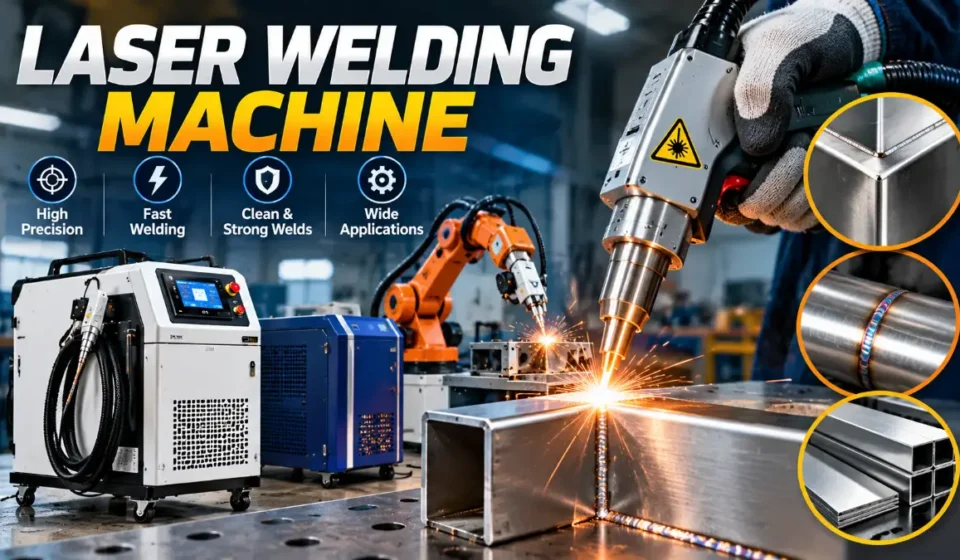

A laser welding machine is a modern metal-joining tool that uses a concentrated laser beam to melt and fuse materials together. It delivers precise welds, fast processing, and reduced heat distortion, making it useful for automotive manufacturing, metal fabrication, electronics, and industrial production.
Unlike conventional welding equipment, laser welding focuses heat on a small area. This helps manufacturers produce narrow, clean welds without unnecessarily heating surrounding metal.
Handheld, fiber laser, and automated welding machines are available for different production needs. Choosing the right model depends on material thickness, welding requirements, safety features, and budget.
What Is a Laser Welding Machine?
A laser welding machine is industrial equipment that joins metal or compatible thermoplastic components using concentrated light energy.
The machine directs a powerful laser beam toward a joint, generating enough heat to melt the material. When the molten area cools, the components become joined.
Laser welding is particularly useful when manufacturers need precise joints, consistent quality, and efficient production.
Unlike traditional MIG or TIG welding, some laser welding applications do not require filler material. However, shielding gas or filler wire may still be necessary for specific metals and joint designs.
How Does a Laser Welding Machine Work?
Laser welding operates by concentrating light energy onto a small area of the workpiece.
First, the laser source generates a beam. Optical components then direct and focus this beam onto the welding joint. The metal absorbs the energy, melts, and eventually solidifies into a welded connection.
The process follows five basic steps:
- Surface preparation: Remove contamination and position the metal components.
- Laser generation: Produce concentrated light through the laser source.
- Beam positioning: Direct the beam accurately toward the joint.
- Heat application: Melt the material within the targeted area.
- Weld formation: Allow the molten material to solidify into a permanent connection.
Two common welding modes are conduction welding and keyhole welding. Conduction welding generally creates shallower welds, while keyhole welding allows deeper penetration.
The engineering organization TWI explains the laser welding process and its operating principles.
Different Types of Laser Welding Machines
Fiber Laser Welding Machine
Fiber laser welding machines use fiber-based laser technology to produce concentrated energy. They are commonly selected for stainless steel fabrication, automotive components, and automated production.
Their advantages include efficient operation, accurate weld placement, and compatibility with robotic systems.
Handheld Laser Welding Machine
Handheld laser welders allow a trained operator to position the welding head manually.
These machines are useful for customized metal products, stainless steel fabrication, and certain repair applications. However, they require strict protection against direct and reflected laser radiation.
Automatic Laser Welding Machine
Automatic machines use programmed movements to perform repeated welding operations.
They are suitable for manufacturers producing similar components in large quantities.
Robotic Laser Welding Machine
Robotic laser welding systems combine industrial robots with laser equipment. They help manufacturers achieve consistent positioning and reduce manual handling during production.
Pulsed Laser Welding Machine
Pulsed machines release laser energy in controlled intervals. They are commonly used for small components, precision joining, and specialized jewelry applications.
Laser Welding Machine Price in 2026
Laser welding machine prices vary according to laser output, equipment quality, cooling system, automation, and supplier services.
The following ranges are illustrative budgeting estimates rather than verified current quotations.
| Equipment category | Approximate budget (USD) |
| Entry-level handheld system | $3,000–$6,000 |
| Midrange handheld fiber system | $5,000–$12,000 |
| Higher-power handheld system | $8,000–$20,000 |
| Automated laser welding system | $20,000+ |
| Custom robotic welding cell | $50,000+ |
Actual pricing may fall outside these ranges. Installation, protective enclosures, ventilation, training, and accessories can significantly increase total costs.
Request an itemized quotation before making a purchase.
Read Also: Roku Account Guide: Setup, Sign In, Billing & Troubleshooting
Laser Welding Machine Power and Material Compatibility
Machine power influences welding speed and penetration, but it is not the only factor affecting performance.
| Power category | Common applications |
| 1000W | Thin sheet metal and light fabrication |
| 1500W | General-purpose metal fabrication |
| 2000W | More demanding metal joints |
| 3000W | Higher-output industrial applications |
These categories are general guidance, not guaranteed thickness specifications.
Laser welding machines can join stainless steel, mild steel, titanium, nickel alloys, and certain aluminum alloys. Aluminum requires additional attention because of its reflectivity and thermal properties.
Material thickness, joint geometry, welding speed, and laser settings determine whether a particular machine is appropriate.
7 Major Benefits of Laser Welding Machines
Laser welding offers several advantages for manufacturers and metalworking businesses.
- Precise welding: Concentrated laser energy produces narrow and accurate weld seams.
- High production speed: Suitable machines can weld thin materials at impressive speeds.
- Reduced heat distortion: Localized heating helps preserve surrounding material.
- Attractive weld appearance: Correctly configured systems can reduce spatter and additional finishing.
- Automation compatibility: Machines integrate with production lines and industrial robots.
- Flexible applications: Different laser technologies support multiple metals and component designs.
- Consistent results: Controlled processing helps maintain repeatable weld quality.
These benefits make laser welding particularly valuable for precision manufacturing and high-volume production.
Disadvantages of Laser Welding Machines
Laser welding also presents some challenges.
Equipment generally costs more than basic MIG welding systems. Many applications require accurate joint alignment because the laser beam is highly focused.
Reflective materials can create processing difficulties, while specialized components may increase maintenance expenses.
Operator training, beam containment, ventilation, and safety equipment add to operating costs.
Therefore, businesses should evaluate both productivity improvements and long-term ownership expenses before investing.
Laser Welding Machine Applications
Laser welding technology serves numerous industries.
| Industry | Typical applications |
| Automotive | Battery assemblies and metal components |
| Aerospace | Precision structural components |
| Electronics | Small assemblies and metal housings |
| Medical manufacturing | Instruments and device components |
| Jewelry | Fine metal joining and repairs |
| Construction fabrication | Architectural metal products |
Laser welding is particularly useful when consistent weld placement and minimal distortion are important.
Laser Welding vs. Traditional Welding
Traditional MIG and TIG welding remain popular because of their versatility and comparatively affordable equipment.
Laser welding offers advantages in precision, automation, and processing speed for suitable joints.
MIG welding is often practical for general fabrication, while TIG welding provides controlled manual welding for detailed work.
Laser equipment usually requires higher initial investment, more precise positioning, and specialized safety controls.
No single method is best for every project. The choice depends on materials, joint accessibility, production requirements, and total cost.
How to Choose the Best Laser Welding Machine
Before purchasing, examine the materials you plan to weld and the required production volume.
Check laser output, duty cycle, cooling equipment, power supply compatibility, and available safety systems.
Choose a supplier that provides clear documentation, replacement parts, operator training, and technical support.
Request sample welds using your intended materials to evaluate penetration, appearance, and consistency.
Also consider operating expenses, including electricity, shielding gas, consumables, maintenance, and safety equipment.
Laser Welding Machine Safety and Maintenance
High-powered industrial laser welders can cause permanent eye injuries, skin burns, and fires.
According to the OSHA laser safety technical manual, industrial laser operations may also produce hazardous fumes requiring effective ventilation.
Safe operation requires trained personnel, appropriate beam enclosures, access restrictions, interlocks, and wavelength-specific protective equipment.
Regular maintenance includes inspecting optics, checking cooling systems, and following manufacturer-recommended servicing procedures.
Never bypass protective interlocks or operate damaged equipment.
Frequently Asked Questions
1. What is the main purpose of a laser welding machine?
A laser welding machine joins metal or compatible materials using concentrated laser energy. It is commonly used for precise manufacturing, automotive components, electronic assemblies, and metal fabrication.
2. How much does a laser welding machine cost?
A basic handheld industrial system may cost several thousand dollars, while advanced automated or robotic equipment can exceed $50,000. Actual prices depend on configuration, supplier, accessories, and installation.
3. Which metals can a laser welding machine weld?
Suitable systems can weld stainless steel, carbon steel, aluminum, titanium, and nickel alloys. Compatibility depends on the laser source, material properties, and welding parameters.
4. Is laser welding stronger than traditional welding?
Laser welding can produce strong, reliable joints when properly configured. However, weld strength depends on the material, joint design, penetration, and process quality rather than the welding method alone.
5. Can beginners operate a laser welding machine?
Beginners should only operate laser welding equipment after appropriate training and under qualified supervision. High-powered systems require engineered safety controls because laser exposure can cause serious injuries.
Conclusion
A laser welding machine is an effective manufacturing solution for businesses seeking precision, speed, repeatability, and reduced heat distortion.
Handheld systems provide flexibility, while automated and robotic equipment support higher production volumes. Before purchasing, compare laser power, metal compatibility, safety features, maintenance requirements, and total ownership costs.