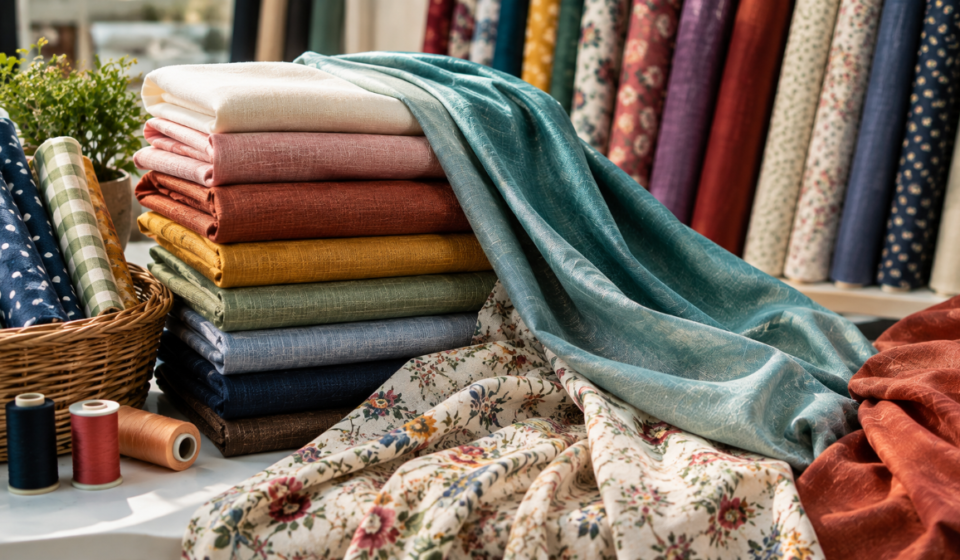

Fabric is a textile material made from fibers, yarns, or bonded fiber webs. Its properties depend on the fiber type, yarn structure, fabric construction, weight, and finishing-not simply on whether it is called cotton, denim, satin, or fleece.
This distinction matters because the same fiber can produce very different materials. Cotton jersey is soft and stretchy because it is knitted, while cotton denim is firm and durable because it is woven in a twill structure. Understanding how these elements work together makes it easier to choose the right material for clothing, sewing, home textiles, crafts, upholstery, and technical uses.
Understanding Fabric Structure
Fabric performance follows a practical sequence:
Fiber → Yarn → Construction → Finish → Performance
- Fiber is the raw textile material, such as cotton, wool, silk, polyester, or nylon.
- Yarn is a continuous strand made by spinning fibers or using filaments. Thickness, twist, and texture influence strength and surface feel.
- Construction is how yarns or fibers are assembled into a textile.
- Finish is a treatment that changes the surface, appearance, hand, or function.
- Performance is the final result: softness, stretch, drape, breathability, durability, opacity, warmth, and care requirements.
Fiber vs. fabric vs. weave
| Term | Meaning | Examples |
| Fiber | The basic textile raw material | Cotton, wool, silk, polyester |
| Yarn | A continuous strand made from fibers or filaments | Cotton yarn, wool yarn, polyester filament yarn |
| Fabric | The finished flexible textile material | Denim, jersey, canvas, chiffon |
| Construction | How yarns or fibers become material | Woven, knitted, nonwoven |
| Weave or stitch | The pattern within a construction | Plain weave, twill, satin weave, rib knit |
| Finish | A treatment that changes appearance or performance | Brushed, softened, water-repellent |
Cotton is a fiber. Denim is a fabric, usually made with cotton yarns. Twill is the diagonal weave structure commonly used to make denim. Satin is also a weave structure, not a fiber, so satin fabric may be made from silk, polyester, nylon, or other materials.
Read More: Reviews of Competitors
Main fabric construction methods
Construction affects stretch, stability, texture, drape, strength, airflow, and edge behavior. The principal methods are weaving, knitting, and nonwoven bonding.nios.ac+1
Woven fabric is made by interlacing lengthwise warp yarns and crosswise weft yarns at right angles. Woves are generally more stable than knits, although certain structures may have mechanical stretch. Elastane-containing yarns and bias cutting can also create stretch.
The three fundamental woven structures are:
- Plain weave: Alternating warp and weft yarns create a balanced, stable surface. Poplin, muslin, voile, and organza commonly use plain-weave variations.
- Twill weave: Diagonal lines appear on the surface. Denim, gabardine, drill, and many trouser fabrics use twill.
- Satin weave: Longer yarn floats create a smooth, often lustrous face. Satin can be made from silk, polyester, nylon, acetate, or blends.
Knitted fabric is made from interlocking loops of yarn. It is usually more flexible and elastic than comparable woven material, making it useful for T-shirts, sweaters, underwear, socks, activewear, and body-skimming garments.
- Weft knits include jersey, rib knit, interlock, and many sweater knits.
- Warp knits include tricot and raschel, which are often used for lingerie, mesh, lace-like textiles, and performance fabrics.
Knit edges vary by stitch structure. Some curl, some remain fairly stable, and some can unravel or fray depending on the yarn, stitch, and finishing.
Nonwoven fabric is made from fiber webs that are mechanically entangled, heat-bonded, chemically bonded, or otherwise fused rather than woven or knitted. Felt, interfacing, filtration media, wipes, insulation, and some upholstery backings are common examples.
Fabric Fibers by Source
Fibers are generally grouped into natural, regenerated cellulosic, and synthetic families. The final material may also contain blends that combine the benefits of different fibers.
Natural fibers
Natural fibers come from plant or animal sources. Their performance changes according to yarn, construction, weight, and finishing.
| Fiber | Source | Typical qualities | Common uses |
| Cotton | Cotton plant | Soft, absorbent, versatile | Shirts, denim, towels, bedding |
| Linen | Flax plant | Crisp, breathable, strong | Summer clothing, curtains, table linen |
| Hemp | Hemp plant | Strong, textured, breathable | Casual apparel, bags, home textiles |
| Jute | Jute plant | Coarse, firm, strong | Rugs, sacks, décor |
| Wool | Sheep and other animals | Insulating, resilient, moisture-absorbing | Knitwear, coats, suiting |
| Silk | Silkworm cocoon | Smooth, lustrous, fine, drapey | Scarves, blouses, dresses |
| Cashmere | Cashmere goat | Soft, warm, lightweight | Premium knitwear, scarves |
| Mohair | Angora goat | Lustrous, resilient, lofty | Knitwear, suiting blends |
Leather is not a textile fiber or a fabric construction. It is animal hide processed through tanning and commonly used with textiles in footwear, bags, upholstery, and garments.
Regenerated cellulosic fibers
Regenerated cellulosic fibers are manufactured from cellulose that is processed and re-formed into textile fibers. They are often chosen for softness, absorbency, and drape.
| Fiber | Typical qualities | Common uses |
| Viscose/rayon | Soft, absorbent, fluid | Dresses, blouses, linings |
| Modal | Smooth, soft, often stable in blends | Underwear, T-shirts, loungewear |
| Lyocell | Smooth, absorbent, strong-feeling | Shirts, dresses, bedding |
| Cupro | Fine, smooth, fluid | Linings, blouses, occasionwear |
Acetate is a cellulose-derived manufactured fiber often used in linings and dress fabrics. It is best considered separately because its composition and care behavior differ from viscose, modal, and lyocell.
Synthetic fibers
Synthetic fibers are manufactured from polymers. They are widely used where stretch, resilience, quick drying, strength, or abrasion resistance is useful.
| Fiber | Typical qualities | Common uses |
| Polyester | Durable, wrinkle-resistant, quick-drying | Activewear, fleece, uniforms, bedding |
| Nylon/polyamide | Strong, lightweight, abrasion-resistant | Swimwear, hosiery, bags |
| Acrylic | Lightweight, warm, wool-like | Sweaters, blankets |
| Elastane/spandex | High stretch and recovery | Leggings, swimwear, fitted clothing |
| Olefin/polypropylene | Lightweight, moisture-resistant | Carpets, outdoor and technical textiles |
Fabric blends
Blends combine two or more fibers to balance comfort, durability, stretch, appearance, and care.
- Cotton-polyester can improve wrinkle resistance and drying time while retaining a cotton-rich feel.
- Cotton-elastane adds stretch and recovery to jeans, trousers, and fitted garments.
- Wool-nylon can improve resilience and abrasion resistance in socks and outerwear.
- Viscose-linen can combine fluid drape with linen texture.
- Polyester-elastane is common in activewear because it supports movement and recovery.
A blend is not automatically superior to a single-fiber material. Its performance depends on the fiber ratio, yarn, construction, weight, and finish.
Fabric Properties and Finishes
Fabric properties determine whether a material is suitable for a specific design or product.
| Property group | What it includes | Why it matters |
| Comfort | Softness, hand, breathability, moisture behavior | Affects how it feels against the body |
| Appearance | Luster, texture, opacity, color depth | Determines visual effect |
| Movement | Drape, stretch, recovery, flexibility | Influences fit and silhouette |
| Durability | Strength, abrasion, tear, seam, pilling resistance | Affects lifespan |
| Stability | Shrinkage, wrinkle resistance, shape retention | Influences fit and care |
| Care | Washing, drying, pressing, heat sensitivity | Determines everyday practicality |
Drape, stretch, and recovery
Drape describes how a material falls and moves. Chiffon, crepe, rayon, lyocell, and silk often drape fluidly. Denim, canvas, and firm poplin hold more shape.
Stretch is the ability to extend. Recovery is the ability to return close to the original dimensions after stretching. Knits often have mechanical stretch because of their loop structure, while elastane can provide additional stretch and recovery.
Strength and durability
Durability includes tensile strength, abrasion resistance, tear resistance, seam strength, snag resistance, and resistance to pilling. It is not determined by fiber alone.
Dense canvas can be highly durable because of its weight and tight plain weave. Denim withstands regular wear because of its twill construction and robust yarns. Fine chiffon can be an excellent choice for an overlay or scarf but is not appropriate for high-abrasion uses such as bags.
Fabric weight: GSM and oz/yd²
Fabric weight is commonly expressed in grams per square metre (GSM) or ounces per square yard (oz/yd²).
- Lightweight fabrics suit blouses, scarves, linings, summer clothing, and overlays.
- Midweight fabrics work well for many shirts, trousers, skirts, dresses, and home-sewing projects.
- Heavyweight fabrics are often used for denim, bags, upholstery, workwear, and outerwear.
Weight does not independently determine quality, warmth, durability, opacity, or drape. Fiber type, yarn density, construction, and finishing must also be considered.
Fabric finishes
Finishing treatments can alter a textile’s appearance, hand, dimensional stability, or function. Two materials with similar fiber content can perform differently because of their finishing.
Common finishes include:
- Brushing or raising for softness and warmth
- Calendaring for smoothness or luster
- Softening for improved hand feel
- Preshrinking to reduce later dimensional change
- Wrinkle-resistant finishing
- Water-repellent finishing
- Coating or laminating for added structure or weather resistance
Finishes can change over time through laundering, heat, abrasion, and wear. Always follow the specific care instructions where available.
Common Fabric Types and Uses
| Fabric type | Typical construction | Key qualities | Common uses |
| Denim | Usually cotton twill | Durable, structured, diagonal texture | Jeans, jackets, bags |
| Chambray | Plain-weave cotton | Lightweight, soft, denim-like appearance | Shirts, dresses |
| Poplin | Fine plain weave | Smooth, crisp, stable | Shirts, uniforms |
| Broadcloth | Dense plain weave | Smooth, tightly woven, durable | Shirts, uniforms, quilting |
| Oxford | Basket-like weave | Textured, durable | Button-down shirts |
| Canvas | Dense plain weave | Firm, abrasion-resistant | Totes, aprons, décor |
| Muslin | Plain-weave cotton | Soft, simple, versatile | Test garments, baby items |
| Voile | Fine plain weave | Airy, lightweight, semi-sheer | Summer clothing, curtains |
| Seersucker | Puckered woven fabric | Lightweight, airy, textured | Summer shirts, dresses |
| Twill | Diagonal woven structure | Durable, stable, often opaque | Trousers, jackets, uniforms |
| Gabardine | Dense twill | Smooth, firm, durable | Trousers, coats |
| Satin | Satin weave | Smooth, lustrous, fluid | Dresses, skirts, linings |
| Crepe | Textured woven surface | Crinkled, fluid or structured | Blouses, dresses |
| Georgette | Lightweight crepe | Sheer, textured, fluid | Dresses, scarves, overlays |
| Chiffon | Lightweight sheer weave | Airy, delicate, flowing | Scarves, eveningwear |
| Organza | Crisp sheer weave | Structured, transparent | Formalwear, décor |
| Batik | Wax-resist dyed fabric, often cotton | Decorative patterned surface | Dresses, skirts, home décor |
| Jersey | Weft knit | Soft, flexible, stretchy | T-shirts, loungewear |
| Rib knit | Knitted vertical ribs | Stretchy, close-fitting | Cuffs, neckbands, fitted tops |
| Interlock | Double-knit structure | Smooth, stable, soft | T-shirts, underwear |
| Fleece | Usually brushed polyester knit | Warm, soft, insulating | Sweatshirts, blankets |
| Flannel | Brushed woven or knit | Soft, warm | Shirts, sleepwear, bedding |
| Velvet | Woven or knitted pile | Plush, rich surface | Occasionwear, upholstery |
| Corduroy | Cut-pile woven material | Textured, durable, warm | Trousers, jackets |
| Terry cloth | Commonly woven loop pile, knitted versions exist | Absorbent, bulky | Towels, robes |
| Lace | Decorative openwork textile | Delicate, ornamental | Lingerie, trims |
| Mesh | Open knit or weave | Breathable, lightweight | Sportswear, linings |
| Tulle | Fine net fabric | Sheer, lightweight, structured | Veils, tutus |
| Brocade | Decorative woven fabric | Patterned, structured | Formalwear, upholstery |
| Jacquard | Woven integrated pattern | Textured, decorative | Dresses, home décor |
How to Choose the Right Fabric
Choose material based on what the finished item needs to do, not simply on how it looks.
| Intended use | Suitable options | Important properties |
| T-shirts and casual tops | Jersey, interlock, cotton-modal knits | Softness, stretch, recovery |
| Jeans and workwear | Denim, twill, canvas, gabardine | Durability, structure, abrasion resistance |
| Flowing dresses | Crepe, rayon, lyocell, silk, chiffon | Drape, comfort, opacity |
| Tailored clothing | Wool suiting, gabardine, twill | Body, drape, seam stability |
| Activewear | Polyester-elastane, nylon-elastane knits | Stretch, recovery, moisture management |
| Warm layers | Wool, fleece, flannel | Insulation, softness, care |
| Towels and robes | Terry cloth, waffle cotton | Absorbency, loop stability |
| Bags and aprons | Canvas, denim, heavy twill | Strength, structure, abrasion resistance |
| Upholstery | Jacquard, velvet, tightly woven blends | Abrasion resistance, stability, care |
| Beginner sewing | Poplin, quilting cotton, stable woven blends | Easy cutting, pressing, seam stability |
How to test fabric before buying
A swatch or in-store sample can prevent expensive mistakes.
- Hold it against light to check opacity.
- Drape it over your hand to assess fluidity and body.
- Stretch it in every direction if fit depends on elasticity.
- Release it after stretching to evaluate recovery.
- Scrunch it to see how readily it creases.
- Rub the surface gently to check for snagging, fuzzing, or pile direction.
- Wash a small sample if shrinkage, dye transfer, or texture change could matter.
Common selection mistakes
- Choosing by fiber name without checking construction, weight, finish, or blend ratio
- Using a woven material for a pattern that requires stretch knit
- Ignoring opacity in white, pale, lightweight, or fitted garments
- Choosing a material that does not match the pattern’s required drape
- Skipping prewashing for items intended to be laundered
- Using delicate textiles for high-abrasion bags, workwear, or upholstery
- Forgetting that linings, interfacing, and seam finishes may be needed
Fabric Care Basics
Follow the care label whenever possible. Fiber content alone does not account for dyes, coatings, pile, surface finishes, construction, or trims.
- Wash new dark or intensely dyed materials separately at first.
- Use lower heat for many synthetics, which can be heat-sensitive.
- Handle silk, lace, chiffon, pile fabrics, and loose weaves gently.
- Reshape suitable knits while damp to support their dimensions.
- Test an inconspicuous area before ironing coated, printed, metallic, or heat-sensitive textiles.
- Store materials and garments clean, dry, and away from prolonged direct sunlight.
Frequently Asked Questions
What is the difference between fabric and textile?
Textile is a broad term for products made from fibers, yarns, or finished cloth. Fabric usually refers to the flexible sheet material used for clothing, furnishings, accessories, and similar products. In everyday language, the words are often used interchangeably. Technically, textile can also include yarn, thread, rope, narrow fabrics, nonwoven materials, and technical fiber products. Cotton and polyester are fibers, denim and jersey are fabrics, a finished shirt is a textile product.
Is cotton a fabric or a fiber?
Cotton is a natural plant-based fiber. Cotton fabric is a finished textile made from cotton fibers, commonly spun into yarn and then woven or knitted. Cotton can become many distinct materials, including denim, canvas, poplin, muslin, flannel, terry cloth, and jersey. These do not perform the same way: denim is usually firm and durable, while jersey is soft and stretchy. Check the construction, weight, finish, and any blended fibers to understand a cotton textile.
Is satin a fiber or a fabric type?
Satin is primarily a weave structure rather than a fiber. It uses longer yarn floats to create a smooth, often lustrous surface. Satin may be made from silk, polyester, nylon, acetate, or blends, so fiber content affects its care, breathability, durability, feel, and cost. Silk satin and polyester satin can look similar but do not behave identically. When choosing satin, check the fiber content, fabric weight, opacity, and whether it is woven or knitted.
Which fabrics are best for hot weather?
Lightweight linen, cotton, voile, poplin, and suitable lyocell or rayon materials are common warm-weather choices. Construction and fit matter as much as fiber: a loose, lightweight textile generally allows more airflow than a dense or coated alternative. Linen is crisp and breathable but wrinkles readily. Cotton is versatile and easy to find. Rayon and lyocell can offer fluid drape for loose garments. Choose breathable construction and a relaxed silhouette rather than relying only on a fiber label.
What is the difference between woven and knitted fabrics?
Woven fabrics are made by interlacing warp and weft yarns, generally producing a stable material with limited stretch. They are common in shirts, trousers, jackets, denim, canvas, and many home textiles. Knitted fabrics are formed from interlocking loops, which usually creates more flexibility and stretch. Jersey, rib knit, interlock, and sweater textiles are knitted. Structured designs often use woven materials, while fitted or movement-focused garments commonly use knits.
How can I tell whether fabric has enough stretch?
Check the pattern’s required stretch percentage and direction of stretch. Measure a section of the material, stretch it in the required direction, and compare its expanded measurement with the pattern guide. Then release it to assess recovery. Material that extends sufficiently but does not recover well can bag at knees, elbows, waistbands, or seat areas. Also check whether it stretches crosswise, lengthwise, or both ways, since stretch direction affects fit and construction.
What does GSM mean in fabric?
GSM means grams per square metre. It measures how much one square metre of textile weighs and helps compare material weight. Lower-GSM fabrics are generally lighter, while higher-GSM fabrics are usually heavier or denser. GSM does not independently determine quality, warmth, opacity, or durability. A lightweight technical nylon can be strong, while a heavier loose knit may be bulky but less resistant to abrasion. Consider GSM alongside fiber content, construction, density, and end use.
Should fabric be prewashed before sewing?
Prewashing is generally useful when the finished item will later be washed. It can reveal shrinkage, dye bleeding, twisting, texture changes, or loss of surface finish before cutting. Wash the material using a method similar to the care routine intended for the completed item. Some dry-clean-only, coated, upholstery, and specialty textiles need different handling. If unsure, wash and assess a small swatch before treating the full length.
Why does fabric pill after washing?
Pilling happens when loose surface fibers work free, tangle into small balls, and remain attached to the textile. Friction from wear, washing, tumble drying, and rubbing against other garments contributes to it. Pilling varies by fiber length, yarn twist, construction, brushed surfaces, and blend composition. To reduce it, wash garments inside out, avoid overloading the washing machine, use an appropriate cycle, and limit repeated high-friction wear. A swatch can provide an early indication of surface behavior.
Are natural fabrics always more sustainable than synthetic fabrics?
No. Sustainability cannot be decided from “natural” or “synthetic” alone. Environmental impact can involve raw-material production, land and water use, chemical processing, dyeing, energy, durability, laundering, transport, and end-of-life options. Product lifespan also matters. A material that is suited to its purpose, cared for properly, and used for a long time can be preferable to a short-lived alternative regardless of fiber category. Consider the specific textile, expected use, care needs, and supplier information.