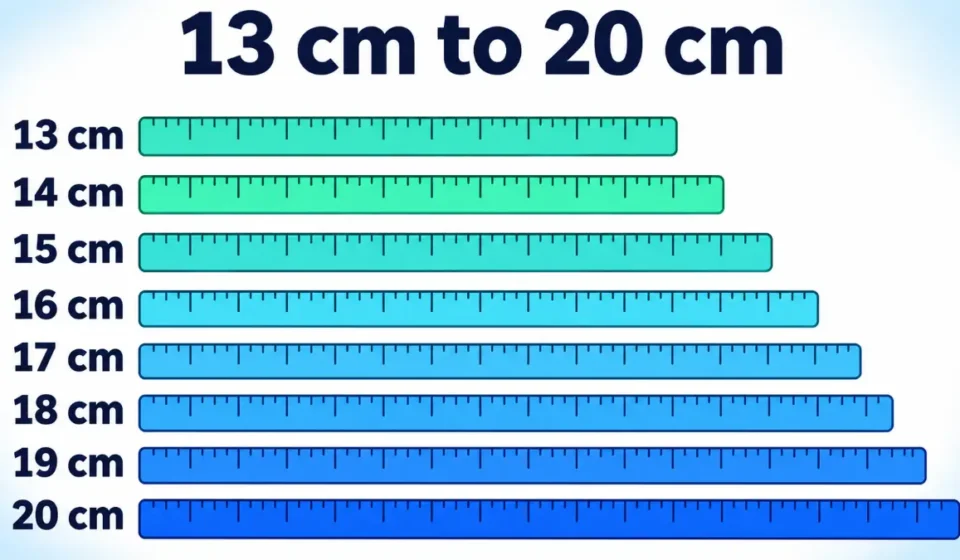

Understanding measurements between 13 cm to 20 cm can help you compare product sizes, measure everyday objects, and convert centimeters into inches accurately. These measurements range from approximately 5.12 inches to 7.87 inches and are commonly encountered in product dimensions, stationery, household accessories, craft materials, and other practical applications.
Whether you are checking the length of an object, purchasing something online, or working on a project, knowing the actual size in both centimeters and inches makes comparisons easier. This guide explains eight individual measurements, their conversions, practical examples, and the correct methods for measuring length.
Understanding Centimeters and Inches
A centimeter is a metric unit used to measure length and distance. It is equal to one-hundredth of a meter, meaning 100 centimeters make one meter. Each centimeter also contains 10 millimeters.
An inch is another unit of length, commonly used in the United States. One inch is exactly equal to 2.54 centimeters.
The basic conversion formula is:
Inches = Centimeters ÷ 2.54
For example, converting 16 centimeters into inches requires dividing 16 by 2.54, which gives approximately 6.30 inches.
The reverse calculation is equally simple:
Centimeters = Inches × 2.54
These formulas help you convert measurements without depending on online calculators.
13 cm to 20 cm: Size in Inches and Practical Measurement Examples
13 cm equals approximately 5.12 inches or exactly 130 millimeters. This measurement is slightly longer than five inches and is useful when checking the dimensions of compact household objects, stationery, small accessories, and product components. To visualize this length,
imagine a five-inch line extended by approximately three millimeters. A standard 3 × 5-inch index card provides a familiar comparison because its longer side measures 12.7 centimeters, just three millimeters shorter than 13 centimeters. When measuring an object of this length, place a ruler on a flat surface,
align the object’s starting point with zero, and check the opposite end. If you are purchasing a container or accessory with a stated dimension of 13 centimeters, check whether that measurement refers to its length, width, or height. This distinction is important because objects with identical lengths can have very different overall dimensions.
14 cm: Conversion, Actual Length, and Everyday Uses
14 cm equals approximately 5.51 inches or exactly 140 millimeters. It is one centimeter longer than the previous measurement and slightly more than five and a half inches. This size can appear in specifications for compact stationery, cosmetic accessories, small tools, decorative items,
and storage organizers. Although one centimeter may not seem significant, it can affect how well an object fits into a drawer, protective case, or narrow compartment. For instance, a rigid item measuring 14 centimeters cannot fit straight into an internal space that provides only 13 centimeters along the same direction. A measuring tape or ruler with millimeter markings can help you determine the size more precisely. When shopping online,
review the manufacturer’s dimensions instead of judging size entirely from product photographs. Camera angles, perspective, and image cropping can make small objects appear larger or smaller than their actual physical measurements.
15 cm: How Big Is It Compared With Six Inches?
15 cm equals approximately 5.91 inches or exactly 150 millimeters. This measurement is especially easy to understand because it is very close to six inches. A standard six-inch ruler measures 15.24 centimeters, making it only 2.4 millimeters longer than a 15-centimeter measurement. This size may be relevant when measuring school supplies,
craft materials, small packaging, or household accessories. It can also help when cutting paper, arranging materials, or checking the dimensions of handmade items. For accurate measurements, avoid beginning at the physical end of a damaged ruler; instead, use the printed zero mark. If the item has a curved surface,
a flexible measuring tape may be more convenient. Keep in mind that the measured length describes only one dimension. An object that is 15 centimeters long could be narrow, wide, flat, or thick depending on its shape and intended function.
16 cm: Inches Conversion and Real-World Applications
16 cm equals approximately 6.30 inches or exactly 160 millimeters. It is a little longer than six inches and can be measured using an ordinary metric ruler. This length may appear in descriptions of handheld accessories, craft tools, kitchen utensils, or smaller electronic products. Understanding this measurement is particularly useful when comparing two products that differ by only a few centimeters. For example,
an item measuring 16 centimeters is approximately 6.7% longer than an otherwise identical item measuring 15 centimeters. However, this length difference alone does not establish anything about their weight, capacity, or performance. When purchasing fitted accessories,
make sure you understand whether the listed dimension represents the external size or the usable internal measurement. A case with an outside length of 16 centimeters may offer less than 16 centimeters of interior space because of its walls, padding, or construction.
17 cm: Actual Size, Inches, and Measurement Tips
17 cm equals approximately 6.69 inches or exactly 170 millimeters. This length falls between six and seven inches and is slightly shorter than 6.75 inches. It can be useful when comparing household products, desk accessories, small equipment components,
and packaging dimensions. A common source of confusion is the order in which manufacturers display product measurements. Some use length × width × height, while others use width × depth × height. As a result, a 17-centimeter measurement could represent different sides of different objects. Always read the product’s dimension labels carefully before comparing sizes. If you are checking whether an item fits inside a storage compartment,
measure the opening as well as the interior. An object may fit within the available internal space but still be too large to pass through a narrower opening. Leaving a small amount of clearance can also make everyday use more convenient.
18 cm: Understanding Its Length in Inches
18 cm equals approximately 7.09 inches or exactly 180 millimeters. This measurement is slightly longer than seven inches and can be compared with objects measured using an inch-based ruler. It is a practical size reference when examining household accessories, craft supplies, stationery,
or small storage products. When measuring something that is 18 centimeters long, position the measuring tool parallel to the length you want to record. Measuring diagonally across a rectangular item will produce a different and usually longer measurement. For objects with irregular shapes,
it may be helpful to record the greatest length, width, and height separately. For example, an object measuring 18 centimeters along its longest side may require a larger storage space if it also has protruding handles or curved edges. Accurate measurements are especially important when selecting boxes, shelves, or protective coverings.
19 cm: Exact Conversion and Important Size Details
19 cm equals approximately 7.48 inches or exactly 190 millimeters. It is very close to seven and a half inches, although 7.5 inches is exactly 19.05 centimeters. This small difference is generally unimportant for casual size comparisons but can matter in work requiring tighter tolerances. A 19-centimeter length may be relevant when measuring home accessories,
organizers, craft components, or other manufactured products. For most everyday purposes, rounding the conversion to 7.48 inches is sufficiently accurate. In manufacturing or precision work, however, the original metric measurement may be preferable because repeated conversions and rounding can introduce errors. When comparing products,
also check whether the manufacturer specifies a measurement tolerance. A nominal dimension may not always be identical to the finished product’s measured dimension. Using the original specification and an appropriately accurate measuring instrument helps reduce mistakes.
20 cm: Inches Conversion, Size, and Everyday Examples
20 cm equals approximately 7.87 inches or exactly 200 millimeters. It is slightly shorter than eight inches because eight inches equals 20.32 centimeters. Twenty centimeters also equals 0.2 meters, or one-fifth of a meter. This measurement can be found in descriptions of kitchen accessories, stationery, decorative products,
storage containers, and other everyday objects. A 20-centimeter ruler can provide a straightforward visual reference for this length. If you need to measure an object longer than your available ruler, carefully mark the ruler’s endpoint and reposition it without leaving gaps or overlapping measurements. For rectangular objects,
remember that length alone does not determine surface area. An item measuring 20 centimeters long and 10 centimeters wide has an area of 200 square centimeters, while another measuring 20 centimeters long and 5 centimeters wide has an area of only 100 square centimeters. This demonstrates why complete dimensions matter.
Read Also: How Big Is 5cm? Simple Comparisons and Ruler Guide
Complete Centimeters to Inches Conversion Char
The following table compares all eight measurements in inches, millimeters, meters, and feet.
| Centimeters | Inches (Approx.) | Millimeters | Meters | Feet (Approx.) |
| 13 cm | 5.12 in | 130 mm | 0.13 m | 0.427 ft |
| 14 cm | 5.51 in | 140 mm | 0.14 m | 0.459 ft |
| 15 cm | 5.91 in | 150 mm | 0.15 m | 0.492 ft |
| 16 cm | 6.30 in | 160 mm | 0.16 m | 0.525 ft |
| 17 cm | 6.69 in | 170 mm | 0.17 m | 0.558 ft |
| 18 cm | 7.09 in | 180 mm | 0.18 m | 0.591 ft |
| 19 cm | 7.48 in | 190 mm | 0.19 m | 0.623 ft |
| 20 cm | 7.87 in | 200 mm | 0.20 m | 0.656 ft |
The difference between consecutive rows is exactly one centimeter, equivalent to approximately 0.394 inches.
The total difference between the smallest and largest measurements is seven centimeters, or approximately 2.76 inches.
How to Measure Centimeters Correctly
Measuring length is straightforward, but small mistakes can affect accuracy. Following a consistent method produces more reliable results.
- Select an appropriate measuring tool. A ruler works well for short, straight objects, while flexible measuring tapes are better for curved surfaces.
- Identify the zero marking. Begin measuring from the printed zero line, which may be slightly separated from the ruler’s physical edge.
- Align the tool properly. Keep the ruler straight and parallel to the dimension you want to measure.
- Read the measurement carefully. Look directly above the marking to avoid errors caused by viewing it at an angle.
- Record the correct unit. Clearly identify whether the measurement is in centimeters, millimeters, or inches.
If an object falls between two centimeter markings, use the smaller millimeter divisions to record its length more precisely.
Common Mistakes When Converting Measurements
One common mistake is treating one centimeter as half an inch. In reality, one centimeter equals approximately 0.394 inches, so this shortcut can produce noticeable errors.
Another mistake involves rounding too early. For instance, repeatedly converting and rounding numbers can result in slightly different measurements.
People also sometimes confuse centimeters with millimeters. A measurement of 150 millimeters equals 15 centimeters, not 150 centimeters.
Finally, remember that measurements describe specific physical dimensions. A product’s length should not be mistaken for its width, diameter, circumference, or available internal space.
Where These Measurements Are Most Useful
Measurements between 13 and 20 centimeters appear in many everyday situations.
Online shopping: Product listings often provide dimensions in centimeters, particularly when items are sold internationally. Converting these values makes comparison easier.
School and education: Students regularly use metric rulers in geometry, drawing, scientific activities, and classroom projects.
Home organization: Accurate measurements help when selecting drawer organizers, storage containers, shelves, and accessories.
Crafts and DIY projects: Cutting, arranging, and assembling materials often requires reliable measurements in centimeters or millimeters.
Product compatibility: Knowing complete dimensions helps determine whether objects will fit inside cases, holders, storage spaces, or other accessories.
For specialized uses such as clothing, footwear, or medical equipment, measurements should be interpreted according to the relevant product’s sizing instructions rather than relying on length alone.
Frequently Asked Questions
1. How many inches are 13 cm and 20 cm?
Thirteen centimeters equals approximately 5.12 inches, while twenty centimeters equals approximately 7.87 inches. The difference between them is seven centimeters, equivalent to approximately 2.76 inches.
2. Is 15 cm the same as 6 inches?
No. Fifteen centimeters equals approximately 5.91 inches, while six inches equals exactly 15.24 centimeters. The difference is only 0.24 centimeters, or 2.4 millimeters, making the measurements very close but not identical.
3. How can I convert 16 cm, 17 cm, and 18 cm into inches?
Divide each centimeter measurement by 2.54. Sixteen centimeters is approximately 6.30 inches, seventeen centimeters is 6.69 inches, and eighteen centimeters is 7.09 inches.
4. Can I measure centimeters using an inch ruler?
Yes. You can convert the required centimeter value into inches and use the corresponding inch markings. However, a metric ruler with millimeter divisions is generally more convenient when the original measurement is expressed in centimeters.
5. What is the easiest way to convert centimeters into millimeters?
Multiply the centimeter measurement by 10. For example, 14 centimeters equals 140 millimeters, 19 centimeters equals 190 millimeters, and 20 centimeters equals 200 millimeters. This conversion is exact because the metric system uses decimal relationships.
Conclusion
Measurements between 13 and 20 centimeters cover lengths of approximately 5.12 to 7.87 inches. Understanding these values helps with product comparisons, school projects, household measurements, and everyday purchases.