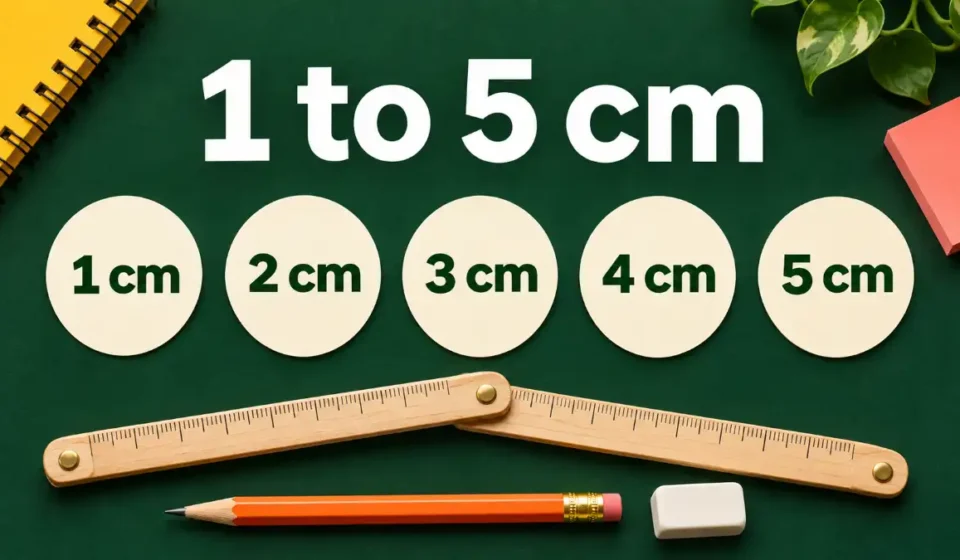

1 cm to 5 cm can help you measure everyday objects, understand product dimensions, complete school assignments, and convert metric measurements into inches. These five lengths range from 10 to 50 millimeters, making them ideal for measuring small items accurately.
But what does one centimeter actually look like? Is five centimeters the same as two inches? How can you estimate these lengths when you do not have a ruler nearby?
This guide answers these questions with real-world comparisons, conversion tables, measurement techniques, and practical examples that make centimeters easier to understand.
Understanding Centimeters and Their Actual Size
A centimeter is a standard unit of length in the metric system. It is abbreviated as cm and represents one-hundredth of a meter. Centimeters are commonly used to measure height, width, length, thickness, and the distance between two points.
The metric system makes calculations simple because its units follow a base-ten structure. Each centimeter contains exactly ten millimeters, and one hundred centimeters make one meter.
Here are the fundamental measurements:
- 1 centimeter = 10 millimeters
- 1 centimeter = 0.01 meters
- 1 centimeter ≈ 0.3937 inches
- 1 inch = 2.54 centimeters
- 100 centimeters = 1 meter
Unlike inches, which are often divided into fractions, metric measurements use decimal values. For example, 2.5 centimeters equals 25 millimeters, making calculations and comparisons relatively straightforward.
1 cm to 5 cm Size Comparison Chart
Use this quick reference table to compare the actual lengths and their equivalent measurements.
| Length in CM | Millimeters | inches | Meters | Approximate Real-Life Comparison |
| 1 cm | 10 mm | 0.3937 | 0.01 m | Small craft bead |
| 2 cm | 20 mm | 0.7874 | 0.02 m | Diameter of a small coin |
| 3 cm | 30 mm | 1.1811 | 0.03 m | Width of a small paper clip |
| 4 cm | 40 mm | 1.5748 | 0.04 m | Diameter of a table tennis ball |
| 5 cm | 50 mm | 1.9685 | 0.05 m | Length of a large paper clip |
Note: Everyday objects vary in size. These comparisons provide a visual estimate rather than an exact measurement, except where a standardized dimension applies.
1cm: How Small Is One Centimeter?
1cm is equal to 10 millimeters, approximately 0.39 inches, or 0.01 meters. It is the smallest whole-centimeter measurement on a standard metric ruler and is useful for measuring tiny objects and narrow distances.
Imagine a small decorative bead or the width of a person’s fingernail. Some may measure close to one centimeter, although their dimensions vary. This makes one centimeter a convenient reference when estimating the size of small items.
On a ruler, the distance between the zero mark and the number one represents this length. The ten smaller intervals between them allow you to measure in millimeters.
One centimeter is frequently used in science experiments, jewelry making, small-scale models, paper crafts, and educational activities. For example, a student might draw a one-centimeter grid to practice counting squares or understanding area.
If you need to measure something smaller than one centimeter, you can express the measurement as a decimal. A length of 0.7 centimeters, for instance, equals seven millimeters.
This relationship makes centimeter measurements flexible enough for both everyday tasks and basic technical work.
2cm: How Long Is Two Centimeters?
2cm represents a distance of 20 millimeters, 0.02 meters, or approximately 0.79 inches. It is exactly twice the length of one centimeter and about 79% of an inch.
A United States penny provides a helpful visual comparison. Its official diameter is 19.05 millimeters, making it slightly smaller than two centimeters. A U.S. nickel measures 21.21 millimeters in diameter, making it slightly larger.
These familiar objects can help you visualize a two-centimeter length without immediately reaching for a ruler.
Two centimeters is commonly used to describe button diameters, small decorative pieces, ribbon widths, and short distances in printed diagrams. In sewing, it might represent a fabric width or seam allowance, depending on the pattern.
When measuring an object on a ruler, align its first edge with zero and check whether its opposite edge reaches the second numbered centimeter mark.
A two-centimeter measurement is also useful when working with scale models. For instance, a model built at a 1:10 scale would represent a real-world length of 20 centimeters with a two-centimeter model component.
This demonstrates how small metric measurements can represent much larger dimensions.
3 cm: What Does Three Centimeters Look Like?
3 cm equals 30 millimeters, 0.03 meters, or approximately 1.18 inches. It is noticeably longer than one inch but still small enough to measure conveniently with a pocket ruler.
Three centimeters is close to the length of some small paper clips, depending on their design. A square drawn with three-centimeter sides also provides a simple visual reference for this measurement.
This length is useful for measuring craft pieces, spacing between objects, small product dimensions, and lines in technical drawings.
For example, when creating a handmade greeting card, you might cut decorative paper into strips measuring three centimeters wide. In mathematics, students can use this measurement to draw triangles, squares, and rectangles.
Three centimeters also provides a helpful introduction to the difference between length and area. A square with three-centimeter sides has an area of nine square centimeters, while its perimeter measures twelve centimeters.
Although both calculations use the same side length, they describe different properties of the shape.
To convert three centimeters into inches, divide 3 by 2.54. The result is approximately 1.1811 inches. This conversion becomes useful when comparing metric measurements with American product specifications.
4cm: Real-Life Size and Measurement Examples
4cm is equal to 40 millimeters, 0.04 meters, or approximately 1.57 inches. A standard table tennis ball offers an excellent visual reference because its official diameter is 40 millimeters.
This comparison makes four centimeters particularly easy to understand. Measuring straight across the center of a standard table tennis ball gives a diameter of four centimeters.
In everyday life, this length can be used to describe small round containers, decorative labels, fabric strips, and accessories. Four centimeters may also represent the width of a small rectangular object or the height of a miniature model.
The measurement is convenient for dividing into equal sections. For example, dividing four centimeters into two equal parts produces two-centimeter lengths. Dividing it into four equal parts produces one-centimeter lengths.
When comparing four centimeters with inches, it falls between one and two inches and is slightly longer than one and a half inches.
To measure the diameter of a round object accurately, position the ruler across its widest point. Measuring off-center will give a shorter reading than the actual diameter.
This technique is particularly useful when checking the dimensions of circular craft materials or small containers.
5 cm: Is Five Centimeters the Same as Two Inches?
5 cm equals 50 millimeters, 0.05 meters, or approximately 1.97 inches. It is almost two inches long, but the measurements are not exactly the same.
Two inches equals 5.08 centimeters. Therefore, five centimeters is 0.8 millimeters shorter than two inches. This difference is small enough for rough estimates but can matter in precision measurement.
A large paper clip measuring around 50 millimeters can provide a practical visual comparison. Another useful reference is the short distance between two marks spaced five centimeters apart on a ruler.
Five centimeters is often used in classroom activities, sewing instructions, craft projects, and small household measurements.
For example, a paper strip measuring five centimeters wide can be divided into five equal one-centimeter sections. A ruler measuring ten centimeters can also be divided into two equal five-centimeter lengths.
In geometry, a square with five-centimeter sides has an area of 25 square centimeters and a perimeter of 20 centimeters.
Five centimeters is also equivalent to half a decimeter. This makes it useful for understanding how centimeters fit into the larger metric system.
Read Also: 13 cm to 20 cm: Complete Size Guide, Inches Conversion, and Measurement Examples
Visual Comparison of Centimeter Lengths
The illustration below shows how the five measurements increase in size.
Compare 1 cm, 2 cm, 3 cm, 4 cm and 5 cm
Proportional illustration only. On-screen dimensions depend on your device and are not guaranteed to represent actual physical size.
Each bar is one centimeter longer than the previous bar. The five-centimeter bar is five times the length of the first bar, demonstrating how metric measurements increase consistently.
How to Convert Centimeters Into Inches
Converting centimeters to inches is helpful when shopping online, reading international size charts, or working with instructions from the United States.
The conversion formula is:
Inches = Centimeters ÷ 2.54
For example, suppose you want to convert four centimeters into inches:
4 ÷ 2.54 = 1.5748 inches
For most everyday purposes, rounding the result to two decimal places gives a useful estimate of 1.57 inches.
The reverse conversion is equally simple:
Centimeters = Inches × 2.54
According to the National Institute of Standards and Technology (NIST), the international inch is defined as exactly 2.54 centimeters.
How to Measure Small Objects Accurately
A physical ruler remains one of the simplest tools for measuring small objects. Most standard metric rulers display centimeters and millimeters.
Follow this method:
- Place the object on a flat surface.
- Locate the zero mark on your ruler.
- Align the starting edge of the object with zero.
- Keep the ruler parallel to the object.
- Read the mark corresponding to the object’s opposite edge.
If the object ends four millimeters beyond the three-centimeter mark, its total length is 3.4 centimeters.
For objects with curved surfaces, determine whether you need the straight-line distance or the length along the curve. A flexible measuring tape may be more suitable for curved measurements.
For precise thickness or diameter measurements, a caliper can provide finer readings than a conventional ruler.
Measuring Centimeters Without a Ruler
You can estimate small lengths using objects with known dimensions. Coins, standard-size sports equipment, and premeasured paper strips may serve as convenient references.
| Reference Object | Known Dimension |
| U.S. penny | 1.905 cm diameter |
| U.S. nickel | 2.121 cm diameter |
| U.S. quarter | 2.426 cm diameter |
| Standard table tennis ball | 4 cm diameter |
| Two-inch reference mark | 5.08 cm length |
The United States Mint coin specifications provide official dimensions for American coins.
Remember that these objects are best suited for approximate comparisons. If your project requires accurate measurements, use a ruler, measuring tape, or another calibrated tool.
Common Centimeter Measurement Mistakes
Small measurement errors can affect school projects, sewing patterns, product designs, and craft activities.
Avoid these common mistakes:
- Confusing centimeters and millimeters: Five millimeters is only 0.5 centimeters.
- Starting at the wrong mark: Always locate the ruler’s zero mark instead of assuming its physical edge represents zero.
- Rounding too early: Keep additional decimal places during calculations when precision matters.
- Measuring from an angle: Read the ruler from directly above.
- Assuming approximate sizes are exact: Everyday objects may differ in dimensions even when they appear similar.
You should also include the correct unit when recording measurements. Writing only the number five without specifying centimeters or inches can create confusion.
Frequently Asked Questions
1. How big is 1 cm compared to 5 cm?x
One centimeter equals 10 millimeters, while five centimeters equals 50 millimeters. Five centimeters is exactly five times longer than one centimeter, with a difference of four centimeters.
2. How many inches are in 1 cm to 5 cm?
One centimeter equals approximately 0.39 inches, two centimeters equals 0.79 inches, three centimeters equals 1.18 inches, four centimeters equals 1.57 inches, and five centimeters equals 1.97 inches.
3. What everyday object is exactly 4 cm?
A standard table tennis ball has an official diameter of 40 millimeters, which equals four centimeters. It provides a useful physical reference for understanding this measurement.
4. Can I use my phone screen to measure five centimeters?
A smartphone measuring app or calibrated on-screen ruler may help estimate five centimeters. However, screen size, resolution, calibration, and device settings affect accuracy. A physical ruler is preferable for reliable measurements.
5. Is 2 cm closer to one inch or half an inch?
Two centimeters is closer to one inch. It equals approximately 0.79 inches, while half an inch equals 1.27 centimeters. One inch equals exactly 2.54 centimeters.
Conclusion
Understanding measurements from one to five centimeters makes it easier to visualize small objects, read rulers, convert units, and complete practical tasks. Each centimeter equals ten millimeters, while 2.54 centimeters equal one inch.
With familiar reference objects, accurate conversion formulas, and proper measuring techniques, you can confidently compare lengths and avoid common measurement errors in everyday life.