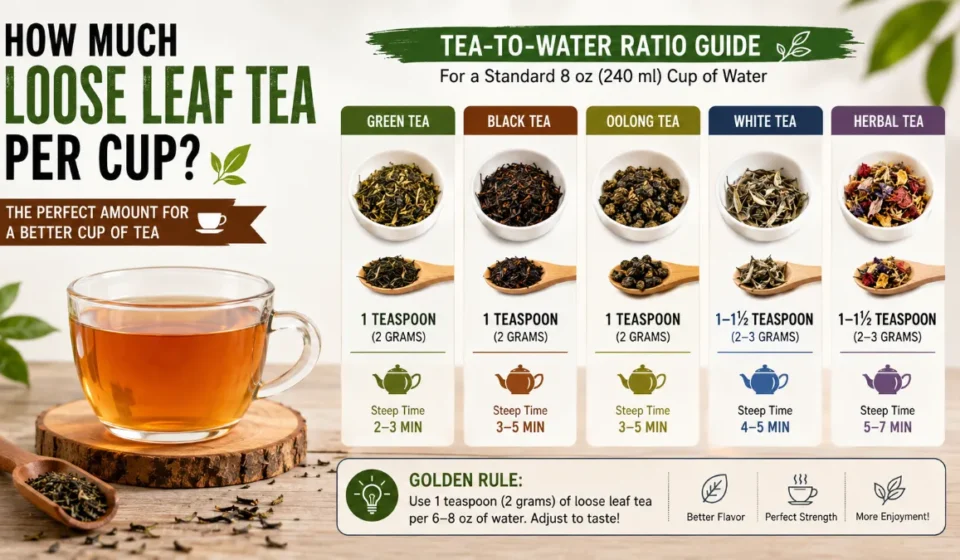

how much loose leaf tea per cup The easiest answer is: use about 2 grams of loose leaf tea for each 8 oz (240 ml) of water, then adjust slightly for the leaf style and the strength you enjoy. For many compact teas, that is close to one level teaspoon; for large, light, or fluffy leaves, you may need considerably more volume in the spoon.
Loose leaf tea is best approached as a small recipe rather than a universal measurement. The water amount, leaf style, brewing method, steep time, and temperature work together. Once you understand which variable to change, you can make a satisfying cup without memorising a separate rule for every tea.
Begin with a “test cup”
Instead of trying to find one permanent answer for every tea, brew a test cup. Use the producer’s instructions if available; otherwise, begin with 2 g per 8 oz of water. Taste before adding milk, sugar, lemon, or other additions so you can assess the tea itself.
A dependable first test looks like this:
| Brewing variable | Starting point |
| Water | 8 oz / 240 ml |
| Loose leaf tea | About 2 g |
| Teaspoon estimate | 1 level teaspoon for dense leaves |
| Brewing vessel | Mug with a roomy basket infuser |
| Next adjustment | Change one variable only |
This starting point aligns with guidance from tea sellers and tea organisations, although the exact spoon volume can vary significantly with leaf density.
If the cup is pleasant but lighter than you want, use a little more tea next time. If it is bitter or drying, do not automatically remove tea first: examine the temperature and steep time as well.
Why one teaspoon is not a universal answer
A teaspoon holds a fixed volume, but different teas occupy that volume differently. This is why two recipes that both say “one teaspoon per cup” can give very different results.
Think of the difference between rice and popcorn. A spoonful of rice packs closely together, while a spoonful of popcorn contains much more air. Tea behaves similarly:
- Broken black tea and small leaf particles tend to pack densely.
- Rolled oolong may be compact before steeping, then expand dramatically.
- Large white tea leaves may take up substantial space but weigh very little.
- Chamomile, mint, and fruit blends can be especially bulky.
For the most predictable brew, use a kitchen scale. If you prefer measuring spoons, learn the right spoonful for each tea you buy rather than assuming the same teaspoon will work across your whole collection.
Choose your measurement route
You can measure loose leaf tea in three practical ways. Each has a different use case.
| Method | Best for | Limitation |
| Digital scale | Repeatable everyday brewing and tea-specific recipes | Requires a scale |
| Teaspoon | Quick single cups and travel brewing | Leaf density changes the result |
| Tea scoop | Convenient routine with one familiar tea | Scoop capacity varies by product |
A digital scale does not need to be complicated. Weigh the tea once, note the amount that produced the cup you liked, and reuse that number. If you prefer a teaspoon, weigh your usual spoonful once to discover how many grams it actually contains for that tea.
How Much Loose Leaf Tea Per Cup quantity to your vessel
how much loose leaf tea per cupThe water in your cup determines how much tea you need. “One cup” is not always a useful measurement because teacups, mugs, tumblers, and teapots hold different amounts.
Use this practical starting guide for Western-style brewing:
| Vessel or water amount | Suggested loose leaf tea |
| Small teacup: 6 oz / 180 ml | About 1.5 g |
| Standard cup: 8 oz / 240 ml | About 2 g |
| Large mug: 12 oz / 355 ml | About 3 g |
| Travel mug: 16 oz / 475 ml | About 4 g |
| Small pot: 24 oz / 710 ml | About 6 g |
| Large pot: 32 oz / 950 ml | About 8 g |
This chart is deliberately simple: it uses a 2 g per 8 oz baseline. Start there, then add a little more leaf if the tea is too light for your taste. Some guides recommend one teaspoon per 6 oz cup, while others use one level teaspoon or 2 g per 8 oz, which is one reason water volume and tea type matter more than a single spoon rule.
Measure by leaf shape, not only tea category
Tea labels such as black, green, white, or oolong tell you something useful, but the physical leaf is often more helpful when choosing a spoon measurement.
Small or broken leaves
Fine-cut black tea, small green tea leaves, and compact blends tend to be dense. Start close to the 2 g baseline for an 8 oz cup. A level teaspoon may be enough.
These teas can be extracted quickly. If they taste harsh, reduce the steep time or use slightly cooler water where appropriate before making large changes to the amount of leaf.
Large, open, or fluffy leaves
White tea, large-leaf green tea, open-leaf oolong, chamomile, mint, and many herbal blends can look excessive in a spoon while still weighing relatively little.
For these teas, use the same approximate weight target first, but expect the spoon measurement to be larger. A heaped teaspoon—or even more volume—may be appropriate depending on the blend.
Tightly rolled leaves
Rolled oolongs and some other compact teas are deceptive: they may look like a small amount at first but unfold in the water. Measure moderately, leave plenty of room in the infuser, and avoid packing the leaves into a small tea ball.
Blended teas
A blend may contain tea leaves alongside flower petals, dried fruit, spices, or herbs. The mix may settle in storage, so gently turn or shake the container before measuring if the product directions permit it. This helps keep successive cups more consistent.
Use an infuser that lets the leaves move
The right tea infuser does not determine the gram weight, but it does affect how efficiently the leaves brew. Leaves need water contact and enough open space to unfurl.
A basket infuser is usually the most versatile option because it can hold fine leaves while also allowing larger leaves and herbal ingredients to expand. Harney & Sons similarly recommends a roomy infuser so full tea leaves have space to “swim.”
A small tea ball can be adequate for compact leaves, but it may crowd open-leaf oolong, white tea, whole-leaf black tea, or bulky herbal blends. If the tea tastes thin despite a reasonable dose, lack of space may be part of the problem.
Keep leaf amount separate from other brewing choices
A weak or unpleasant cup does not always mean you used the wrong amount of tea. Diagnose the result before changing the recipe.
| What you notice | Likely variable to review first | Practical next step |
| Thin flavour and little aroma | Tea quantity or water volume | Add a small amount of leaf or check mug capacity |
| Bitter green tea | Water temperature or steep time | Use cooler water or steep for less time |
| Dry, puckering black tea | Steep time | Shorten the infusion |
| Flat tea with muted aroma | Tea freshness or water quality | Try fresher tea or fresh-drawn water |
| Uneven strength between cups | Measurement or blend separation | Weigh the tea or mix the blend gently |
| Weak large-leaf tea | Spoon volume or infuser space | Use more leaf volume or a larger basket |
For a stronger cup, begin by adding a modest amount of tea while staying within the recommended temperature and time range. Then make separate changes to steep time if you need to alter extraction and balance. This approach avoids using a very long steep as the default solution for weak tea.
Read More: Long John Silver’s
Where brewing style changes the ratio
The per-cup measurement above is meant for a typical Western-style infusion: a relatively large amount of water and one moderate-length steep.
Gongfu brewing works differently. It uses a small pot or gaiwan, a higher proportion of leaf, and several short infusions. Because the water amount and steep time are so different, a gongfu leaf dose should not be copied into a standard mug.
| Style | Typical vessel | Leaf-to-water approach | Infusion pattern |
| Western-style | Mug, teapot, or basket infuser | Lower leaf concentration | One or a few longer steeps |
| Gongfu style | Gaiwan or small teapot | Higher leaf concentration | Multiple short steeps |
If your main goal is a quick morning cup, Western-style brewing is generally the simpler place to begin. If you want to explore how a high-quality oolong or pu-erh changes across repeated infusions, gongfu brewing offers a different experience rather than merely “stronger” tea.
A practical brew routine for beginners
Use this method to make your first dependable loose leaf cup:
- Fill your mug with water, then measure that water once to learn the mug’s capacity.
- Add approximately 2 g of tea per 8 oz of water.
- Put the leaves in a basket infuser or another brewing vessel with room to expand.
- Heat fresh water to the temperature recommended for the tea.
- Pour water over the leaves and steep for the suggested time.
- Remove the leaves or strain the tea when the steep is complete.
- Taste the tea plain.
- Write down one adjustment for the next cup, if needed.
For black tea, a common traditional guideline is one teaspoon per 6 oz cup; Harney & Sons also advises one teaspoon per cup in its black tea method. This does not conflict with a weight-first approach—it shows why the exact leaf and cup size must be considered before treating a teaspoon as a universal conversion.
Common situations and sensible adjustments
“My tea is weak, but I already used one teaspoon”
First, check the capacity of your cup. A large mug may contain twice the water of a traditional small teacup. Next, consider leaf density: one teaspoon of white tea, chamomile, or a bulky herbal blend may contain much less tea by weight than a teaspoon of fine black tea.
Increase the leaf amount slightly for the next cup. If the tea is green, white, or oolong, also make sure the leaves have sufficient space and that the water temperature is suitable.
“My tea is too strong but not bitter”
The tea dose is probably higher than you prefer. Reduce the leaf amount slightly while keeping the same water temperature and steep time. This preserves the tea’s balance more effectively than making a drastic change.
“My tea is strong and unpleasantly bitter”
Review steep time and water temperature before blaming the tea quantity. Green tea often becomes bitter when brewed too hot or too long; black tea can become drying when over-steeped. Use the tea maker’s recommended conditions as your reset point.
“I am making tea for several people”
Measure the actual water going into the teapot, then scale the tea weight. For example, a 32 oz pot begins at about 8 g using the simple 2 g-per-8 oz starting point. Avoid relying on “one spoon for each person” because serving cups may not all be the same size.
“I do not own a scale”
Use a teaspoon, but keep a simple note for each tea: level teaspoon, rounded teaspoon, or heaped teaspoon per mug. Over time, this creates a personal brewing guide that is more useful than a generic conversion chart.
When to depart from the baseline
The baseline is a tool, not a rule. Consider moving away from about 2 g per 8 oz when:
- The producer recommends another dose for that tea.
- You are making a concentrated base for iced tea.
- You are cold-brewing tea, which follows a separate time-and-ratio approach.
- You are brewing gongfu style.
- You have a highly compressed, rolled, or unusually bulky tea.
- You want to make a recipe such as milk tea, where a stronger initial brew may be appropriate.
For iced tea, recipes often brew a concentrate before adding cold water or ice. Harney & Sons, for example, suggests using the normal single-glass leaf amount with half the water when preparing a concentrate, then adding cold water and ice.
The simplest way to remember it
Start with 2 g of loose leaf tea for every 8 oz of water, use a teaspoon only as an approximate shortcut, and make your next adjustment based on what you taste.
That method avoids two common problems: under-measuring for an oversized mug and over-steeping to compensate. With a scale, a roomy infuser, suitable water temperature, and a few notes on your favourite teas, you can turn a general ratio into a reliable personal recipe.
Frequently Asked Questions
Is one teaspoon of loose leaf tea the same as one tea bag?
Not necessarily. A teaspoon measures volume, while tea bags and loose tea are portioned by weight. The amount in a teaspoon changes with leaf size and density, and tea bags also vary by brand and product. If you are replacing a tea bag with loose leaves, begin with roughly 2 g for an 8 oz cup, then adjust after tasting. For compact tea, that may be near one teaspoon; for a fluffy blend, it may take more volume.
Do I need a scale to brew loose leaf tea?
No. A teaspoon and a little trial and error are enough to make good tea. A scale simply makes how much loose leaf tea per cup your results more repeatable, especially if you brew several tea styles or want to follow a tea producer’s recipe. A useful compromise is to weigh your favourite spoonful once. You can then use the same spoon measurement in daily brewing while knowing the approximate amount of tea it contains.
Why does one tea need a heaped teaspoon while another needs a level teaspoon?
The difference comes from density. Fine-cut leaves, broken tea, and tightly rolled tea pack into less space. Whole leaves, white tea, mint, chamomile, and fruit pieces take up more space while often weighing less. A heaped spoonful of a fluffy tea may therefore contain a similar weight to a level spoonful of a compact tea. Weight removes this variation, which is why grams are the more consistent measurement.
Can I make loose leaf tea directly in a mug without an infuser?
Yes. Place the leaves in the mug, add water, steep, then pour through a fine strainer into a second cup or use a strainer while drinking carefully. This method gives leaves ample room to expand. It is less convenient than an infuser because you need to separate the leaves at the right time, but it can work well when you do not have specialised equipment.
Does hard water affect how much tea I should use?
Hard water can change how tea tastes and may make flavours seem muted or different, but it does not automatically mean you should use more tea. Start with the normal amount and compare the result using freshly drawn filtered water if possible. If the flavour improves, water quality-not the leaf quantity-was likely the main issue. Adjusting several variables at once can make troubleshooting difficult.
Should I fill a tea infuser completely?
No. Fill it loosely enough that the leaves can expand and circulate in water. This matters most for whole-leaf tea, oolong, white tea, and bulky herbal blends. A crowded infuser can restrict extraction and lead to an uneven or weak cup. Choose a larger basket-style infuser when you regularly brew leaves that open significantly during steeping.
How do I measure tea for a teapot without guessing?
how much loose leaf tea per cupMeasure the water capacity of the pot, then apply your starting ratio to the actual volume. At about 2 g per 8 oz, a 24 oz pot begins with around 6 g of tea and a 32 oz pot with around 8 g. If you do not have a scale, use the spoon measurement you have already learned for that specific tea and multiply it by the number of 8 oz servings.
Does adding milk change how much loose tea I need?
It can. Milk dilutes the brewed tea and changes how strongly flavours come through, so a slightly stronger initial infusion may suit your preference. Start by increasing the tea quantity modestly rather than steeping black tea excessively long. The best amount depends on the tea, how much milk you add, and whether you sweeten it.
Why should I remove the leaves after steeping?
Leaving tea leaves in hot water continues extraction. Depending on the tea and the temperature, this can make the cup overly strong, bitter, or astringent. Removing the infuser at the suggested time makes the result easier to control and gives you a better chance of reproducing a cup you enjoyed. Some teas can be re-steeped after removal.
Can I use the same ratio for cold-brew loose leaf tea?
Not exactly. Cold brewing uses cool water and a much longer infusion, so its recipe should be treated separately from hot tea. Start with a cold-brew recipe from the tea producer when one is available, then adjust for your preferred strength. Do not assume that a hot-brew steep time or ratio will translate directly because extraction occurs differently in cold water.