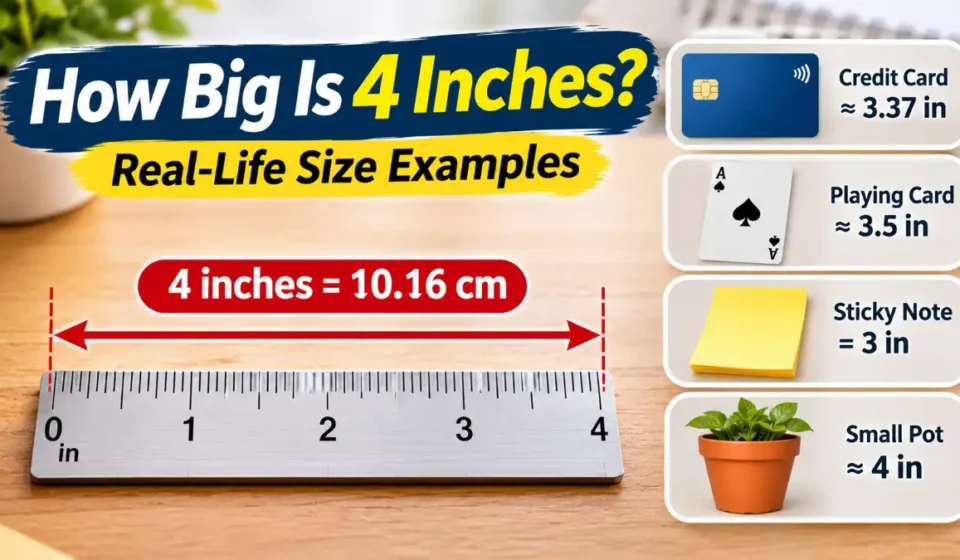

How big is 4 inches? Four inches equals exactly 10.16 centimeters, 101.6 millimeters, or one-third of a foot. It’s approximately the length of a standard playing card plus half an inch, or slightly longer than the width of a typical adult palm. The easiest way to visualize 4 inches is to imagine a 10-centimeter ruler with an additional 1.6 millimeters.
Understanding inches is useful when shopping online, measuring household objects, completing DIY projects, or converting measurements between the US customary and metric systems.
Although 4 inches may seem like a small distance, it appears frequently in everyday measurements. From stationery and kitchen tools to electronics and home accessories, many objects have dimensions close to this length.
How Big Is 4 Inches in Centimeters, Feet, and Millimeters?
An inch is a unit of length commonly used in the United States. The international inch is defined as exactly 2.54 centimeters.
To convert inches into centimeters, multiply the measurement by 2.54.
42.54=10.16cm
The following table shows the equivalent measurements.
| Measurement unit | Equivalent of 4 inches |
| Centimeters | 10.16 cm |
| Millimeters | 101.6 mm |
| Feet | 0.333 ft |
| Meters | 0.1016 m |
| Yards | 0.111 yd |
| Micrometers | 101,600 µm |
Four inches is exactly one-third of a foot because one foot contains 12 inches.
These conversions are particularly useful when comparing US product measurements with metric specifications.
7 Everyday Objects That Help You Visualize 4 Inches
When you don’t have a measuring tape, familiar objects can provide useful size references.
1. A Standard Playing Card
A typical poker-sized playing card measures approximately 3.5 inches long and 2.5 inches wide.
Four inches is half an inch longer than its longest side.
This makes a playing card a convenient reference when estimating small measurements.
2. A Standard Credit Card
Most standard credit cards measure approximately 3.37 inches long.
A 4-inch distance extends about 0.63 inches beyond the card’s longest edge.
Because credit cards follow standardized dimensions, they provide a reasonably consistent comparison.
3. A Square Sticky Note
A common square sticky note measures 3 × 3 inches.
Four inches is exactly one inch longer than one side of this note.
You can place two additional half-inch sections beside the sticky note to visualize the complete distance.
4. A Smartphone’s Width
Many smartphones are approximately 2.7–3.2 inches wide, although dimensions vary by model.
Four inches is noticeably wider than most standard smartphones.
This comparison is helpful when estimating the width of small accessories or electronic devices.
5. A Small Plant Pot
Some compact plant pots have a diameter of approximately 4 inches.
A pot of this size is commonly used for small houseplants, seedlings, or herbs.
Remember that the advertised dimension may describe the opening’s diameter rather than the pot’s height.
6. A Four-Inch Tile
Some decorative and backsplash tiles measure 4 inches along each side.
A square tile of this size provides an accurate representation of a 4-inch length when measured along one edge.
However, a 4-by-4-inch tile covers an area of 16 square inches, not 4 square inches.
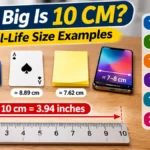
7. A 10-Centimeter Ruler
Ten centimeters equals approximately 3.94 inches.
Therefore, a 10-centimeter ruler is only 1.6 millimeters shorter than 4 inches.
This is one of the simplest and most accurate ways to imagine the measurement.
Read Also: How Long Is 9 Inches? Everyday Comparisons and Measuring Tips
How Big Is 4 Inches Compared to Your Hand?
A person’s hand can provide a rough measurement reference, but hand dimensions vary considerably.
For some adults, 4 inches is close to the width of the palm when measured across its widest area. For others, the palm may be smaller or larger.
Hand size depends on factors such as age, body proportions, and individual anatomy.
You can measure your own palm once and use it as a personal reference when estimating similar distances.
However, hand-based estimates should not replace a ruler when accurate dimensions are required.
How Big Is 8 Inches?
If you’re wondering how big is 8 inches, it equals exactly 20.32 centimeters, 203.2 millimeters, or two-thirds of a foot. Eight inches is twice as long as 4 inches, making it easy to compare the two measurements. A standard US letter-size sheet of paper measures 8.5 inches wide, so an 8-inch length is just half an inch shorter than the paper’s shorter side. Some small dinner plates, tablets, and kitchen utensils may also measure approximately 8 inches, depending on their design. This measurement is commonly used for electronics, household products, and decorative accessories. For an accurate reference, use the 8-inch mark on a measuring tape.
How Big Is 9 Inch?
Understanding how big is 9 inch helps when comparing product dimensions or planning household measurements. Nine inches equals exactly 22.86 centimeters, 228.6 millimeters, or 0.75 feet. It’s one inch longer than 8 inches and 5 inches longer than 4 inches. A common 9-inch pie plate provides a useful example of this measurement when referring to its nominal diameter. Some small dinner plates and decorative trays also measure around 9 inches across. In everyday English, the phrase 9 inches is generally used when describing length, while 9-inch appears before a noun, such as a 9-inch plate. Always check whether the measurement represents length, width, height, or diameter.
How Big Is 38 Inches?
If you’re asking how big is 38 inches, the measurement equals exactly 96.52 centimeters, 965.2 millimeters, or 3 feet 2 inches. This is a considerably larger distance than 4, 8, or 9 inches. Thirty-eight inches is 9.5 times the length of 4 inches and slightly shorter than one meter. This measurement commonly appears in clothing size charts, furniture dimensions, television specifications, and home improvement projects. For example, 38 inches may describe the width of a furniture piece or a waist measurement in a clothing chart. However, a 38-inch television measurement generally refers to its diagonal screen size rather than its width. Using a measuring tape is especially important for larger dimensions.
Inches to Centimeters Comparison Chart
The following chart makes it easy to compare all four measurements.
| Inches | Centimeters | Millimeters | Feet |
| 4 inches | 10.16 cm | 101.6 mm | 0.333 ft |
| 8 inches | 20.32 cm | 203.2 mm | 0.667 ft |
| 9 inches | 22.86 cm | 228.6 mm | 0.75 ft |
| 38 inches | 96.52 cm | 965.2 mm | 3.167 ft |
Visual length comparison
4 inches
10.16 cm
8 inches
20.32 cm
9 inches
22.86 cm
38 inches
96.52 cm
Bars represent relative length, with 38 inches shown as the full scale.
This comparison shows how much longer 38 inches is than the smaller measurements.
How to Measure 4 Inches Accurately
Measuring four inches is simple when you have a ruler or measuring tape.
Step 1: Choose the correct measuring tool. Use an inch ruler for small objects and a measuring tape for larger surfaces.
Step 2: Find the zero mark. Position the starting point of the object at zero rather than automatically using the ruler’s physical edge.
Step 3: Align the ruler. Keep it parallel to the length you’re measuring.
Step 4: Locate the 4-inch mark. The distance between the zero mark and this point is exactly 4 inches.
Step 5: Check the reading. Look directly above the ruler to avoid measurement errors caused by viewing it at an angle.
If you only have a metric ruler, measure 10.16 centimeters instead.
Why Understanding Inch Measurements Matters
Knowing how to estimate and convert inches is useful in many everyday situations.
Online shopping: Product listings often include dimensions that determine whether an item fits your space.
Home improvement: Accurate measurements help when installing shelves, arranging furniture, or selecting hardware.
Education: Students frequently convert inches into centimeters and feet during mathematics lessons.
Clothing and accessories: Size charts may list waist, chest, or inseam measurements in inches.
Arts and crafts: Cutting materials to accurate lengths improves consistency and reduces waste.
For precise projects, always verify estimated measurements using a proper measuring instrument.
Common Mistakes When Comparing Inches
One frequent mistake is confusing inches with centimeters.
Four inches is not the same as four centimeters. Four inches equals 10.16 cm, while four centimeters equals approximately 1.57 inches.
Another mistake is confusing length with area. A line measuring 4 inches describes distance, while a square measuring 4 inches on each side has an area of 16 square inches.
It’s also important to distinguish between screen size and device width. Television and monitor sizes typically describe diagonal screen measurements.
Understanding these differences can prevent errors when purchasing or measuring products.
Frequently Asked Questions
1. Is 4 inches exactly 10 centimeters?
No. Four inches equals exactly 10.16 centimeters, while 10 centimeters equals approximately 3.94 inches. The difference is 1.6 millimeters.
2. What common object is approximately 4 inches long?
A standard playing card is about 3.5 inches long, making it half an inch shorter than 4 inches. A small plant pot may also measure approximately 4 inches across its opening.
3. How many 4-inch sections make one foot?
Three 4-inch sections make exactly one foot because one foot contains 12 inches.
4+4+4=12inches
4. Is 4 inches a large measurement?
Four inches is relatively small compared with furniture or large household objects. However, it can be a meaningful dimension for accessories, stationery, electronics, and small tools. Its importance depends on what you’re measuring.
5. Can I measure 4 inches without a ruler?
Yes, you can make an approximate estimate using familiar objects. A 3.5-inch playing card or a 3.37-inch credit card can provide a reference. However, a ruler or measuring tape is necessary when precise measurements matter.
Final Thoughts
Understanding how big is 4 inches becomes easier when you compare it with familiar objects and convert it into other units.
Four inches equals exactly 10.16 centimeters, making it slightly longer than 10 cm and precisely one-third of a foot.
Larger measurements such as 8 inches, 9 inches, and 38 inches can also be understood through everyday comparisons and simple conversion formulas.
Whether you’re measuring household objects, shopping online, or completing a school assignment, knowing these measurements can help you estimate dimensions more confidently and avoid common sizing mistakes.