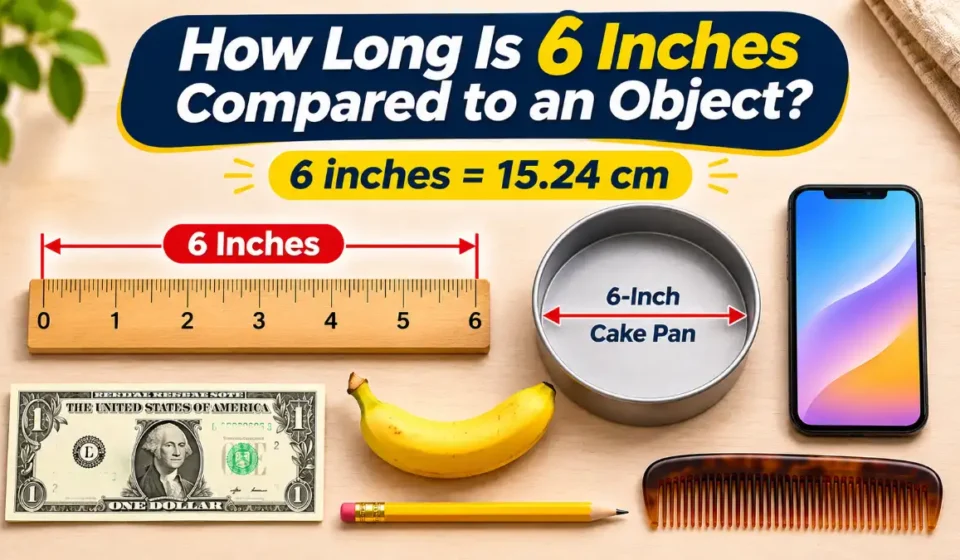

How long is 6 inches compared to an object? Six inches equals exactly 15.24 centimeters or half a foot. The easiest way to visualize this length is with a U.S. dollar bill, which measures approximately 6.125 inches long. Other familiar comparisons include a six-inch ruler, a small banana, a compact smartphone, or the diameter of a six-inch cake pan.
You don’t always need a ruler to understand how big six inches really is. Many household objects can help you estimate this distance when shopping online, measuring furniture, planning a DIY project, or checking product dimensions.
This guide explains 15 everyday size comparisons, the difference between six and seven inches, and practical ways to estimate measurements without a ruler.
How Long Is 6 Inches Compared to an Object Measurement Units?
Six inches might sound small, but understanding its exact dimensions makes it easier to compare everyday objects.
| Measurement | Equivalent to 6 inches |
| Centimeters | 15.24 cm |
| Millimeters | 152.4 mm |
| Feet | 0.5 feet |
| Meters | 0.1524 meters |
| Yards | 0.1667 yards |
| Standard ruler | Half of a 12-inch ruler |
For a simple visual reference, imagine a straight line measuring from the zero mark to the six-inch mark on a standard school ruler.
15 Everyday Objects That Are About 6 Inches Long
The following objects can help you understand the actual size of six inches. Some provide nearly exact measurements, while others are approximate because their dimensions vary.
1. A U.S. Dollar Bill
A U.S. dollar bill is one of the most reliable household references for six inches.
Its length is 6.125 inches, just one-eighth of an inch longer than the target measurement. That difference is small enough for everyday visual estimates.
According to the Federal Reserve’s currency information, U.S. banknotes share this standard length.
Place the bill flat beside an object to compare the two lengths.
2. A 6-Inch Ruler
A six-inch ruler provides an exact measurement rather than an estimate.
These shorter rulers are commonly found in stationery sets, pencil cases, and small tool kits.
They are particularly useful for measuring notebooks, photographs, craft materials, and small household items.
Unlike objects with variable dimensions, a properly manufactured ruler has marked measurement intervals.
3. Two Credit Cards
A standard credit card measures approximately 3.37 inches long and 2.125 inches wide.
When you place two cards end to end along their longer sides, the combined length becomes 6.74 inches.
That’s about three-quarters of an inch longer than six inches, so subtract a small amount mentally.
These dimensions follow the ISO/IEC 7810 ID-1 card standard.
ISO+1
4. A Small Banana
Some small bananas measure approximately five to six inches from tip to tip.
Their actual sizes depend on the variety and growing conditions.
For a visual estimate, choose a relatively straight banana and compare the distance between its ends.
Because bananas are curved and vary naturally, they are better for rough comparisons than accurate measurements.
5. A Smartphone
Many standard-sized smartphones have physical heights around six inches.
However, phone sizes vary by manufacturer and model. Some compact phones are shorter, while larger models may exceed six and a half inches.
Also, don’t confuse screen size with phone height.
A phone advertised with a 6.1-inch display has a screen measured diagonally, not necessarily a body measuring 6.1 inches tall.
Check your device’s physical dimensions before using it as a measurement reference.
6. A Used Wooden Pencil
A new standard wooden pencil is commonly around seven to seven and a half inches long.
After repeated sharpening, its length gradually decreases.
A moderately used pencil may measure around six inches, making it a practical reference for estimating shorter distances.
However, its length depends on how frequently it has been sharpened.
7. A Six-Inch Sandwich
A six-inch submarine sandwich provides another familiar size comparison.
Many sandwich shops offer portions described as six inches long.
Although the finished bread may differ slightly from the advertised size, it gives you a helpful mental picture.
Imagine the length of a small sub sandwich placed horizontally on a plate.
8. A Small Hair Comb
Compact pocket combs are often sold in lengths around five to seven inches.
A comb labeled six inches can serve as a convenient comparison because it has a relatively straight shape.
Larger styling combs may be considerably longer, so not every comb will match this measurement.
If you carry a compact comb, checking its length once can make future size estimates easier.
9. A Six-Inch Cake Pan
A round cake pan labeled six inches typically measures approximately six inches across its interior diameter.
The diameter is the straight-line distance from one side of the circular opening to the opposite side through its center.
This comparison is useful when visualizing round objects, decorative plates, or small baking dishes.
Remember that the exterior dimensions may be slightly larger because of the pan’s walls.
10. Half of a 12-Inch Ruler
A standard school ruler measures 12 inches.
Dividing its length into two equal sections gives exactly six inches.
This comparison is simple, accurate, and useful for students learning measurements.
You can also visualize six inches as one-quarter of a 24-inch distance.
11. A Small Paperback Book
Certain pocket-sized paperback books measure approximately six inches tall.
However, book dimensions differ between publishers and formats.
For example, many mass-market paperbacks are taller than six inches, while smaller pocket editions can be closer to that measurement.
Use books only as approximate references unless their dimensions are printed or verified.
12. A Kitchen Utility Knife Blade
Some kitchen utility knives feature blades approximately six inches long.
The blade length generally refers to the distance from the heel of the cutting edge toward its tip, rather than the total length including the handle.
A knife can help you imagine the distance, but it shouldn’t be used as a makeshift ruler.
Use a proper measuring tool instead when accuracy matters.
13. A Small Flashlight
Certain handheld flashlights measure around six inches from end to end.
Compact everyday-carry flashlights may be shorter, while larger outdoor models can be longer.
A flashlight with a verified six-inch body is a convenient reference because of its relatively straight shape.
However, don’t assume every flashlight has the same dimensions.
14. A Six-Inch Plant Pot
Many small flowerpots are sold with a six-inch diameter.
This measurement generally describes the width across the top, although product listings may use different measuring conventions.
A six-inch pot provides a useful visual comparison for small containers, bowls, and decorative items.
Check whether the listed measurement refers to the opening or the widest exterior dimension.
15. A Small Dessert Plate
Some dessert or side plates measure approximately six inches in diameter.
Unlike rectangular objects, the measurement runs straight across the circular plate’s center.
This is helpful when estimating the width of small dishes or circular household accessories.
Because plate sizes vary, a six-inch dessert plate should be identified by its stated diameter rather than appearance alone.
Quick Comparison Chart: How Close Are These Objects to 6 Inches?
The table below separates exact measurements from approximate examples.
| Object | Length or diameter | Accuracy |
| Six-inch ruler | 6 inches | Exact |
| Half of a 12-inch ruler | 6 inches | Exact |
| U.S. dollar bill | 6.125 inches | Very close |
| Two standard credit cards | 6.74 inches | Slightly longer |
| Small banana | Around 5–6 inches | Approximate |
| Compact smartphone | Model-dependent | Approximate |
| Used wooden pencil | Around 6 inches | Approximate |
| Six-inch cake pan | 6-inch nominal diameter | Close to exact |
| Six-inch plant pot | 6-inch nominal diameter | Depends on manufacturer |
| Small pocket comb | Around 5–7 inches | Approximate |
For the most accurate everyday comparison, a U.S. dollar bill is preferable to variable-size objects such as bananas or smartphones.
How Long Is 7 Inches Compared to an Object?
How long is 7 inches compared to an object? Seven inches equals exactly 17.78 centimeters, making it one inch longer than six inches.
A new wooden pencil is a useful visual reference because many standard pencils measure around 7–7.5 inches long.
Two standard credit cards placed lengthwise end to end measure approximately 6.74 inches, making their combined length closer to seven inches than six.
Read Also: How Big Is 10 CM? 7 Easy Size Comparisons With Real-Life Examples
6 Inches vs. 7 Inches: What’s the Difference?
| Feature | 6 Inches | 7 Inches |
| Centimeters | 15.24 cm | 17.78 cm |
| Millimeters | 152.4 mm | 177.8 mm |
| Feet | 0.5 ft | 0.5833 ft |
| Everyday reference | Dollar bill | New wooden pencil |
| Difference | Baseline | 1 inch longer |
Seven inches is approximately 16.7% longer than six inches.
While one inch might seem insignificant, it can make a noticeable difference when selecting storage boxes, shelves, phone accessories, or products that must fit a particular space.
How to Measure 6 Inches Without a Ruler
You can estimate six inches using household items that have familiar dimensions.
Use a Dollar Bill
Place a U.S. dollar bill flat on a surface and align one end with the object you want to measure.
Since the bill is only one-eighth of an inch longer than six inches, it provides a close estimate.
Use Two Credit Cards
Place two standard credit cards end to end along their longer edges.
Their combined length is approximately 6.74 inches. Subtract about three-quarters of an inch to estimate six inches.
Use Your Smartphone
Look up your phone’s official physical dimensions.
Once you know its height, compare it with other items around your home.
This approach is particularly useful because you can reuse the same familiar reference.
Create a Paper Measuring Strip
If you have access to a ruler once, mark six inches on a strip of paper or cardboard.
Keep the strip in your wallet or desk drawer for future estimates.
Unlike memory-based comparisons, a properly marked strip can provide consistent results.
How Big Is 6 Inches Compared to Your Hand?
Six inches may be close to certain hand measurements, but adult hands differ considerably in size.
The distance between the wrist crease and the middle fingertip can be longer than six inches for many adults.
Similarly, the span between the thumb and little finger when fully extended varies significantly.
Instead of assuming your hand measures six inches, measure a consistent part of it once and remember the result.
This technique can help when estimating furniture gaps, packaging dimensions, or small objects while away from home.
When Is a 6-Inch Measurement Useful?
Understanding this measurement helps with several everyday activities.
Online shopping: Product descriptions frequently list dimensions in inches. Visual comparisons help you understand whether something will fit.
Home improvement: Measuring small gaps, decorative items, and installation spaces requires an understanding of short distances.
Cooking and baking: Cake pans, kitchen utensils, and certain food portions are commonly described using inches.
Gardening: Plant pots and spacing recommendations often use inch-based measurements.
School projects: Students frequently encounter six-inch measurements in mathematics, geometry, and craft activities.
For tasks involving exact fitting or cutting, always confirm the dimensions with an appropriate measuring instrument.
Common Mistakes When Estimating 6 Inches
Several mistakes can make visual estimates unreliable.
First, people sometimes assume that all smartphones, pencils, or books have identical dimensions. In reality, their sizes vary.
Second, curved objects are often measured along their surface rather than in a straight line between endpoints.
Third, some people confuse radius with diameter. A six-inch-diameter circle has a three-inch radius.
Finally, measuring from the edge of a damaged ruler instead of its zero mark can produce an incorrect result.
To avoid these problems, use standardized reference objects whenever possible.
Frequently Asked Questions (FAQs)
1. What common household object is closest to 6 inches?
A U.S. dollar bill is one of the closest common references. It measures approximately 6.125 inches long, making it just one-eighth of an inch longer than six inches. A six-inch ruler provides an exact measurement.
2. Is 6 inches the same as half a foot?
Yes. One foot contains exactly 12 inches, so six inches equals half a foot. It also equals 15.24 centimeters, 152.4 millimeters, and 0.1524 meters.
3. How can I estimate 6 inches using my hand?
Measure a consistent distance on your hand using a ruler, then remember that reference. Hand spans and finger lengths vary, so no single hand position provides an accurate six-inch measurement for everyone.
4. Is 7 inches much bigger than 6 inches?
Seven inches is one inch longer than six inches, representing an increase of approximately 16.7%. The difference is relatively small visually but may be important when buying fitted products or measuring limited spaces.
5. Can I use my phone to measure 6 inches?
Yes, if you know your phone’s exact physical height. Compare the phone with the object you want to measure. However, smartphone dimensions vary, and advertised screen size is not the same as the device’s height.
Conclusion
Understanding the size of six inches becomes much easier when you compare it with familiar objects. A U.S. dollar bill, a six-inch ruler, a small banana, and certain kitchen items can all help you visualize this distance.
The most important distinction is between approximate and exact measurements. Everyday objects are useful for quick estimates, but they cannot always replace a ruler.
Whether you’re shopping online, working on a home project, or comparing product dimensions, knowing that six inches equals 15.24 centimeters provides a reliable starting point.