
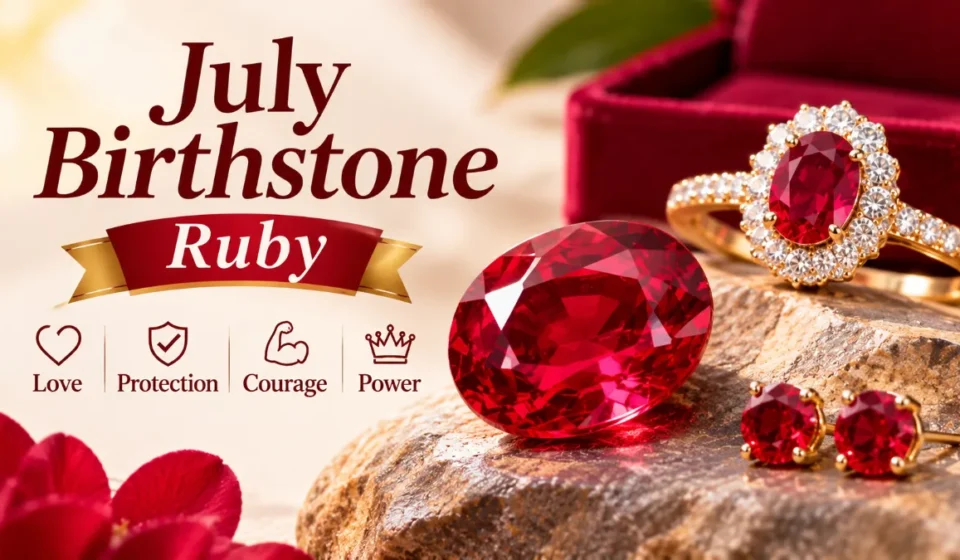

The July birthstone is ruby, a red gemstone known for its brilliant color, remarkable durability, and traditional symbolism of love, passion, courage, and protection. Ruby is the recognized traditional and modern birthstone for July. It belongs to the corundum mineral family, gets its red color primarily from chromium, and has a Mohs hardness rating of 9. These qualities make it a popular choice for birthday jewelry, including rings, pendants, bracelets, and earrings.
People born in July are associated with one of the world’s most prized colored gemstones. Whether you’re choosing a birthday gift or simply exploring birthstone meanings, understanding ruby’s history, color, quality, and care requirements can help you appreciate what makes this gemstone special.
What Is the Birthstone for July?
Ruby is the official gemstone associated with July birthdays in the standard American birthstone tradition. The American Gem Society’s July birthstone guide identifies ruby as the month’s recognized gemstone.
Rubies are a variety of corundum, the mineral family that also includes sapphires. Red corundum is classified as ruby, while other colors are generally classified as sapphire.
Natural rubies develop within the Earth through geological processes. Their striking appearance and relative rarity, particularly in fine-quality specimens, have made them desirable for centuries.
July Birthstone Facts at a Glance
| Characteristic | Details |
| Birthstone | Ruby |
| Month | July |
| Gemstone Color | Red to slightly purplish red |
| Mineral | Corundum |
| Chemical Composition | Aluminum oxide (Al₂O₃) |
| Red Coloring Element | Chromium |
| Mohs Hardness | 9 |
| Traditional Symbolism | Love, courage, passion, protection |
| Popular Jewelry | Rings, pendants, earrings, bracelets |
July Birthstone Meaning: What Does Ruby Symbolize?
Ruby has traditionally represented intense emotions, personal strength, and prosperity. Its rich red appearance has often been linked with the heart, fire, and vitality.
Several symbolic meanings have developed around the gemstone.
Love and devotion: Ruby is associated with romantic affection, loyalty, and lasting relationships. Its red color makes it a popular choice for meaningful jewelry gifts.
Courage and confidence: Historically, the gemstone has represented bravery, strength, and determination.
Protection: Some ancient societies believed rubies could protect their owners from danger or misfortune.
Wealth and power: Rubies were treasured by rulers and wealthy families, making them symbols of status and influence.
These meanings reflect historical traditions rather than scientifically established gemstone powers. Wearing ruby has not been shown to provide supernatural protection or medical benefits.
Ruby Birthstone History and Cultural Significance
Ruby’s history stretches back thousands of years. In ancient India, the gemstone was highly valued for its beauty and rarity. It was sometimes described as the king of precious stones.
Throughout history, rubies also appeared in royal ornaments, ceremonial objects, and valuable jewelry. In medieval Europe, people associated them with prosperity, wisdom, and protection.
Myanmar, historically called Burma, became particularly well known for its prized rubies. Other important producing countries include Mozambique, Thailand, Sri Lanka, and Madagascar.
The gemstone’s name comes from the Latin word ruber, meaning red. Its historical significance and connection with love are explored in the history of the July birthstone.
Ruby eventually became established as July’s birthstone through traditional and modern birthstone lists.
July Birthstone Color: Why Are Rubies Red?
Red is the defining color of ruby, but the shade can vary considerably. Some rubies appear bright crimson, while others show deeper red, purplish red, or slightly orangish red tones.
The color comes mainly from chromium, a trace element incorporated into corundum’s crystal structure.
A ruby’s appearance depends on three important color characteristics:
- Hue: The dominant red color and any secondary purple or orange tones.
- Tone: Whether the gemstone looks relatively light or dark.
- Saturation: How strong and vivid the red color appears.
The most highly prized rubies generally display a vivid red to slightly purplish red color without appearing excessively dark.
What Is a Pigeon’s Blood Ruby?
Pigeon’s blood is a gemstone trade term associated with exceptionally desirable vivid red rubies.
It does not describe a separate mineral or gemstone species. Different laboratories and sellers may apply specific criteria when using this designation.
A ruby advertised as pigeon’s blood should not automatically be assumed to be valuable solely because of the description. Its overall quality, treatments, and supporting documentation still matter.
Ruby Gemstone Properties and Durability
One reason ruby is popular in fine jewelry is its hardness.
Ruby measures 9 on the Mohs scale, placing it among the hardest naturally occurring gemstones. Only a few natural minerals, including diamond, have a higher hardness.
The gemological properties of ruby include its corundum composition, chromium-related coloration, and strong resistance to scratching.
However, hardness and toughness are not identical. Although ruby resists surface scratches well, it may still chip or fracture after a significant impact.
For everyday rings, a secure setting helps protect the gemstone. Earrings and pendants generally experience fewer direct impacts than rings, making them practical jewelry options.
July Birthstone Jewelry: Popular Gift Ideas
Ruby jewelry is frequently chosen for July birthdays because of its distinctive appearance and traditional association with love.
Popular styles include:
- Ruby rings: A striking option for birthday presents, engagement rings, and anniversary gifts.
- Ruby necklaces: Solitaire pendants and delicate necklaces allow the gemstone’s color to stand out.
- Ruby earrings: Studs and drop earrings complement both casual and formal outfits.
- Ruby bracelets: Small ruby accents can add color without overwhelming the design.
Ruby pairs well with yellow gold, rose gold, white gold, and platinum.
When selecting a gift, consider the recipient’s preferred jewelry style, how frequently they will wear it, and the level of protection provided by the setting.
What Makes a Ruby Valuable?
Not all rubies have the same quality or market value. Their prices depend on several characteristics, with color usually playing the most important role.
Color: Strong, vivid red coloration generally commands greater interest than dull or excessively dark shades.
Clarity: Natural rubies commonly contain inclusions. Stones with fewer distracting inclusions and good transparency are often more valuable.
Cut: A skillfully cut ruby displays attractive color and brightness while minimizing distracting dark or transparent areas.
Carat weight: Large, fine-quality rubies are relatively rare. Their price per carat may increase substantially as size increases.
Origin: Geographic origin can influence value, particularly when supported by reliable laboratory documentation. However, origin alone does not establish quality.
Treatments: Heat treatment is common and widely accepted in the gemstone trade. Other enhancements, including fracture filling, can influence durability and price.
The main ruby quality factors explain why two stones of similar size can have significantly different values.
For an expensive purchase, ask the seller about treatments and whether an independent gemological report is available.
Natural Ruby vs. Lab-Grown Ruby
Natural and lab-grown rubies share essentially the same chemical composition, crystal structure, and fundamental physical properties.
Their difference lies in how they form.
Natural rubies develop through geological processes, while lab-grown rubies are created under controlled conditions.
Both can have beautiful red coloration, although natural rubies are generally more expensive when comparing fine-quality stones with similar characteristics.
Lab-grown ruby is not the same as an imitation ruby. Imitations may be made from glass or other materials that only resemble the gemstone.
Read Also: 45 Seasonal Cute Nails Ideas for Spring, Summer, Autumn and Winter
How to Care for Your July Birthstone
Ruby is durable, but regular care helps preserve its appearance and protect the jewelry setting.
Untreated and conventionally heat-treated rubies can generally be cleaned using warm water, mild soap, and a soft brush.
For routine cleaning:
- Prepare a small bowl of warm, mildly soapy water.
- Gently brush the gemstone and accessible parts of the setting.
- Rinse carefully with clean water.
- Dry using a soft, lint-free cloth.
- Store the jewelry separately to avoid scratches and accidental impacts.
Special care is required for rubies that have been glass-filled, dyed, or treated with certain fracture-filling materials. These stones should generally be wiped with a soft, damp cloth rather than soaked.
Avoid harsh chemicals and unnecessary impacts. Ultrasonic or steam cleaning should only be considered when the stone’s treatment status and condition make those methods appropriate.
The ruby care and cleaning guidelines provide further guidance for different types of ruby treatments.
Frequently Asked Questions
1. What is the traditional birthstone for July?
Ruby is the traditional birthstone for July and is also recognized as its modern birthstone in standard American birthstone lists. Its red color and historical symbolism make it a popular choice for birthday jewelry.
2. What color is the July birthstone?
The July birthstone is red. Ruby can range from lighter red to deep, vivid red, sometimes with slightly purple or orange undertones. Its coloration comes primarily from chromium within the mineral corundum.
3. Is ruby an expensive birthstone?
Ruby can be expensive, especially when a natural stone has exceptional color, clarity, and size. However, prices vary widely, and more affordable options include smaller rubies, treated stones, and lab-grown rubies.
4. Can July’s ruby birthstone be worn daily?
Yes. Ruby’s hardness of 9 on the Mohs scale makes it suitable for everyday jewelry. It is highly scratch-resistant but can still chip or fracture if struck hard, so secure settings and careful handling are recommended.
5. Is ruby the only official birthstone for July?
Ruby is the recognized traditional and modern July birthstone in standard American birthstone lists. Some alternative traditions may associate other gemstones with July, but ruby remains the established choice.