
How Big Is 1 cm 2 cm 3 cm 4 cm and 5 cm When you see a measurement written in centimeters, it isn’t always easy to picture its actual size. Whether you’re buying jewelry, measuring school supplies, working on a DIY project, or checking product dimensions online, understanding small measurements can help you make better decisions.
A centimeter (cm) is a metric unit of length. One centimeter equals 10 millimeters or approximately 0.39 inches. Five centimeters is nearly two inches long, while measurements between 1 and 4 cm represent progressively shorter distances.
In this guide, you’ll discover what each measurement looks like, how it compares with everyday objects, and how to convert centimeters into inches.
Understanding Centimeters Through Everyday Measurements
The centimeter belongs to the metric system, which is widely used for measuring length and distance. Unlike inches, which are divided into fractions, centimeters are divided into millimeters.
For example, a 5 cm line contains 50 millimeters, while a 2 cm line contains 20 millimeters.
The following table provides a quick reference.
| Measurement | Equivalent in Inches | Equivalent in Millimeters |
| 1 cm | 0.39 inches | 10 mm |
| 2 cm | 0.79 inches | 20 mm |
| 3 cm | 1.18 inches | 30 mm |
| 4 cm | 1.57 inches | 40 mm |
| 5 cm | 1.97 inches | 50 mm |
These conversions make it easier to understand product descriptions, compare sizes, and complete measurement-based activities.
How Big Is 1 cm 2 cm 3 cm 4 cm and 5 cm in Real Life?
If you’re wondering how big is 1 cm, imagine a distance slightly shorter than half an inch. One centimeter measures exactly 10 millimeters and approximately 0.3937 inches. Although it might appear tiny, this length is useful when measuring buttons, small pieces of jewelry, electronic components, and other compact objects. A familiar example is a standard wooden pencil, which commonly measures around 7–8 millimeters in diameter,
making 1 cm slightly wider than the pencil itself. Another comparison is a small clothing button that measures approximately 10 mm across, although buttons come in many sizes. On a metric ruler, 1 cm stretches from the zero mark to the first numbered centimeter mark. Between those two numbers, you’ll usually notice ten smaller divisions representing millimeters. Understanding this distance is especially helpful for craft projects, school assignments, and online purchases where even a few millimeters can affect an object’s fit.
How Big Is 2 cm Compared to Everyday Objects?
To understand how big is 2 cm, picture the diameter of a US penny. A penny measures approximately 19.05 millimeters across, which is very close to 2 centimeters. The actual length of 2 cm is 20 millimeters or roughly 0.79 inches, making it noticeably shorter than one full inch. Another way to visualize it is by placing two 1 cm sections together on a ruler. This measurement appears frequently in clothing accessories,
craft materials, decorative items, and jewelry descriptions. For example, a pendant measuring 2 cm across would be approximately the width of a penny, provided that measurement refers to its diameter or width. When comparing dimensions, remember that the size of an object depends on more than one measurement. A decorative piece that is 2 cm wide but 5 cm long will look very different from a circular piece measuring 2 cm in diameter. Using a ruler remains the best way to confirm the exact dimensions.
How Big Is 3 cm When Measured in Inches?
Many people ask how big is 3 cm when trying to understand measurements larger than one inch. Three centimeters equal 30 millimeters or approximately 1.18 inches, meaning this length extends about 4.6 millimeters beyond a standard one-inch measurement. A useful comparison is the diameter of a US half-dollar coin, which measures approximately 30.61 millimeters. This makes the coin almost the same width as a 3 cm line. The measurement is also relevant when choosing small household accessories, designing handmade decorations,
measuring craft supplies, and comparing jewelry sizes. For instance, a circular badge with a 3 cm diameter would be close in size to a half-dollar coin. If you’re measuring with an inch-based ruler, locate the one-inch mark and extend the distance slightly farther to approximate 3 cm. However, for sewing, woodworking, and other activities requiring accurate dimensions, it’s better to use a metric ruler rather than rely on visual comparisons.
How Big Is 4cm Without Using a Measuring Tape?
Understanding how big is 4cm becomes easier when you compare it with familiar objects. Four centimeters measure 40 millimeters or approximately 1.57 inches, placing this length between one and a half inches and one and three-quarter inches. Imagine two US pennies arranged side by side with their edges touching. Together, their diameters total approximately 3.81 centimeters,
which is slightly shorter than 4 cm. This comparison provides a convenient estimate when you don’t have a ruler nearby. A 4 cm measurement may describe the width of a decorative ornament, a small badge, a sewing accessory, or a compact household component. It can also be useful when checking packaging dimensions or planning the placement of objects on shelves and desks. When measuring objects with curved surfaces, remember that the straight-line distance across an object differs from the distance around it. For example, a circle with a 4 cm diameter has a circumference of approximately 12.57 cm.
How Big Is 5 cm Compared to Two Inches?
If you want to know how big is 5 cm, imagine a line almost exactly two inches long. Five centimeters equal 50 millimeters or approximately 1.97 inches. Since two inches equal 5.08 centimeters, the difference between these measurements is less than one millimeter. This makes a two-inch reference particularly useful for estimating 5 cm in everyday situations. You can also compare the measurement with a standard golf ball,
which has a minimum diameter of approximately 4.27 cm. A 5 cm distance is somewhat longer than that diameter. This measurement is commonly used in craft instructions, jewelry dimensions, household product specifications, and educational activities. For example, when an online retailer lists an accessory as 5 cm long, you can expect its length to be close to two inches. However, if the product is three-dimensional, its width and thickness also matter. Checking all available dimensions helps prevent misunderstandings when buying small products.
Read also: 1 cm to 5 cm: How Big Are These Measurements in Real Life?
How to Visualize 1 cm to 5 cm on a Ruler
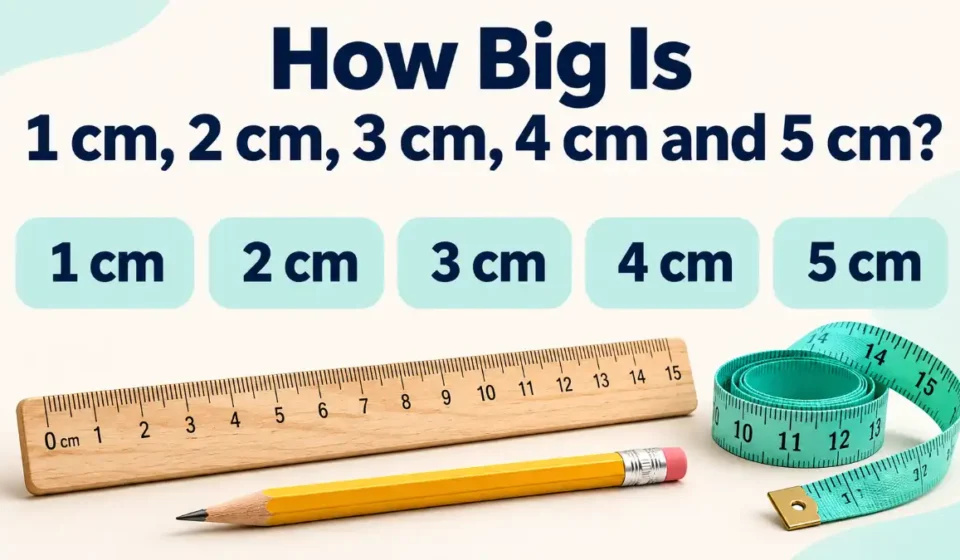
A metric ruler is the simplest tool for understanding centimeter measurements. Most standard rulers display numbered centimeter marks along one edge.
Illustration of a 5 cm metric scale. Screen display size may vary, so it should not be used as a physical ruler.
To measure an object correctly, place one end at the ruler’s zero mark and identify the number where the opposite end finishes.
For example, an object extending from zero to the fourth centimeter mark is 4 cm long. If it reaches halfway between the fourth and fifth marks, its length is 4.5 cm.
Be careful not to confuse the beginning of the ruler with its zero mark. Some rulers have extra space before the measurement scale starts.
Why Centimeter Measurements Matter in Daily Life
Small measurements are important in many situations. Students use centimeters in geometry, science experiments, and classroom assignments. Designers rely on them to establish spacing and proportions, while shoppers use them to understand product sizes.
In clothing and accessories, a difference of just 1 cm can affect how an item fits or looks. Similar differences matter when measuring screws, decorative pieces, or electronic accessories.
Learning to estimate centimeters also improves your ability to interpret measurements from international websites, where metric dimensions are common.
Frequently Asked Questions
1. How many centimeters are in one inch?
One inch equals exactly 2.54 centimeters. To convert inches into centimeters, multiply the inch measurement by 2.54.
2. Is 2 cm smaller than a US quarter?
Yes. A US quarter measures approximately 2.426 cm in diameter, making it slightly wider than a 2 cm measurement.
3. What everyday object is approximately 3 cm wide?
A US half-dollar coin is an excellent comparison. Its diameter is approximately 3.061 cm, which is very close to 3 cm.
4. Can I measure 4 cm with my fingers?
You can estimate 4 cm using your fingers, but finger sizes vary from person to person. For accurate measurements, use a ruler or measuring tape.
5. How many millimeters make 5 centimeters?
Five centimeters contain exactly 50 millimeters. Multiply the number of centimeters by 10 to convert any centimeter measurement into millimeters.
Final Thoughts
Visualizing small measurements becomes much easier when you connect centimeters with familiar objects. A single centimeter is slightly less than half an inch, 2 cm is close to the diameter of a penny, 3 cm resembles a half-dollar coin, 4 cm is approximately 1.57 inches, and 5 cm is almost exactly two inches.
These comparisons provide helpful estimates for shopping, crafting, studying, and everyday measuring. Whenever precision matters, however, use a properly marked ruler or another suitable measuring instrument rather than relying entirely on visual references.