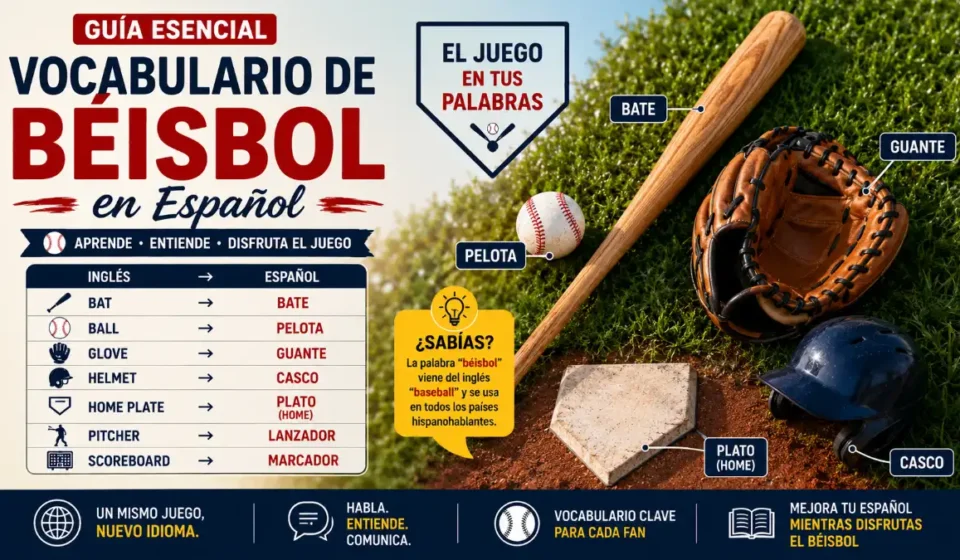

Baseball in Spanish is béisbol or beisbol. Both forms are accepted, but they reflect regional pronunciation: béisbol is common in Spain and much of Latin America, while beisbol is frequent in Mexico, Central America, and parts of the Caribbean. The useful part for learners is knowing what comes next – how fans describe a pitch, a score, a player, and a big moment in the game.rae+2
If your goal is to understand a Spanish-language baseball broadcast or chat with fans, you do not need to memorize an enormous glossary at once. Start with the high-frequency language of a single game: who is playing, what just happened, what the score says, and how people react. This guide turns the baseball Spanish translation into practical language you can recognize and use.
The First Choice: Béisbol or Beisbol?
The sport has two standard written forms in Spanish. They do not refer to separate games or styles of play; the difference is pronunciation and regional preference.
| Form | Say it roughly as | Stress | Typical usage |
| béisbol | BAYS-bol | First syllable | Spain and much of Latin America |
| beisbol | bays-BOL | Last syllable | Mexico, Central America, and parts of the Caribbean |
The Real Academia Española and the Association of Spanish Language Academies recognize both forms. FundéuRAE identifies beisbol as especially common in Mexico, Guatemala, Colombia, Venezuela, Cuba, and the Dominican Republic. In Cuba and Puerto Rico, either pronunciation may be heard.rae+2
Use the form you see in the league, publication, team, or country you are following. In either case, it is masculine:
- El béisbol es popular en mi ciudad. – Baseball is popular in my city.
- Me gusta mucho el beisbol. – I like baseball a lot.
The informal short form beis also appears in casual speech, particularly in Mexico and Central America. For example, Vamos a jugar beis means “Let’s play ball.”rae
Read a Game Recap in Spanish
A good way to learn baseball vocabulary is to follow the order of a game recap. Consider this short headline-style sentence:
El abridor lanzó seis entradas, permitió una carrera y salió con ventaja antes de que el relevo cerrara el partido.
It means:
The starting pitcher threw six innings, allowed one run, and left with the lead before the relief pitching closed out the game.
This one sentence includes language you will see repeatedly in articles, box-score summaries, and broadcasts.
| Spanish expression | Meaning in English | Why it matters |
| El abridor | The starting pitcher | A pitcher who starts the game |
| Lanzó seis entradas | Pitched six innings | A common way to describe a pitcher’s workload |
| Permitió una carrera | Allowed one run | Used in game recaps and statistics |
| Con ventaja | With the lead | Indicates which team is ahead |
| El relevo | Relief pitching / bullpen | Pitchers who enter after the starter |
| Cerró el partido | Closed out the game | Finished the game successfully |
Once you can unpack a sentence like this, baseball in Spanish starts to feel much less like a list of isolated terms.
The Words That Move a Game Forward
Baseball commentary changes quickly, but most plays rely on a manageable group of core nouns and verbs. Learn these first.
When the Pitch Is Thrown
| English | Spanish | Example |
| Pitcher | Lanzador / Pícher | El lanzador tiró una recta. – The pitcher threw a fastball. |
| Catcher | Receptor / Cácher | El receptor pidió tiempo. – The catcher called time. |
| To pitch | Lanzar / Pichear | Va a lanzar desde el montículo. – He is going to pitch from the mound. |
| Strike | Strike | El primer lanzamiento fue strike. – The first pitch was a strike. |
| Ball | Bola | La cuenta está en tres bolas y un strike. – The count is three balls and one strike. |
| Full count | Cuenta completa | El bateador está en cuenta completa. – The batter has a full count. |
Lanzador is a broad, neutral choice for pitcher. Pícher is an adapted English form heard often in parts of the Americas. Likewise, receptor is broadly useful for catcher, while cácher is common in some regional baseball settings.scholarsarchive.byu+1
When the Batter Makes Contact
| English | Spanish | Example |
| Batter | Bateador | El bateador llegó a primera. – The batter reached first. |
| To bat | Batear | Hoy va a batear tercero. – Today he will bat third. |
| Hit | Imparable / Hit | Conectó un imparable al centro. – He hit a single to center. |
| Single | Sencillo | Abrió la entrada con un sencillo. – He opened the inning with a single. |
| Double | Doble | Pegó un doble por la raya. – He hit a double down the line. |
| Triple | Triple | El corredor llegó a tercera con un triple. – The runner reached third on a triple. |
| Bunt | Toque / Toque de bola | Intentó un toque de bola. – He tried a bunt. |
| Home run | Jonrón / Cuadrangular | Conectó un jonrón de dos carreras. – He hit a two-run home run. |
Jonrón is the established Spanish adaptation of “home run.” Cuadrangular is another accepted term. Both are valuable to know, because one broadcaster may say jonrón while another prefers cuadrangular.fundeu+1
Read More: Slim Chickens Guide
When an At-Bat Ends
| English | Spanish | Example |
| Strikeout | Ponche | Terminó el inning con un ponche. – He ended the inning with a strikeout. |
| To strike out | Poncharse | El bateador se ponchó. – The batter struck out. |
| Walk | Base por bolas | Recibió una base por bolas. – He drew a walk. |
| Out | Out / Fuera | El corredor fue puesto out. – The runner was called out. |
| Safe | A salvo / Safe | El corredor está a salvo. – The runner is safe. |
| Error | Error | El tiro terminó en error. – The throw resulted in an error. |
Spanish-language baseball keeps some English words, especially in live commentary. Hearing out, safe, or strike does not mean the speaker has stopped speaking Spanish – those terms are part of real baseball usage in many places.
Follow the Score Without Translating Every Word
You do not need to understand every sentence in a broadcast to follow the situation. Score language gives you the fastest route into the game.
| What you want to know | Spanish you may hear | Meaning |
| Which inning is it? | Estamos en la octava entrada. | We are in the eighth inning. |
| Who is ahead? | Los visitantes tienen ventaja. | The visitors have the lead. |
| Is it tied? | El marcador está empatado. | The score is tied. |
| How many runs? | Anotaron cuatro carreras. | They scored four runs. |
| Is there a runner on base? | Hay corredor en segunda. | There is a runner on second. |
| Is the game close? | Es un partido cerrado. | It is a close game. |
| Did it go long? | Se fue a entradas extra. | It went to extra innings. |
The most useful scoreboard words are entrada (inning), carrera (run), marcador (scoreboard or score), ventaja (lead), empate (tie), and entradas extra (extra innings).
A sentence such as Necesitan dos carreras para empatar tells you nearly everything you need: “They need two runs to tie.”
Who Plays Where?
Baseball positions in Spanish are not always named identically from one country to another. The terms below give you a practical starting point, including alternatives you may encounter.
| Number | Position in English | Spanish term | Other term you may hear |
| 1 | Pitcher | Lanzador | Pícher |
| 2 | Catcher | Receptor | Cácher |
| 3 | First baseman | Primera base | Inicialista |
| 4 | Second baseman | Segunda base | Camarero |
| 5 | Third baseman | Tercera base | Antesalista |
| 6 | Shortstop | Paracorto / Parador en corto | Torpedero / Campocorto |
| 7 | Left fielder | Jardinero izquierdo | – |
| 8 | Center fielder | Jardinero central | – |
| 9 | Right fielder | Jardinero derecho | – |
For the shortstop role, the RAE recommends Spanish alternatives such as paracorto, parador en corto, and torpedero for the player, while campo corto can refer to the area between second and third base. These terms are useful to recognize because shortstop and short may still appear in some coverage.
The three outfielders are called jardineros. The word literally means “gardeners,” because the outfield is known as el jardín. You can remember the positions by direction:
- Jardinero izquierdo – left fielder
- Jardinero central – center fielder
- Jardinero derecho – right fielder
Ask and Answer Like a Fan
These short exchanges are designed for normal conversations, not textbook drills. They help you use baseball Spanish in a stadium, group chat, watch party, or class discussion.
Talking About the Matchup
¿Quién abre hoy?
Who is starting today?
Abre el lanzador novato.
The rookie pitcher is starting.
¿Contra quién juegan?
Who are they playing against?
Juegan contra los campeones.
They are playing against the champions.
¿Cómo va la serie?
How is the series going?
Van dos juegos a uno.
They are up two games to one.
Reacting to a Play
¡Qué atrapada!
What a catch!
Ese batazo casi sale del parque.
That hit almost left the park.
Le dieron base por bolas.
They gave him a walk.
El corredor robó segunda.
The runner stole second.
Fue una doble matanza.
It was a double play.
El árbitro marcó strike tres.
The umpire called strike three.
Summing Up the Result
Ganaron por tres carreras.
They won by three runs.
Perdieron en la novena entrada.
They lost in the ninth inning.
El partido estuvo emocionante hasta el final.
The game was exciting until the end.
El abridor tuvo una buena salida.
The starter had a good outing.
A Regional Listening Guide
The best strategy for Spanish baseball terms is not to search for one supposedly universal word. Listen for the term a specific region uses and connect it to its neutral equivalent.
| If you hear this | It usually refers to | A useful equivalent to know |
| Pícher | Pitcher | Lanzador |
| Cácher | Catcher | Receptor |
| Ampáyer | Umpire | Árbitro / Juez |
| Jonrón | Home run | Cuadrangular |
| Doble play | Double play | Doble matanza |
| Shortstop | Shortstop position/player | Paracorto / Torpedero |
| Beis | Informal baseball | Béisbol / Beisbol |
This approach prevents a common learner mistake: treating an English-derived term as “wrong” merely because a more traditional Spanish term exists. Baseball Spanish has always mixed translations, borrowings, and local expressions. Knowing the relationship between the terms is more useful than trying to eliminate variation.
Build Your Own Baseball Spanish Sentences
A simple sentence pattern makes it easier to speak without translating word by word from English.
Use a Player + Action + Result Pattern
El lanzador + verbo + resultado
- El lanzador lanzó siete entradas. – The pitcher threw seven innings.
- El lanzador permitió dos carreras. – The pitcher allowed two runs.
- El lanzador ponchó a ocho bateadores. – The pitcher struck out eight batters.
El bateador + verbo + destination/result
- El bateador conectó un doble. – The batter hit a double.
- El bateador recibió una base por bolas. – The batter drew a walk.
- El bateador impulsó dos carreras. – The batter drove in two runs.
El equipo + verbo + situación de juego
- El equipo tomó la ventaja en la séptima entrada. – The team took the lead in the seventh inning.
- El equipo empató el marcador. – The team tied the score.
- El equipo ganó en entradas extra. – The team won in extra innings.
These patterns give you a flexible framework. Swap in a new player, inning, result, or number, and you can describe dozens of real baseball situations.
A Better Way to Memorize the Vocabulary
Rather than studying one giant table, learn five words at a time around a single game moment.
Day 1: Pitching
Learn: lanzador, receptor, lanzar, strike, ponche.
Practice: El lanzador consiguió un ponche.
Day 2: Hitting
Learn: bateador, batear, sencillo, doble, jonrón.
Practice: El bateador conectó un doble.
Day 3: Scoring
Learn: carrera, entrada, marcador, ventaja, empate.
Practice: El equipo tomó ventaja en la sexta entrada.
Day 4: Defense
Learn: jardinero, paracorto, atrapada, error, doble matanza.
Practice: El jardinero hizo una gran atrapada.
After four short sessions, watch a Spanish-language highlight and try to identify at least one word from each group. The goal is not perfect translation. It is building enough recognition to understand the action as it happens.
The Main Point to Remember
The translation for baseball in Spanish is not limited to a single word. Béisbol and beisbol are both valid, and the best choice depends on regional use. Beyond that first translation, practical fluency comes from learning the game’s recurring language: lanzador, bateador, entrada, carrera, ponche, base por bolas, and jonrón.
Start by listening for these core words in a recap or broadcast. Once they become familiar, regional alternatives such as pícher, cácher, ampáyer, and torpedero will feel like useful additions rather than confusing exceptions.
Frequently Asked Questions
Is “baseball” translated as “pelota” in Spanish?
Usually, the clearest translation for the sport is béisbol or beisbol. Pelota normally means “ball,” although in some Caribbean baseball contexts it can be an informal shorthand for the sport itself. If you are a learner and want to avoid confusion, use béisbol or beisbol for the sport and pelota for the physical ball.
What does “abridor” mean in baseball Spanish?
Abridor means starting pitcher. It comes from the verb abrir, meaning “to open,” because this pitcher opens the game for the team. A typical sentence is el abridor lanzó cinco entradas, meaning “the starter pitched five innings.” The pitchers who enter later are often grouped under el relevo, meaning the relief staff or relief pitching.
How do I say “RBI” in Spanish?
A common way to express an RBI is carrera impulsada. For example, impulsó tres carreras means “he drove in three runs.” You may also see the abbreviation CI in Spanish-language statistics, although labels can vary by league or publication. In speech, the full phrase carreras impulsadas is clear and useful.
What is “base por bolas” and why is it not simply “walk”?
Base por bolas is the standard descriptive phrase for a walk: the batter receives first base after four balls outside the strike zone. Some Spanish-language broadcasters may also use English-influenced baseball language, but base por bolas clearly communicates the result in any formal or neutral context. You can say recibió una base por bolas for “he drew a walk.”
What does “doble matanza” mean?
Doble matanza means double play. Literally, it suggests two outs made within one defensive sequence. You may also hear doble play, especially in speech and regional baseball coverage. Learn both terms, because they refer to the same basic result: the defense records two outs on one play.
Is “juego” or “partido” better for a baseball game?
Both juego and partido can mean game or match. Partido de béisbol is a broadly neutral phrase, while juego de béisbol is also common, especially in American Spanish. When you are unsure, partido is a safe choice for a scheduled game, and juego will be readily understood in baseball conversation.
How do I say “bullpen” in Spanish?
Bullpen is frequently retained in Spanish-language baseball coverage. You may also hear el relevo when speakers mean the group of relief pitchers rather than the physical bullpen area. Context matters: el bullpen está listo refers to the bullpen, while el relevo respondió bien means the relief pitchers performed well
What does “impulsar carreras” mean?
Impulsar carreras means to drive in runs. If a player’s hit allows teammates to score, you can say that the player impulsó carreras. For example, el bateador impulsó dos carreras con un doble means “the batter drove in two runs with a double.” It is one of the most common expressions in Spanish-language recaps.
Is “carrera” always a run in Spanish baseball?
In baseball context, carrera means a scored run. Outside sports, it can also mean race, career, degree program, or route, so context determines the meaning. In a line such as anotaron cinco carreras, the baseball meaning is clear: “they scored five runs.”
How can I understand a Spanish baseball broadcast if the announcer speaks quickly?
Start by listening for repeated anchors rather than attempting to translate every phrase: entrada (inning), carrera (run), bateador (batter), lanzador (pitcher), out, and jonrón. Follow the score graphic while you listen, then replay a short highlight and identify one action word per play. Over time, the repeated structure of baseball commentary makes the pace much easier to