
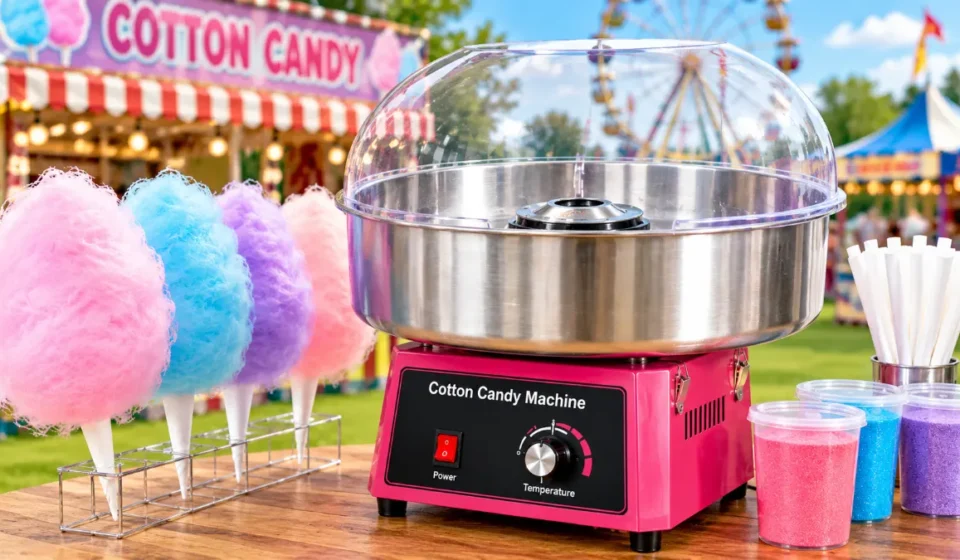

A cotton candy machine is a popular appliance that turns ordinary granulated sugar into fluffy, colorful cotton candy. These machines are commonly used at birthday parties, carnivals, fairs, school events, food stalls, and commercial businesses. With the right machine, you can prepare fresh cotton candy at home or serve customers at events and celebrations.
Whether you want a small cotton candy machine for personal use or a commercial model for your business, understanding its types, features, operating costs, and maintenance requirements can help you make the right choice.
What Is a Cotton Candy Machine?
A cotton candy machine is an electric appliance that heats sugar and spins it through tiny openings to create fine sugar strands. These strands cool as they move through the air and collect around a paper cone or stick, forming the soft, cloud-like candy people enjoy.
Most machines include a heating element, a spinning head, a collection bowl, and a motor. Some models are designed for occasional home use, while others are built for continuous operation in commercial settings.
How Does a Cotton Candy Machine Work?
A cotton candy machine works through a simple heating and spinning process.
- Add sugar: Place the recommended amount of granulated sugar or suitable cotton candy sugar into the machine’s spinning head.
- Heat the sugar: The heating element melts the sugar inside the spinning head.
- Spin the head: Centrifugal force pushes the melted sugar through small holes.
- Form sugar strands: The thin sugar streams cool and solidify into delicate threads.
- Collect the candy: Rotate a cone or stick around the bowl to gather the strands into a fluffy shape.
Always follow the manufacturer’s instructions for preheating, sugar quantity, and operating time.
Types of Cotton Candy Machines
Different machines suit different budgets, locations, and production needs.
1. Home Cotton Candy Machines
Home machines are compact, lightweight, and designed for occasional use. They are suitable for birthday parties, family gatherings, and children’s celebrations.
These models usually have lower production capacity than commercial machines and may require more time to produce each serving.
2. Commercial Cotton Candy Machines
Commercial machines are designed for food stalls, event businesses, fairs, and busy venues. They generally feature stronger motors, larger bowls, and more durable components.
If you plan to sell cotton candy regularly, choose a model with an appropriate production rate and a duty cycle that matches your expected workload.
3. Professional Cart-Style Machines
Cart-style machines combine a cotton candy maker with a stand or serving cart. They are useful for outdoor events, festivals, markets, and mobile food businesses.
Some models include storage compartments, wheels, and protective covers. Check the machine’s dimensions and portability before purchasing.
4. Automatic Cotton Candy Machines
Automatic models reduce some manual steps and may offer preset controls or automated production features. They can be useful in high-traffic locations, depending on their capacity, cleaning requirements, and maintenance needs.
Not every machine advertised as automatic offers the same level of automation, so compare its actual functions before buying.
Important Features to Consider
Before purchasing a cotton candy machine, evaluate these important features:
- Heating performance: Consistent heating helps produce fine, even sugar strands.
- Motor quality: A durable motor is important for frequent use.
- Bowl size: A larger bowl provides more room to collect cotton candy.
- Production capacity: Match the machine’s stated output to your expected customer demand.
- Temperature controls: Adjustable settings can help with consistent results.
- Ease of cleaning: Removable components can simplify maintenance.
- Safety features: Look for stable construction, suitable electrical protection, and clear operating instructions.
- Portability: Compact machines are easier to transport to parties and events.
- Warranty and replacement parts: Reliable support can reduce long-term maintenance problems.
Cotton Candy Machine Price
The price of a cotton candy machine depends on its size, construction, features, brand, and intended use. Home models generally cost less than professional machines.
| Machine type | General price level | Best use |
| Small home machine | Budget | Family use and parties |
| Mid-range machine | Moderate | Frequent celebrations and small events |
| Commercial machine | Higher | Food stalls and regular sales |
| Professional cart model | Higher | Festivals and mobile businesses |
| Automatic machine | Varies widely | Specialized or high-volume operations |
Prices vary by seller, country, and availability. Compare current listings, shipping charges, warranty terms, and included accessories before making a purchase.
Read Also: Laser Welding Machine: Types, Working Process, Cost, and Buying Guide (2026)
What Sugar Can You Use in a Cotton Candy Machine?
Many machines work with granulated sugar or specially prepared cotton candy sugar. Some models also support flavored or colored sugar products.
However, the recommended ingredients depend on the machine.
- Granulated white sugar: Suitable for many standard machines.
- Flavored cotton candy sugar: Provides different flavors without requiring separate flavoring.
- Colored sugar: Creates visually appealing cotton candy when approved for the machine.
- Specialty sugar products: May be designed for particular commercial machines.
Avoid adding liquid flavorings, food coloring, or other ingredients unless the manufacturer specifically permits them. Extra moisture or unsuitable additives can affect performance and create cleaning problems.
How to Use a Cotton Candy Machine at Home
Making cotton candy at home is straightforward when you follow the correct procedure.
- Place the machine on a flat, stable, heat-resistant surface.
- Assemble the machine according to the instruction manual.
- Check that the spinning head and bowl are clean and properly secured.
- Preheat the machine for the recommended time.
- Add the approved quantity and type of sugar.
- Wait for the sugar strands to form.
- Hold a paper cone or stick vertically and rotate it around the bowl to collect the strands.
- Serve the cotton candy immediately for the best texture.
Keep children away from the hot spinning head and moving components. Never touch internal parts while the machine is operating or before it has cooled completely.
Is a Cotton Candy Machine Profitable?
A cotton candy machine can be a useful investment for an event or food business, but profitability depends on demand, operating costs, and the number of servings sold.
Potential business locations include birthday parties, school fairs, carnivals, festivals, shopping events, and local markets.
To estimate profitability, calculate the cost of sugar, cones, electricity, packaging, transportation, event fees, labor, and maintenance. Then compare the total cost per serving with your selling price.
For example, if you sell 100 servings, your revenue equals the selling price per serving multiplied by 100. Your actual profit is the revenue minus all associated expenses.
A commercial machine may be worthwhile for frequent events, while a home model may be more economical for occasional parties. No machine guarantees a particular level of sales or profit.
How to Clean and Maintain a Cotton Candy Machine
Regular cleaning helps maintain performance and food hygiene.
- Turn off and unplug the machine after use.
- Allow the heating element and spinning head to cool completely.
- Remove sugar residue according to the manufacturer’s instructions.
- Wash removable bowls and accessories using approved cleaning methods.
- Keep electrical components and motor housings dry.
- Inspect the power cord, plug, and moving parts for damage.
- Store the machine in a clean, dry place.
Do not pour water directly onto the motor or electrical components. For commercial use, follow applicable food-safety and sanitation requirements.
Common Cotton Candy Machine Problems
Why Is My Cotton Candy Machine Not Making Cotton Candy?
The machine may not be sufficiently heated, the spinning head may be blocked, or the sugar may be unsuitable. Switch off the machine, unplug it, let it cool, and follow the manufacturer’s troubleshooting instructions.
Why Is Cotton Candy Coming Out in Clumps?
Clumping can result from moisture, incorrect sugar, unsuitable temperature settings, or residue inside the spinning head. Use the recommended sugar and keep the machine clean and dry.
Why Is the Machine Making Too Much Noise?
Excessive noise may indicate an unstable surface, loose components, or a motor problem. Turn off and unplug the machine before inspecting it. Stop using it if the noise continues or you notice damage.
Frequently Asked Questions (FAQs)
1. Which cotton candy machine is best for home use?
A compact electric model with simple controls, easy cleaning, and adequate safety features is usually suitable for home use and occasional parties.
2. Can you use regular sugar in a cotton candy machine?
Many machines support ordinary granulated sugar, but some require specialty sugar. Check the manufacturer’s instructions before using any ingredient
3. How long does it take to make cotton candy?
Preparation and production time vary by machine, preheating requirements, sugar type, and serving size. Follow the manufacturer’s recommended operating procedure.
4. Is a commercial cotton candy machine worth buying?
It may be worthwhile if you regularly serve customers at events or operate a food stall. Consider production capacity, purchase price, maintenance, and expected demand.
5. How do you store homemade cotton candy?
Store cotton candy in an airtight container in a cool, dry place. Moisture can make the delicate sugar strands shrink or become sticky.
Conclusion
A cotton candy machine can make parties more enjoyable and provide an opportunity to start a small event-based business. Home machines are suitable for occasional use, while commercial and cart-style models are better suited to frequent production.
Before buying, compare capacity, price, safety features, cleaning requirements, and warranty coverage. Choosing a machine that matches your needs and maintaining it properly will help you produce fresh cotton candy more consistently.