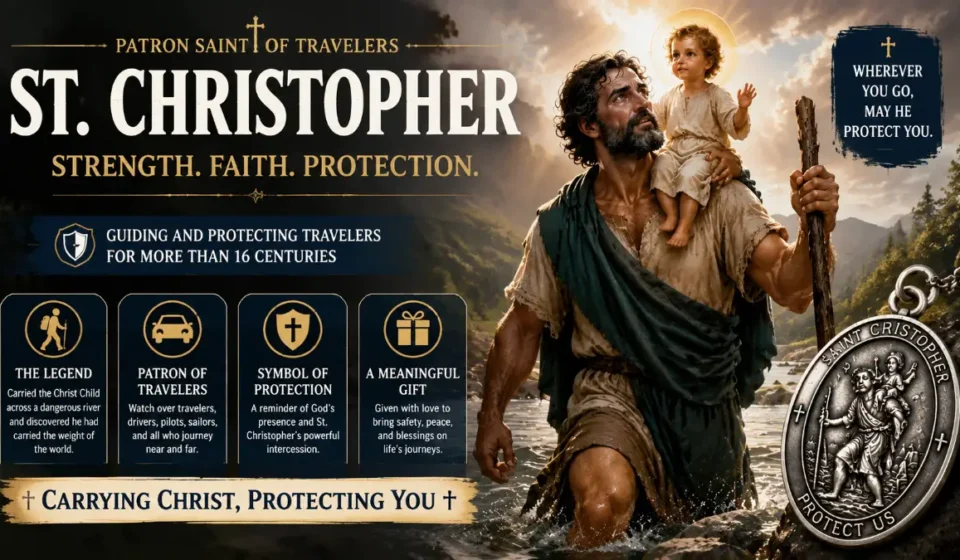

St. Christopher surviving Roman document names him. No contemporary account describes his martyrdom. And yet St. Christopher remains one of the most recognized and widely venerated figures in Christian tradition, carried literally on chains around necks and clipped to car mirrors on every continent. Few religious figures illustrate the gap between historical proof and lived devotion as clearly as St. Christopher does.
This piece approaches St. Christopher the way a researcher would approach any figure caught between legend and history: by separating what can be reasonably said from what belongs to storytelling, then asking why the storytelling mattered so much that it outlasted the historical record itself. Along the way, it covers the origin of his name, the structure of his patronage, the calendar dispute that still confuses people, and the everyday rituals that keep his memory active today.
A Saint Defined by an Absence of Proof
Historians face an unusual problem with St. Christopher: there is essentially no primary-source documentation from his supposed era, the third century, describing an individual matching his story. What exists instead is a devotional tradition that grew steadily from the early Church period through the Middle Ages, culminating in the detailed narrative most people recognize today.
This absence of contemporaneous evidence does not automatically mean St. Christopher was invented from nothing. Early Christian communities frequently venerated local martyrs whose names and basic circumstances were remembered even when detailed records were not kept,
particularly during periods of persecution when documentation was dangerous or impossible. Over subsequent centuries, storytellers and religious writers filled in the biographical gaps with symbolic narrative, a common pattern in early Christian hagiography. The result is a figure who likely has some historical root, wrapped in centuries of legendary elaboration that scholars and the Catholic Church both acknowledge cannot be verified in its specifics.
The most complete and influential version of his story appears in Jacobus de Voragine’s The Golden Legend, compiled in the 13th century, roughly a thousand years after Christopher’s supposed lifetime. That gap alone explains much of the uncertainty historians raise.
Three Movements of a Single Legend
The Christopher narrative unfolds in three distinct stages, each carrying its own theological weight.
Searching for a Master Worth Serving
The legend begins not with Christopher but with a man named Reprobus, later called Offerus, a figure of unusual size and physical strength. Dissatisfied with serving anyone less than the greatest power in existence, Offerus worked his way through a succession of masters, a king who feared the devil, then the devil himself, who in turn feared the sight of a roadside cross. Each discovery pushed him toward a higher authority, until a hermit finally directed him toward Christ as the one master worth his devotion.
A Task Built Around His Size
Unable to fast or recite lengthy prayers as the hermit suggested, Offerus was given a different form of service: using his strength to carry travelers across a river with no bridge and a dangerous current. He accepted, settling into a simple life of ferrying strangers from one bank to the other.
The Crossing That Gave Him a New Name
The turning point arrives when a child requests passage across the river. Partway through the crossing, the child becomes progressively heavier, until Offerus struggles simply to stay upright against the current. Reaching the far shore, he learns the child was Christ, and that the crushing weight represented the burden of the world itself. From that encounter, Offerus became Christopher, a name built from the Greek Christos and phero, meaning one who carries Christ. Some tellings add that the staff he leaned on took root and grew into a tree, a detail meant to signal that the encounter produced lasting spiritual fruit.
What the Legend Is Actually Saying
Read purely as narrative, the Christopher story rewards a closer look than most casual retellings give it. The increasing weight of the child is not a physical detail meant to be taken literally; it functions as a metaphor for spiritual growth, suggesting that the closer one draws to genuine faith, the heavier and more demanding that faith becomes to carry.
The river itself represents uncertainty and risk, the kind every person eventually has to cross, literally or otherwise. Medieval audiences, largely illiterate and dependent on oral storytelling and church art for religious instruction, absorbed this theology through image and narrative rather than doctrine, which is part of why Christopher’s legend spread so widely and remained so visually consistent for centuries.
From River Guide to Universal Travel Patron
St. Christopher’s patronage did not emerge all at once. It expanded in layers, each new group adopting him as their circumstances changed.
| Era or Context | Group That Adopted His Patronage | Connection to the Original Legend |
| Medieval period | Pilgrims and foot travelers | Direct extension of river-crossing narrative |
| Age of maritime exploration | Sailors and mariners | Shared theme of crossing dangerous water |
| Early 20th century | Motorists and drivers | Automobiles replaced older travel methods needing protection |
| Mid-20th century onward | Aviators and air travelers | Informal extension as flying became common |
| 1998 to present | U.S. Army Transportation Corps | Formal military recognition through the Honorable Order of Saint Christopher |
This progression shows a pattern worth noting: Christopher’s patronage has never been static. It has consistently absorbed whatever new form of travel a given generation relies on most, which partly explains why his relevance never faded even as transportation technology changed dramatically.
Beyond travel specifically, tradition also places St. Christopher among the Fourteen Holy Helpers, a group of saints invoked for protection against particular afflictions such as sudden death, storms, and epilepsy, a devotion especially strong in medieval Germanic regions.
Read More: How Much Loose Leaf Tea Per Cup
The Medal as an Object of Popular Faith
Unlike many devotional items tied to formal liturgy, the St. Christopher medal functions primarily as a personal, portable object. Its imagery, the saint wading through water with the Christ Child on his shoulder, has remained visually consistent since medieval pilgrim badges first appeared, long before the medal became a standard car accessory in the 20th century.
Catholic teaching is clear that the medal itself holds no independent power; it operates as a devotional reminder and a request for the saint’s intercession rather than a protective charm in its own right. Even so, its cultural reach has extended well past religious practice. In 1960s California, surfers adopted the St. Christopher necklace as a personal talisman,
detached from any specific liturgical meaning, and that trend helped introduce the medal to audiences who had no particular connection to Catholicism. Today the same basic object functions simultaneously as a religious sacramental, a sentimental gift, and a piece of everyday jewelry, depending entirely on who is wearing it.
One Saint, Four Different Calendars
Christian traditions do not agree on a single date for honoring St. Christopher, a reflection of how independently Eastern and Western liturgical calendars developed over the centuries.
- Roman Catholic dioceses generally observe his memorial on July 25, though it is optional rather than mandatory following the 1969 calendar reform
- Certain German-speaking dioceses mark his feast on July 24 instead
- The Eastern Orthodox Church commemorates him on May 9, a completely separate date from the Western tradition
- The Coptic Church observes his feast on 2 Parmouti, following its own liturgical calendar structure
These differences are not contradictions to be resolved; they simply reflect how separately each tradition preserved and organized its own veneration of Christopher over the centuries.
Why 1969 Still Generates Confusion
The Second Vatican Council’s liturgical reforms prompted a 1969 revision of the General Roman Calendar, during which several saints with limited historical documentation, St. Christopher among them, were shifted from the universal, obligatory calendar to an optional, local one. This administrative change is frequently misinterpreted as the Vatican declaring Christopher fictional or removing him from sainthood altogether. Neither claim is accurate.
What actually happened was narrower: Christopher’s feast stopped being a mandatory observance across the entire Church and instead became something individual dioceses could choose to keep. July 25 became primarily associated with the Feast of St. James the Greater on the universal calendar, while Christopher’s memorial persisted as a permitted local option, which many dioceses and parishes still observe. He was never stripped of canonization, and formal Church teaching continues to permit and even encourage devotion to him as patron of travelers.
How the Devotion Survives in Daily Life
St. Christopher’s continued relevance owes less to formal liturgy than to small, repeated personal habits that keep his memory active outside church settings entirely.
Travelers commonly recite a brief, informal prayer asking for St. Christopher’s protection before setting out on a journey, with no fixed wording required by the Church. Parents and grandparents frequently give St. Christopher medals to new drivers, students moving away from home, or family members departing on long trips, treating the object as both a spiritual gesture and an emotional keepsake.
Sailors and long-distance travelers have historically chosen tattoos depicting the saint as a permanent, personal marker of protection, a practice that predates and outlasts most temporary trends in religious jewelry. Meanwhile, institutional recognition, such as the U.S. Army Transportation Corps’ formal honor established in his name, shows that new, secular-adjacent expressions of his patronage can still emerge centuries after the original legend was first written down.
Frequently Asked Questions
Is there any archaeological or written evidence proving St. Christopher existed?
No document or archaeological find from the third century confirms a specific historical individual matching the detailed legend. Most historians believe the veneration likely grew around a real early martyr whose actual biography was later expanded with symbolic and legendary detail, a common pattern for saints from that period whose records were lost or never formally kept.
Why does the legend describe Christopher as a giant specifically?
His unusual size serves a narrative purpose: it establishes him as uniquely capable of carrying travelers across a dangerous river, setting up the pivotal moment when even his great strength is tested by the weight of the Christ Child. The physical detail reinforces the story’s central theme about the true weight of faith and service.
Does the Catholic Church still allow public veneration of St. Christopher?
Yes. Removing his feast from the universal calendar in 1969 did not restrict private or parish-level veneration. Many dioceses continue to observe his memorial locally, and Catholics remain free to pray for his intercession and display his image without restriction.
What is the theological significance of the child growing heavier during the crossing?
The increasing weight is generally interpreted as a symbol of spiritual growth, suggesting that as a person draws closer to genuine faith, the responsibility and weight of that faith intensifies rather than lightens. It reframes physical struggle in the story as a spiritual lesson about the cost of true devotion.
How does St. Christopher’s patronage compare to that of other travel saints?
Compared to other saints associated with specific forms of travel, Christopher’s patronage is unusually broad, spanning pilgrims, sailors, motorists, aviators, and even a formally recognized military transportation honor. This breadth traces directly back to the core legend being about the physical act of carrying someone through danger, a theme flexible enough to apply to almost any mode of travel.
Did the St. Christopher medal originate as a car accessory?
No. The medal tradition predates automobiles by several centuries, beginning with pilgrim badges in the late Middle Ages. Its association with cars only developed in the early 20th century as automobiles became the dominant travel method, extending an already established devotional custom rather than creating a new one.
Why do the Eastern Orthodox and Catholic traditions honor St. Christopher on different dates?
The two traditions developed their liturgical calendars independently over centuries, resulting in separate commemoration dates, May 9 for the Eastern Orthodox Church and July 25 for most Roman Catholic dioceses. This reflects broader historical divergence between Eastern and Western Christian calendar systems rather than any disagreement about Christopher’s identity or status.
Is wearing a St. Christopher medal considered a superstition rather than genuine faith?
Catholic teaching distinguishes clearly between sacramentals, objects that support and express faith, and superstition, which attributes independent power to an object itself. The medal is intended as a devotional reminder and request for intercession rather than a good-luck charm, though its meaning can vary for individuals who wear it without a specific religious framework.
What happened to the U.S. military connection to St. Christopher, and is it still active?
The U.S. Army Transportation Corps established the Honorable Order of Saint Christopher in 1998 as a recognition awarded to individuals for distinguished service within that branch. This remains an active honor, illustrating how his patronage of travelers and transportation has continued generating new, formally recognized expressions well into modern institutional life.
Can the St. Christopher legend be found in any form outside Western Christianity?
Eastern Christian traditions include their own versions of the Christopher narrative with some differing details, separate from the Western account popularized by The Golden Legend. While the core symbolism around carrying and protection remains consistent, the specific details and commemorative practices developed independently within Eastern Christianity.