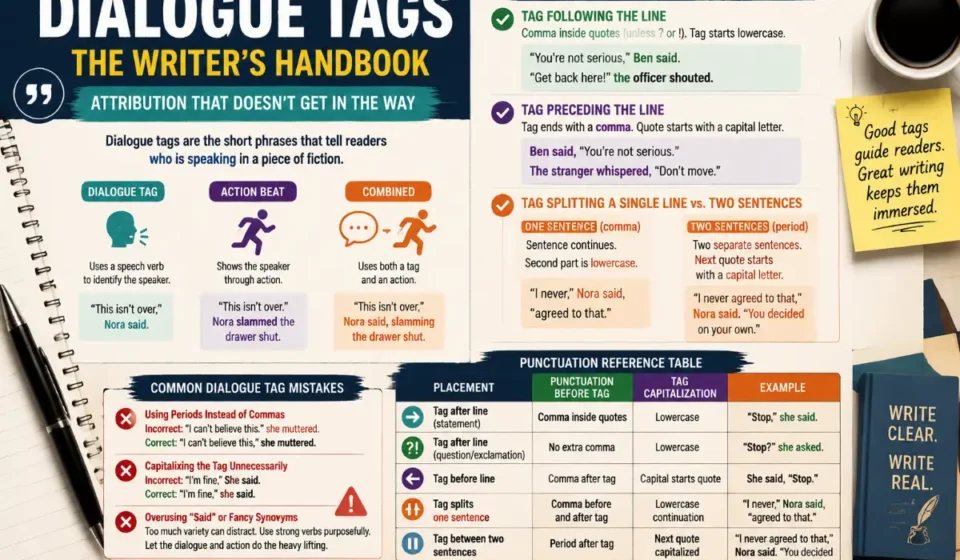

Most readers never consciously notice a dialogue tag. That’s the whole point. The moment they do notice-because a tag reads oddly, breaks a punctuation pattern, or repeats too often-the illusion of a live conversation cracks, and they’re reminded they’re reading a manuscript instead of overhearing two people talk. This handbook breaks down what dialogue tags are, how to punctuate them across every placement, where beginner writers typically go wrong, and how to build a working vocabulary of alternatives to “said” that doesn’t feel like a thesaurus exercise.
Note on scope: These are widely followed conventions for quoted dialogue in fiction written in English. Specific publishers and editors sometimes apply house-style variations, so treat the rules here as strong defaults rather than fixed law.
The Problem Dialogue Tags Actually Solve
Picture a scene with two characters arguing over a phone call, written entirely without attribution:
“You can’t just leave.”
“I already did.”
“That’s not what we agreed on.”
Without any tag or beat, a reader dropped into the middle of this scene can’t confirm which character opens the exchange or how many people are actually speaking. Dialogue attribution-delivered through a tag, an action, or sometimes nothing at all once a rhythm is set-exists to remove that friction before it interrupts the reading experience. Understanding dialogue attribution is really about understanding when a reader needs help and when they don’t.
What Is a Dialogue Tag, Exactly?
A dialogue tag combines a subject with a speech-related verb to identify a speaker: Nora said, the officer asked, Ben muttered. That’s the entire job description. Anything beyond speaker identification-implied volume, emotion, or manner-is a secondary detail riding along with the verb choice, not the tag’s core purpose.
It’s worth separating three tools writers use for attribution, because conflating them causes most punctuation errors:
- Dialogue tag: “This isn’t over,” Nora said.
- Action beat: “This isn’t over.” Nora slammed the drawer shut.
- No attribution at all: relying purely on established speaker order in a fast exchange.
A fourth, less obvious option is combining a tag and a beat in the same line: “This isn’t over,” Nora said, slamming the drawer shut. Writers who lean on only one of these tools for an entire scene tend to produce dialogue that feels either flat (all tags) or overly choreographed (all beats).
Punctuation Across Every Tag Placement
Where a tag sits relative to the quoted line changes both the punctuation and the rhythm of the sentence. There are three placements to master, and it’s easiest to start with the one that trips writers up most often.
Tag Splitting a Single Line
When a tag interrupts one continuous sentence of dialogue, the portion after the tag continues in lowercase, because grammatically the sentence never actually ended:
“I never,” Nora said, “agreed to that.”
Compare this to a tag placed between two separate, complete sentences. Here, the tag closes with a period instead of a comma, and the next quoted sentence restarts with a capital letter:
“I never agreed to that,” Nora said. “You decided on your own.”
These two structures look almost identical at a glance, but mixing up the comma/period and the capitalization is one of the most frequent dialogue tag examples of an error that slips past a first draft unnoticed.
Tag Following the Line
This is the most common placement in fiction, since it lets the reader absorb the dialogue before learning who said it:
“You’re not serious,” Ben said.
“Get back here!” the officer shouted.
The quoted line ends in a comma rather than a period (unless it’s a question or exclamation), and the tag that follows starts lowercase.
Tag Preceding the Line
Placing the tag first shifts a small amount of emphasis onto the speaker before the reader hears what they say-useful for introducing a new or unexpected voice:
Ben said, “You’re not serious.”
The stranger whispered, “Don’t move.”
The tag ends in a comma, and the quoted dialogue that follows starts with a capital letter.
Punctuation Reference Table
| Placement | Punctuation Before Tag | Tag Capitalization | Example |
| Tag after line (statement) | Comma inside quotes | Lowercase | “Stop,” she said. |
| Tag after line (question/exclamation) | No extra comma | Lowercase | “Stop?” she asked. |
| Tag before line | Comma after tag | Capital starts quote | She said, “Stop.” |
| Tag splits one sentence | Comma before and after tag | Lowercase continuation | “Stop,” she said, “right there.” |
| Tag between two sentences | Period after tag | Capital starts new sentence | “Stop,” she said. “Right there.” |
Choosing Between “Said” and Its Alternatives
There’s a recurring debate among writers about whether “said” is a lazy default or a genuinely useful tool. In practice, “said” carries almost no interpretive weight of its own, which is exactly why many fiction-writing guides treat it as a safe, low-friction choice rather than something to avoid. The more useful question isn’t whether “said” is acceptable-it almost always is-but whether an alternative verb is adding real information or just decorating the sentence.
When an Alternative Genuinely Helps
- The reader needs volume information they can’t infer from context: whispered, shouted, bellowed.
- The manner of delivery changes the meaning of the line: stammered (halting), drawled (slow and deliberate).
- The scene has already established a tone that a plain “said” would undersell, such as a hushed confrontation calling for murmured.
When an Alternative Just Adds Noise
If a line already reads as a question on the page, tagging it doesn’t need reinforcing. If the surrounding action already shows a character trembling with anger, stacking an emotionally loaded verb on top of an adverb-she snarled furiously-doubles up on information the reader already has.
A Tone-Based Vocabulary, Not Just a Synonym List
Rather than memorizing an alphabetical list of said-alternatives, it helps to think about which verbs suit a scene’s emotional register:
| Scene Register | Fitting Attribution Verbs | Why It Works |
| Escalating conflict | snapped, demanded, growled | Signals rising tension without extra adverbs |
| Quiet or intimate | murmured, said softly, breathed | Matches reduced volume naturally |
| High-speed action | called out, shouted, said (kept brief) | Speed matters more than nuance |
| Light or comedic | said, deadpanned, quipped | Overly dramatic verbs undercut comic timing |
| Formal or professional | said, replied, stated | Neutral tags suit measured speech |
| Nervous or hesitant | stammered, trailed off | Reflects disrupted speech patterns |
This kind of register-based thinking tends to produce more natural results than reaching for a thesaurus mid-draft, because it starts from what the scene needs rather than which word hasn’t appeared yet on the page.
Read More: Secretiii
A Note on Borderline Verbs Like “Laughed” and “Sighed”
Some verbs sit in a gray zone between speech and action. Laughed and sighed both carry dictionary senses connected directly to speech-laugh can mean “to utter with a laugh,” and sighed is commonly paired with a quoted line delivered on an exhale. That means a construction like “No,” she laughed isn’t a grammar violation, despite what some style advice implies.
That said, plenty of editors still prefer treating these as separate action beats-“No.” She laughed-or combining them with a neutral tag: “No,” she said, laughing. Neither approach is objectively “correct”, it’s a matter of rhythm and editorial taste rather than fixed grammar. Verbs that describe purely physical actions with no speech-related meaning at all-nodded, shrugged, grinned-don’t have this flexibility and generally read better as standalone beats.
Attribution Mistakes Worth Catching in Revision
Treating a Tag Like a New Sentence
Writing “I’m done here.” Jordan said breaks the tag off as though it were unrelated to the dialogue. It should carry forward with a comma: “I’m done here,” Jordan said.
Capitalizing a Pronoun After a Comma
“Sit down,” He said mistakenly treats the pronoun as if it were a proper noun. It should read “Sit down,” he said.
Doubling Up Emotion
“Get away from me,” Grace snapped angrily layers an adverb onto a verb that already implies tone, which reads as redundant rather than emphatic. Choosing one-either the verb or a supporting beat-usually reads cleaner.
Tagging Every Single Line
In an established two-person exchange, tagging every line slows the read without adding clarity. A tag every few lines, supplemented occasionally by beats, generally reads more naturally than constant attribution once the pattern is set.
Attribution in Scenes With Three or More Speakers
Group conversations remove the shortcut of simple alternation, since a reader can no longer assume who’s next just from turn-taking. Compare these two versions of the same exchange:
Hard to follow: “We need an answer by Friday.” “That’s not enough time.” “It never is.” “Then we start without her.”
Four lines, no attribution-there’s no reliable way to sort out who’s speaking.
Clearer:
“We need an answer by Friday,” Lena said.
Marcus shook his head. “That’s not enough time.”
“It never is,” Grace muttered.
“Then we start without her.” Lena was already reaching for her coat.
Tags and beats alternate here to keep each speaker distinct without over-tagging every single line-striking a balance that group scenes usually need.
A Self-Editing Pass for Dialogue Tags
Rather than second-guessing attribution while drafting, most writers find it faster to run a dedicated revision pass once a scene is finished:
- Read the scene aloud and mark any spot where you had to pause to figure out who was talking.
- Check every mid-sentence tag for correct capitalization, based on whether it splits one sentence or separates two.
- Flag any purely physical verb (nodded, grinned, shrugged) used as a tag, and decide whether it should move to its own action beat.
- Search for adverbs riding along with tags, and test whether the sentence still works without them.
- Count consecutive tagged lines in two-person scenes, and trim tags once the speaker pattern is obvious.
- In scenes with three-plus speakers, confirm every speaker change is marked by either a tag or an unmistakable beat.
Frequently Asked Questions
What’s the simplest way to explain what dialogue tags are to a new writer?
A dialogue tag is a short phrase that names who’s speaking, built from a subject and a speech verb, such as Nora said or the officer asked. Its main job is identifying the speaker, anything beyond that-implied tone, volume, or emotion-is extra information some verbs carry and others don’t.
Do dialogue tags need to appear in every line of a conversation?
No. Once a two-person exchange establishes a clear back-and-forth pattern, readers can usually follow several unattributed lines without confusion. Tags and beats matter more when a new speaker enters, when the pattern breaks, or when a line’s tone could be read more than one way without attribution.
Is there a rule about how many words should separate two dialogue tags in the same scene?
There’s no fixed word-count rule. The better guideline is rhythm-based: tag or beat a line whenever a reader might otherwise lose track of who’s speaking, and skip attribution when the pattern is already obvious. Reading the scene aloud is usually the fastest way to judge whether attribution is too sparse or too frequent.
Why do some writing guides warn against words like “chuckled” or “giggled” as tags?
These verbs describe physical or vocal reactions rather than standard speech delivery, so pairing them directly with a quoted line can read oddly to some editors, even though it appears in published fiction. Splitting them into a separate action beat, or combining them with a neutral tag like “said,” is often considered a cleaner alternative, though it remains a stylistic choice rather than a strict grammatical requirement.
How should dialogue tags be handled when a character is interrupted mid-sentence by another character?
Interruptions are typically shown with an em dash inside the quotation marks rather than a comma, since the sentence is cut off rather than continuing naturally: “I was just about to-” “Don’t.” The attribution, if used, usually follows the interrupted line as a standard tag or beat.
Can a dialogue tag reveal information about a character’s personality over time?
Indirectly, yes, but the tag verb alone isn’t doing the heavy lifting-dialogue content, sentence rhythm, and surrounding beats matter more. A character consistently shown with clipped dialogue and minimal tagging will read differently from one whose lines are frequently interrupted or hedged, but that impression comes from the writing as a whole rather than from repeating one particular verb.
Should dialogue tags in dialogue-heavy genre fiction differ from tags in literary fiction?
Genre fiction with fast pacing-thrillers, action-driven plots-tends to favor short, minimal tags like “said” or “shouted” to keep momentum. Literary fiction sometimes allows more varied or unconventional attribution as a stylistic choice, though even there, unusual verbs risk drawing attention to the mechanics of the prose rather than the story if overused.
Is it acceptable to use present-tense verbs for dialogue tags in a past-tense story?
No, tag verbs should match the narrative’s overall tense. A past-tense story uses “she said,” not “she says,” even if the surrounding sentence structure varies. Writers switching between chapters or timelines with different tenses should specifically double-check that dialogue tags match the tense of the surrounding narration.
Do question marks or exclamation points ever get replaced by a comma before a dialogue tag?
No. Question marks and exclamation points inside the quotation marks stay exactly as written, no comma is added after them. The tag that follows still starts lowercase, since it’s grammatically part of the same sentence: “Are you leaving?” she asked.
What’s a quick way to catch dialogue tag punctuation errors during a self-edit?
Search specifically for dialogue lines followed by a period and then a lowercase pronoun-based tag, since that combination usually signals a missing comma-to-period conversion, such as “I’m done.” she said instead of “I’m done,” she said. This single search often catches a large share of dialogue tag punctuation mistakes across a manuscript.