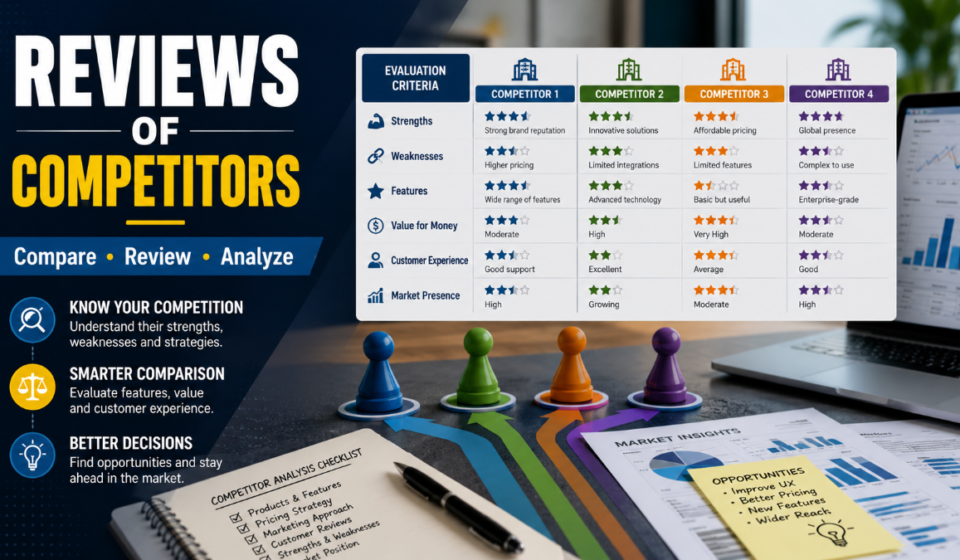

Reviews of competitors are customer ratings, comments, and feedback about businesses competing for the same buyers. Analyzing them helps you identify what customers value, where rivals create friction, what causes customers to switch, and which opportunities your business can credibly address.
The process is straightforward: collect recent feedback, segment the evidence, code themes, compare competitors, validate patterns, prioritize gaps, take action, and monitor changes.
What Competitor Reviews Reveal
Customer feedback shows how people experience a competitor after buying, using the product, receiving delivery, completing onboarding, or seeking support. It can expose the gap between a company’s marketing promise and the customer experience described publicly.
Reviews should inform competitive intelligence, not replace it. Use them alongside customer interviews, win-loss research, sales-call analysis, support data, product research, and pricing research for important decisions.
| Review signal | What it may reveal | Potential use |
| Repeated praise | A true strength or table-stakes expectation | Positioning, product priorities, and service standards |
| Repeated complaint | Customer friction or an unmet need | Customer experience, onboarding, support, or pricing improvements |
| Mixed feedback | A strength paired with a trade-off | Sales messaging and differentiation |
| Feature request | A possible workflow or product gap | Customer research and roadmap validation |
| Switching language | Why customers leave or evaluate alternatives | Retention and acquisition strategy |
| Competitor response | How a business handles visible dissatisfaction | Support and reputation benchmarking |
| Review velocity | How quickly new reviews accumulate | Monitoring changes in customer activity or feedback volume |
Feature-level review analysis can provide more useful competitive insight than average star ratings alone because it separates feedback about attributes such as usability, support, pricing, and onboarding.
What to look for by rating
| Rating range | What to investigate |
| 1–2 stars | Serious failures, trust breakdowns, unmet expectations, unresolved support or delivery issues |
| 3 stars | Trade-offs, partial satisfaction, and specific areas for improvement |
| 4 stars | Strong value with remaining friction or unmet expectations |
| 5 stars | Desired outcomes, differentiators, and language customers use to describe value |
Do not focus only on negative feedback. High-rated reviews can reveal table-stakes expectations, while three- and four-star reviews often explain the trade-offs that create switching opportunities.
Read More: Chitlins
Where to Find Competitor Reviews
Find customer feedback where your target audience researches, compares, buys, uses, and discusses solutions.
| Business type | Review sources | Most useful signals |
| Local business | Google Maps, local directories, Yelp, Facebook, trade directories | Service, staff, location, wait times, issue recovery |
| B2B software | G2, Capterra, TrustRadius, Gartner Peer Insights, product communities | Onboarding, usability, integrations, support, ROI, pricing |
| Ecommerce | Retailer sites, marketplaces, product reviews, Trustpilot | Product quality, delivery, returns, packaging, value |
| Mobile apps | Apple App Store, Google Play, app marketplaces, communities | Bugs, UX, feature requests, performance, subscriptions |
| Agencies | Google, Clutch, specialist directories, professional communities | Communication, expertise, outcomes, timelines |
| Hospitality | Google, Tripadvisor, booking sites, travel marketplaces | Cleanliness, booking, service, facilities, recovery |
Platform-specific limitations
A local-service review, a B2B software review, and an ecommerce review do not carry the same context. Treat each platform as a different evidence source, not as an interchangeable pool of customer sentiment.
| Source | Strongest signal | Main limitation |
| Google reviews | Location-specific service experience | May reflect a branch, region, or individual staff interaction |
| B2B review platforms | Product use, onboarding, features, and support | Reviewer mix may not represent every customer segment |
| Retail and marketplace reviews | Product quality, fulfillment, returns, and value | Product, seller, and delivery issues can overlap |
| App stores | Mobile UX, bugs, releases, and subscriptions | Feedback may reflect a specific device or app version |
| Communities and forums | Detailed language, alternatives, and objections | Self-selected and often anecdotal feedback |
Use several relevant sources where possible. A theme that recurs across platforms and customer types is generally more useful than a single isolated complaint.
How to Analyze Competitor Reviews
Use this process to turn public feedback into an organized, repeatable competitor-review workflow.
1. Define the business question
Start with a decision, not a broad instruction to “analyze competitors.”
Examples include:
- Why are buyers choosing a rival?
- What onboarding frustrations can we prevent?
- Which pricing objections should sales address?
- What causes customers to switch?
- Which category expectations are becoming table stakes?
- Which service standard could differentiate us?
A focused question determines which competitors, platforms, segments, and review themes matter.
2. Select relevant competitors
Choose three to five businesses that compete for the same customer, use case, location, or budget.
Include direct competitors first. Add indirect alternatives, emerging rivals, or aspirational brands only when they affect how customers evaluate your offer.
A smaller competitor may be more strategically relevant than a market leader if it frequently appears in sales conversations, local search results, marketplaces, or customer interviews.
3. Collect an initial review sample
For a small manual audit, begin with a defined convenience sample, such as 20 to 30 recent reviews per competitor. This is an operational starting point—not a statistically representative standard.
Expand the sample when:
- New themes continue to emerge.
- Key customer segments are missing.
- Reviews differ by location, product, service, or plan.
- Competitors have high and varied review volume.
- The decision has substantial commercial or operational impact.
- The early findings remain inconsistent.
Capture positive, negative, mixed, and neutral feedback. Three- and four-star reviews are often particularly valuable because they explain what customers liked and what prevented a better experience.
4. Segment and code the feedback
Treat each meaningful topic within a review as a separate observation.
Review → Topic → Sentiment → Severity → Customer segment → Evidence → Validation → Opportunity → Action → KPI
| Code | Practical rule |
| Positive | Explicit praise of a specific attribute |
| Negative | Explicit dissatisfaction with a specific attribute |
| Mixed | Positive and negative feedback about the same topic |
| Neutral | Descriptive observation without a clear judgment |
| Low severity | Minor inconvenience with limited effect on the outcome |
| Medium severity | Friction affecting satisfaction, time, or perceived value |
| High severity | Problem affecting purchase, trust, adoption, retention, or the intended outcome |
| Product issue | Feature, quality, usability, reliability, or performance problem |
| Service issue | Support, delivery, onboarding, billing, communication, or staff problem |
Illustrative coding example
“The reporting is useful, but setup took longer than expected and support replies were slow.”
| Topic | Sentiment | Severity | Type |
| Reporting | Positive | Low | Product |
| Setup | Negative | High | Onboarding |
| Support response | Negative | Medium | Service |
5. Identify switching triggers
Switching triggers are the experiences or unmet expectations that make customers consider another option.
Search reviews for language such as:
- “I switched because…”
- “The deal breaker was…”
- “I expected…”
- “I would stay if…”
- “For the price, I needed…”
- “I wish I had chosen…”
| Question | Why it matters |
| Why did customers switch? | Identifies possible competitor friction |
| Why did customers stay? | Reveals retention drivers and strengths to respect |
| What disappointed them? | Shows where expectations failed |
| What did they expect? | Reveals purchase criteria and category standards |
6. Measure review volume and velocity
Review volume is the number of reviews collected during a defined period. Review velocity is how quickly new reviews are accumulating during that period.
Review velocity does not measure sentiment by itself. Track it with average rating, negative-topic share, complaint frequency, and major themes to understand whether customer feedback is changing.
| Period | New reviews | Average rating | Negative-topic rate | Main complaint |
| Last 30 days | ||||
| Days 31–60 | ||||
| Days 61–90 |
7. Analyze competitor responses
Public responses can indicate whether a competitor acknowledges concerns, takes ownership, and gives customers a practical path to resolution.
Use these working definitions:
- Response rate: Public responses divided by reviews eligible for a public response.
- Recurrence: Repeated complaints about the same topic within the selected period.
- Resolution direction: Whether a response provides a relevant next step, escalation route, or remedy.
| Response factor | Low | Medium | High |
| Response rate | Rarely responds | Responds selectively | Responds consistently |
| Personalization | Generic reply | Some specific context | Directly addresses the issue |
| Ownership | Defensive or vague | Acknowledges concern | Takes responsibility and gives next steps |
| Resolution direction | No clear path | Invites further contact | Offers a relevant route to resolution |
| Recurrence | Same issue persists often | Mixed pattern | Fewer repeated complaints over time |
Use this as a comparison framework, not as a definitive judgment of a competitor’s customer service.
8. Compare competitors with a scorecard
Use whole-number scores from 1 to 5 unless you have a clearly documented formula for decimal scoring.
| Factor | Competitor A | Competitor B | Competitor C | Your business |
| Product or service quality | 4 | 5 | 3 | 4 |
| Ease of use | 3 | 4 | 3 | 5 |
| Onboarding | 2 | 4 | 3 | 4 |
| Support experience | 2 | 5 | 3 | 5 |
| Pricing clarity | 3 | 5 | 3 | 4 |
| Response quality | 3 | 5 | 2 | 4 |
Define the scoring system before using it:
- 1: Strong, repeated negative evidence.
- 2: More negative than positive evidence.
- 3: Mixed or insufficiently differentiated evidence.
- 4: More positive than negative evidence.
- 5: Strong, repeated positive evidence.
Every score should link back to a defined review period, coded observations, and a confidence level.
Category Gap or Competitor Gap?
A complaint can signal a problem unique to one rival, a category-wide pain point, or an issue your own business also needs to solve.
| Finding | Interpretation | Recommended response |
| Only one competitor receives recurring complaints | Competitor-specific gap | Assess whether you can differentiate credibly |
| Several competitors receive the same complaint | Category-wide pain point | Build a better solution or clearer customer education |
| Customers praise all competitors for the same attribute | Table-stakes expectation | Match the standard before positioning around other differences |
| Only one competitor receives repeated praise | Potential differentiator | Decide whether to match, exceed, or avoid competing on it |
| Your customers report the same issue | Not a credible differentiation opportunity | Improve your own experience first |
This distinction prevents a team from mistaking a category problem for a unique competitive advantage.
A Practical Review Gap Matrix
Use this framework to prioritize which patterns deserve action. It is a practical decision tool, not a standardized research metric.
Gap priority = Frequency × Severity × Recency × Audience Relevance × Competitor Concentration × Addressability
| Factor | Question |
| Frequency | How often does the theme appear? |
| Severity | How strongly does it affect trust, purchase, use, or retention? |
| Recency | Is the pattern visible in the current review period? |
| Audience relevance | Does it matter to the segment you want to win? |
| Competitor concentration | Is the issue isolated to one rival or shared across the category? |
| Addressability | Can your business realistically solve or improve it? |
A theme concentrated in one competitor may create a direct positioning opportunity. A theme repeated across the category may reveal a broader unmet need. Use the score to decide what to validate next, not as proof that an investment should automatically be approved.
Tools for Competitor Review Analysis
| Use case | Best approach | Typical workflow |
| Small manual audit | Spreadsheet | Collect, code, compare, and link source evidence |
| Local reputation research | Maps and reputation-monitoring tools | Track locations, ratings, responses, and service themes |
| SaaS review research | B2B review sites, communities, product marketplaces | Analyze onboarding, support, features, integrations, and ROI |
| Ecommerce research | Marketplace and retailer reviews | Track product, fulfillment, returns, and quality complaints |
| Mobile-app research | App stores and review exports | Identify bugs, UX friction, and feature requests |
| High-volume research | Approved exports, APIs, and text-analysis tools | Clean, classify, cluster, validate, and monitor themes |
| Cross-functional intelligence | Competitive-intelligence platforms | Share findings across product, sales, marketing, and support |
Automation can speed up collection, coding, and theme clustering. Human review remains important for high-impact findings, mixed sentiment, sarcasm, technical language, and context-sensitive complaints.
Illustrative Example: How the Method Works
A software company wants to understand why prospects compare it with three alternatives. Its team gathers a defined initial sample of recent customer feedback from relevant B2B review platforms and communities.
After coding the feedback, the team sees the following patterns:
| Theme | Competitor A | Competitor B | Competitor C | Initial interpretation |
| Onboarding | Delays mentioned repeatedly | Mostly positive | Mixed feedback | Possible category pain point |
| Support | Repeated slow-response complaints | Strongly positive feedback | Mixed feedback | Potential gap if validated |
| Pricing | Add-on confusion | Clear-pricing praise | Value concerns | Messaging opportunity |
| Ease of use | Positive feedback | Positive feedback | Learning-curve complaints | Competitor-specific friction |
| Reporting | Frequently praised | Frequently praised | Mentioned occasionally | Likely table-stakes expectation |
The team should not conclude that one competitor has poor support or that its own product is easier to use. It should validate patterns through sales-call objections, win-loss interviews, its own customer data, and additional feedback where needed.
If the support and onboarding patterns persist, the company could publish a clearer implementation timeline, define response standards, explain pricing boundaries earlier, and measure the effect on activation, conversion, customer satisfaction, and win rate.
Limitations and Ethical Use
Reviews are useful evidence, but they do not independently prove competitor performance, retention, market share, financial health, or customer intent.
Avoid conclusions such as:
- “The competitor has bad support.”
- “Customers hate its pricing.”
- “We are objectively better.”
- “This feature must be built.”
- “The competitor is losing customers.”
Public feedback can also be affected by fake or misleading reviews, incentives, moderation differences, self-selection, and unequal customer populations. Regulatory guidance addresses deceptive review practices and emphasizes authentic feedback and transparent treatment of incentives.
Keep source references, follow platform rules, distinguish opinion from verified fact, and use findings as hypotheses to validate rather than claims to publish without support.
Competitor Review Analysis Template
| Competitor | Platform | Date | Rating | Segment | Topic | Sentiment | Severity | Switching trigger | Evidence reference | Response quality | Confidence | Gap priority | Action | KPI |
Frequently Asked Questions
What are reviews of competitors?
Reviews of competitors are customer ratings, written comments, and public feedback about businesses that serve a similar market, solve the same problem, or compete for the same buyer. They can reveal customer expectations, competitor strengths, recurring frustrations, and possible reasons people switch. Use them to improve your product, service, positioning, and sales process. They should not be treated as proof of market-wide conclusions or as a basis for unsupported claims about rival businesses.
Where can I find competitor reviews?
Look where your target customers research and discuss options. Local businesses should review maps listings, directories, and service-review platforms. SaaS teams can use B2B review platforms, app marketplaces, communities, and forums. Ecommerce brands can examine retailer sites, marketplaces, product reviews, and trust platforms. Mobile-app teams should prioritize app-store feedback. Use more than one relevant source because each platform attracts different reviewers and captures different parts of the customer journey.
How many reviews should I analyze?
Begin with a defined initial sample, such as 20 to 30 recent reviews per competitor for a small manual audit. This is not a statistically representative requirement. Expand the sample if new themes continue to emerge, key segments are missing, or feedback differs across products, plans, locations, or time periods. Review positive, negative, and mixed feedback. The appropriate sample size depends on the decision, review volume, customer diversity, and whether the evidence becomes stable enough to support an informed next step.
What are switching triggers in competitor reviews?
Switching triggers are experiences or unmet expectations that make customers consider an alternative. They may include confusing pricing, difficult onboarding, poor support, unreliable performance, weak communication, or a mismatch between promised and delivered value. Look for phrases such as “I switched because,” “the deal breaker was,” “I expected,” or “I would stay if.” These signals can inform customer-retention strategy, acquisition messaging, product research, sales enablement, and service improvements.
How do I compare competitors using reviews?
Use the same review period, coding rules, topic categories, and scoring definitions for every competitor. Record the platform, date, rating, customer segment, topic, sentiment, severity, evidence reference, and response quality. Then compare competitors through a scorecard covering factors such as quality, usability, onboarding, support, pricing clarity, and response behavior. Link each score to coded evidence and assign a confidence level. Do not compare raw ratings across unrelated platforms or rely on general impressions.
How can I identify unreliable competitor reviews?
Do not label a review fake based on a single clue. Treat feedback cautiously when it is vague, repetitive, unusually clustered, poorly contextualized, or unsupported by other evidence. Check available verification and incentive disclosures, keep the source reference, and look for recurring patterns across relevant review sources. Separate uncertain observations from high-confidence findings. For important decisions, corroborate public feedback through customer interviews, sales data, support trends, or other first-party evidence.
What tools can analyze competitor reviews?
A spreadsheet is often enough for a focused audit involving a few competitors. Local businesses can use map listings and reputation-monitoring tools; SaaS teams can analyze B2B review platforms, communities, and marketplaces; ecommerce brands can use retailer and marketplace reviews; and app teams can work from app-store feedback. Higher-volume work can use approved review exports, APIs, text-analysis tools, or competitive-intelligence platforms. Automation can group themes quickly, but people should validate material findings and retain source evidence.
How should I analyze competitor responses to reviews?
Assess response rate, response timing when visible, personalization, ownership, resolution direction, and complaint recurrence. Calculate response rate by dividing public responses by the reviews eligible for a response during your selected period. Look for whether replies acknowledge the specific concern and provide a relevant next step. Then check whether the same complaint continues in later feedback. Compare response practices only across similar platforms and time periods to avoid misleading conclusions.
How do I know whether a complaint is a category-wide problem?
Compare the same coded complaint across your chosen competitors. If only one rival receives repeated, recent feedback about the issue, it may be competitor-specific. If several competitors receive similar complaints, the issue may reflect a broader category pain point. If customers praise all competitors for a particular attribute, it is likely a table-stakes expectation. Also check your own customer feedback before treating any finding as a differentiator; a shared weakness is an internal improvement priority, not a positioning advantage.
How often should competitor reviews be monitored?
Monitoring frequency should match review velocity and market change. Quarterly analysis may suit businesses with moderate review volume, while fast-moving software categories, high-volume local businesses, and multi-location brands may need monthly or continuous monitoring. Reassesses after product launches, pricing changes, public service issues, market expansion, or major competitor activity. Track recent review count, average rating, negative-topic rate, and recurring themes separately so you can distinguish changes in review activity from changes in customer sentiment.