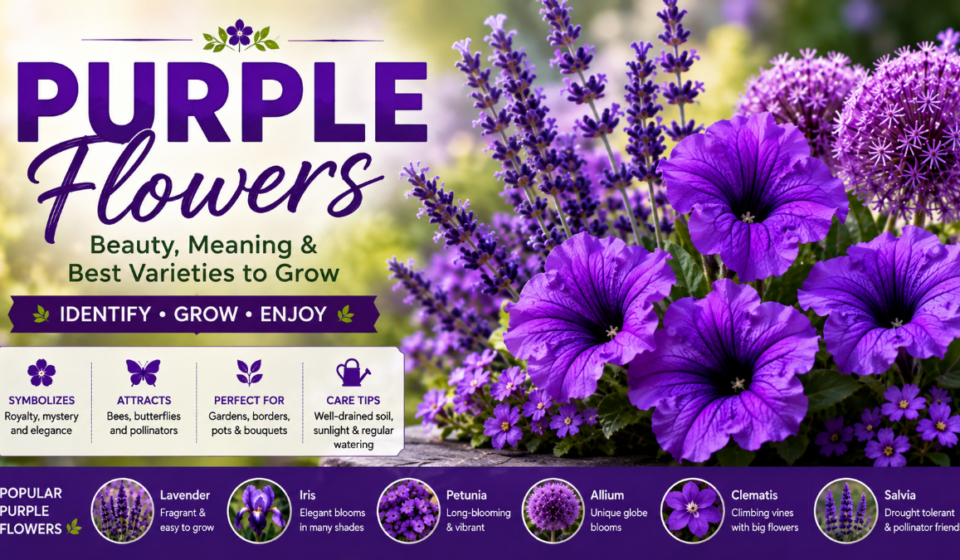

Purple flowers include annuals, perennials, bulbs, shrubs, climbers, and wildflowers in shades from pale lavender to deep violet. Popular examples include lavender, salvia, iris, allium, catmint, coneflower, asters, petunias, and lilacs, each suited to different conditions.
The best choice depends on sunlight, soil drainage, winter hardiness, mature size, and bloom season. Use this guide to identify common plants, compare growing requirements, and select varieties that fit your garden rather than simply choosing by color.
Purple Flowers at a Glance
This comparison table covers widely grown purple flowering plants. Hardiness zones are typical ranges for the species or common garden forms; always check the plant label because cultivars and local conditions can affect winter survival.
| Flower | Plant type | Typical height | Bloom season | Light | Typical USDA zones | Fragrance | Best use |
| English lavender (Lavandula angustifolia) | Woody perennial shrub | 1-3 ft | Summer | Full sun | 5-9 | Strong | Paths, dry borders, containers |
| Woodland sage (Salvia nemorosa) | Perennial | 1-3 ft | Late spring-summer | Full sun | 4-8 | Aromatic foliage | Pollinator borders |
| Catmint (Nepeta spp.) | Perennial | 1-3 ft | Late spring-autumn | Sun to light shade | 3-8 | Aromatic foliage | Edging and informal planting |
| Purple coneflower (Echinacea purpurea) | Perennial | 2-4 ft | Summer-early autumn | Full sun | 3-8 | Low | Wildlife and prairie-style gardens |
| Bearded iris (Iris germanica) | Rhizomatous perennial | 2-4 ft | Late spring | Full sun | 3-9 | Some cultivars | Sunny borders and cutting gardens |
| Ornamental allium (Allium spp.) | Bulb | 1-4 ft | Late spring-early summer | Full sun | 3-9 | Foliage is onion-scented | Structural border accents |
| Garden phlox (Phlox paniculata) | Perennial | 2-4 ft | Summer | Sun to part shade | 4-8 | Often fragrant | Cottage gardens |
| Aster (Symphyotrichum spp.) | Perennial | 1-6 ft | Late summer-autumn | Full sun | 3-8 | Low | Late-season nectar |
| Crocus (Crocus spp.) | Corm | 3-6 in | Late winter-spring | Sun to part shade | 3-8 | Low | Lawns, rock gardens, containers |
| Heliotrope (Heliotropium arborescens) | Tender perennial, often grown as an annual | 1-3 ft | Summer-frost | Full sun | 10-11 | Sweet | Summer containers |
| Petunia (Petunia hybrids) | Annual | 6-18 in | Spring-frost | Full sun | Grown as annual | Low | Pots, baskets, bedding |
| Clematis (Clematis spp.) | Climber | 3-20+ ft | Varies by type | Sun with shaded roots | Varies | Some cultivars | Trellises and fences |
| Lilac (Syringa vulgaris) | Deciduous shrub | 8-15+ ft | Spring | Full sun | 3-7 | Strong | Fragrant shrub borders |
| Caryopteris | Deciduous shrub | 2-4 ft | Late summer-autumn | Full sun | 5-9 | Aromatic foliage | Small, sunny borders |
| Russian sage (Salvia yangii) | Perennial subshrub | 3-5 ft | Summer-autumn | Full sun | 4-9 | Aromatic foliage | Hot, dry borders |
| Anise hyssop (Agastache spp.) | Perennial | 2-4 ft | Summer-autumn | Full sun | Varies | Anise-like | Pollinator planting |
| Spiked speedwell (Veronica spicata) | Perennial | 1-3 ft | Summer | Full sun | 3-8 | Low | Vertical border color |
| Creeping phlox (Phlox subulata) | Ground-cover perennial | 4-6 in | Spring | Full sun | 3-9 | Low | Slopes and rock gardens |
| Balloon flower (Platycodon grandiflorus) | Perennial | 1-3 ft | Summer | Sun to part shade | 3-8 | Low | Mixed borders |
| Scabiosa | Annual or perennial | 1-3 ft | Summer-autumn | Full sun | Varies | Low | Cutting and pollinator gardens |
English lavender is best in full sun and free-draining soil, while Salvia nemorosa generally thrives in full sun and average, dry-to-medium, well-drained soil.rhs.org+1
Quick picks by garden need
| Garden need | Good choices | Why they fit |
| Beginner-friendly | Catmint, salvia, coneflower, crocus, petunia | Reliable choices when matched to suitable conditions |
| Containers | Petunia, heliotrope, compact salvia, lavender | Manageable size and season-long impact |
| Dry, sunny gardens | Lavender, Russian sage, catmint, ornamental allium | Tolerate sunny, well-drained sites |
| Part shade | Sweet violet, hardy geranium, astilbe, hydrangea | Better adapted to reduced direct light |
| Clay soil | Aster, coneflower, hardy geranium, selected salvias | More tolerant of heavier soil if drainage is adequate |
| Fragrance | Lavender, lilac, heliotrope, sweet violet, garden phlox | Scented flowers or aromatic foliage |
| Pollinator borders | Salvia, lavender, anise hyssop, coneflower, aster | Offer flowers across multiple seasons |
| Cutting gardens | Iris, allium, phlox, delphinium, scabiosa | Distinctive blooms with useful stems |
| Small gardens | Compact salvia, catmint, crocus, dwarf iris, petunia | High impact in limited space |
| Long bloom | Catmint, salvia, petunia, heliotrope, Russian sage | Extended display with suitable care |
How to Identify Purple Flowers
Identify a purple flower by combining several clues: flower shape, leaf shape, plant height, bloom season, scent, and growth habit. A single close-up of a bloom is rarely enough for an accurate identification.
Read More: Chitlins
Flower identification by appearance
| Flower appearance | Likely plants | Distinguishing features |
| Fragrant upright spikes above silvery foliage | Lavender | Narrow gray-green leaves; woody base; compact habit |
| Soft mounds covered in small purple-blue flowers | Catmint | Scalloped aromatic leaves; loose, spreading form |
| Dense, upright spikes | Salvia or veronica | Salvia often has aromatic foliage and square stems; veronica spikes are generally denser and more tapered |
| Large daisy with a raised central cone | Purple coneflower | Prominent cone; stiff stems; broad, rough leaves |
| Perfect globe of small flowers | Ornamental allium | Spherical flower head on a leafless stalk |
| Broad flower with upright and drooping segments | Bearded iris | Sword-shaped leaves; fuzzy beard on lower petals |
| Rounded clusters of five-petaled blooms | Garden phlox | Tall stems, broad leaves, summer flowering |
| Low carpet of star-shaped flowers | Creeping phlox | Needle-like foliage; spring bloom; ground-cover habit |
| Bell-shaped or inflated buds | Bellflower or balloon flower | Bellflowers open into bells; balloon flower buds inflate before opening |
| Hanging clusters on a vigorous woody vine | Wisteria | Pea-like blooms in long, drooping racemes |
How to tell similar plants apart
Lavender vs. catmint: Lavender has narrower, grayer foliage and denser flower wands rising from a woody base. Catmint forms a softer, wider mound with broader, usually scalloped leaves and looser flowering stems.
Salvia vs. veronica: Both create vertical spikes, but salvia flowers are often arranged in spaced whorls along square stems. Veronica typically produces a tighter, more tapered spike. Veronica spicata is commonly grown in full sun and may flower from June into August, depending on selection and climate.
Garden phlox vs. creeping phlox: Garden phlox is a tall summer perennial with broad leaves and rounded flower clusters. Creeping phlox stays close to the ground, has needle-like foliage, and is primarily a spring bloomer.
Iris vs. gladiolus: Iris flowers have three upright standards and three falling petals, often with a fuzzy beard. Gladiolus flowers open along one side of a tall, sword-leaved stem.
Russian sage vs. lavender: Russian sage is taller, looser, and airier, with branching silvery stems and a haze of small blue-violet flowers. Lavender is lower, denser, woodier, and usually more fragrant.
Purple flower identification checklist
- Flower shape: Is it a globe, spike, bell, daisy, trumpet, pea flower, or flat cluster?
- Petals: Are there five distinct petals, many narrow rays, fused tubular flowers, or large divided segments?
- Leaves: Are they silver, aromatic, sword-shaped, needle-like, hairy, or broad?
- Plant habit: Is it a ground cover, clump-forming perennial, bulb, shrub, climber, or annual?
- Bloom season: Does it flower in early spring, late spring, summer, or autumn?
- Fragrance: Is the scent floral, sweet, herbal, anise-like, or onion-like?
- Height: Does it stay under 1 foot, form a medium clump, or grow into a tall screen or shrub?
For a reliable identification, photograph the flower, leaves, stem, and full plant, then note the season and location.
Purple Flowers by Plant Type
Purple annual flowers
Annuals provide quick color and are particularly useful in containers, hanging baskets, and gaps between young perennials.
- Petunias: Long-flowering plants for full-sun beds, pots, and baskets
- Heliotrope: Fragrant purple clusters for sunny containers
- Sweet peas: Scented climbing flowers for trellises and cutting gardens
- Pansies and violas: Cool-season color for containers and borders
- Annual verbena: Flower clusters for sunny pots and bedding
- Sweet alyssum: Low, scented edging plant available in violet shades
Purple perennial flowers
Perennials form the long-term structure of a garden and return for multiple seasons when hardy in the local climate.
- Lavender
- Woodland sage
- Catmint
- Purple coneflower
- Bearded iris
- Garden phlox
- Asters
- Anise hyssop
- Spiked speedwell
- Balloon flower
- Scabiosa
- Lupine
- Jacob’s ladder
- Baptisia
- Liatris
- Globe thistle
- Penstemon
Many anise hyssops and related Agastache selections make effective summer-to-autumn pollinator plants. Their hardiness varies: for example, the violet-flowered hybrid ‘Black Adder’ is commonly listed for USDA Zones 6-9 and needs full sun with very well-drained soil.
Purple bulbs, corms, and rhizomes
Bulbs and similar underground storage structures are especially useful for filling seasonal gaps before summer perennials reach full size.
- Crocus: Early flowers for lawns, rock gardens, and containers
- Ornamental allium: Spherical late-spring flower heads
- Dwarf iris: Compact spring color for sunny, well-drained sites
- Bearded iris: Large late-spring flowers from rhizomes
- Gladiolus: Tall summer spikes grown from corms
- Purple hyacinth: Fragrant spring bulbs for beds and pots
Purple flowering shrubs
Shrubs provide structure, height, fragrance, and seasonal presence. Always choose according to the mature size rather than the dimensions of a nursery plant.
- Lilac: Fragrant spring flowers on a substantial deciduous shrub
- Caryopteris: Compact, late-flowering choice for sunny sites
- Butterfly bush: Summer flower panicles; confirm local invasive-plant guidance before growing
- Rhododendron: Suitable for acidic soil and appropriate light conditions
- Hydrangea: Some cultivars produce violet or purple tones under suitable conditions
- Rose of Sharon: Summer flowers on an upright deciduous shrub
Purple climbers and vines
- Clematis: Flowers in many purple shades; pruning depends on flowering group
- Wisteria: Woody climber with cascading flower racemes; needs a strong support and regular pruning
- Sweet pea: Scented annual vine for a trellis or cutting garden
- Hyacinth bean: Ornamental warm-season climber with purple flowers and pods
Purple wildflowers and native plants
A wildflower is not necessarily native, and a native plant is not necessarily suitable everywhere. Native status depends on the exact species and your region.
Potential regionally native purple flowers may include asters, liatris, violets, penstemons, native salvias, and certain bee balms. Use a local native-plant organization, extension service, or botanical garden to confirm the right species for your location.
Growing Purple Flowers Successfully
The most effective approach is to group plants by shared needs. Lavender and Russian sage belong in a dry, sunny planting; astilbe and hydrangea usually need more dependable moisture.
Match plants to the site
Full sun with dry-to-average soil: Lavender, catmint, salvia, allium, Russian sage, coneflower, and anise hyssop are strong choices.
Full sun with moisture-retentive soil: Garden phlox, asters, delphiniums, and many veronicas are better suited to soil that does not dry excessively.
Part shade with evenly moist soil: Sweet violet, astilbe, hardy geranium, hellebore, columbine, and selected hydrangeas are useful options.
Heavy clay: Choose plants that tolerate heavier ground, avoid working wet soil, and use raised or mounded planting for species that need dry crowns. Lavender, bearded iris, and ornamental alliums are poor choices for ground that remains wet through winter.
Purple flowers by garden style
| Garden style | Purple flowers that suit it |
| Cottage garden | Garden phlox, delphinium, iris, salvia, sweet pea, scabiosa |
| Mediterranean or gravel garden | Lavender, catmint, Russian sage, allium, salvias |
| Pollinator garden | Anise hyssop, coneflower, salvia, lavender, aster, liatris |
| Woodland or part-shade garden | Sweet violet, columbine, hardy geranium, hellebore, astilbe |
| Rock garden | Crocus, creeping phlox, dwarf iris, compact bellflowers |
| Modern planting | Alliums, ornamental grasses, salvia, veronica, Russian sage |
| Cutting garden | Iris, phlox, allium, scabiosa, sweet pea, delphinium |
For pollinators, build a flowering sequence rather than relying on one plant. Early bulbs, summer salvias and coneflowers, and late asters provide flowers across much of the growing season. Flowering plants need adequate sunlight to produce the energy and nectar that support butterfly gardens.
Planting and maintenance
- Confirm mature size and hardiness. Read the label before buying and allow adequate spacing.
- Prepare soil for the plant. Improve drainage for dry-garden plants; add organic matter for plants that prefer more moisture.
- Plant at the correct depth. Bulbs, corms, rhizomes, shrubs, and container-grown perennials have different requirements.
- Water during establishment. Newly planted flowers need consistent moisture until roots spread into surrounding soil.
- Deadheads were useful. Removing spent flowers can improve appearance and encourage further bloom in catmint, petunias, some salvias, and selected veronicas.
- Divide crowded clumps. Iris, asters, and other clump-forming plants may flower less freely when congested.
- Leave selected seed heads. Coneflowers, alliums, and grasses can provide autumn structure and visual interest.
Purple flowers and pet safety
Do not assume a plant is safe because it is common in gardens or because another plant with a similar flower color is harmless. Plant toxicity depends on the exact species, the part consumed, and the animal involved.
| Plant | Safety consideration |
| Monkshood (Aconitum spp.) | Highly toxic; avoid where ingestion is possible |
| Foxglove (Digitalis spp.) | Toxic if eaten |
| Iris | Rhizomes can cause illness if ingested |
| Clematis | Sap can irritate skin; ingestion may cause problems |
| Allium | Can be harmful to dogs and cats if consumed |
| Lavender | Can be toxic to cats, dogs, and horses if ingested |
English lavender is listed as toxic to dogs, cats, and horses if consumed. If a pet or child ingests an unknown plant, contact a veterinarian, poison-control service, or medical professional promptly.aspca+1
Short horticultural glossary
- Annual: A plant that completes its life cycle in one growing season.
- Perennial: A plant that lives for multiple years in a suitable climate.
- Bulb: An underground storage structure, as in many alliums.
- Corm: A swollen underground stem, as in crocus and gladiolus.
- Rhizome: A horizontal underground stem, as in bearded iris.
- Cultivar: A named cultivated variety selected for traits such as flower color or compact growth.
- Panicle: A branched flower cluster, as on garden phlox or lilac.
- Raceme: A flower cluster arranged along a central stem, as on wisteria.
Frequently Asked Questions
What are the easiest purple flowers for beginners?
Catmint, woodland sage, purple coneflower, crocus, petunias, and hardy geraniums are dependable beginner choices. They suit different situations: crocus for early spring, petunias for containers, and catmint, salvia, or coneflower for sunny borders. The simplest plant is always one that suits the site. A lavender plant can be low-maintenance in bright, sharply drained soil but difficult in shade, wet clay, or a container without drainage.
Which purple flowers smell the best?
Lavender, lilac, heliotrope, sweet violet, sweet pea, and some garden phlox are among the most fragrant choices. Lavender provides herbal fragrance from both foliage and flowers, while heliotrope and lilac are valued primarily for their floral scent. Fragrance can vary by cultivar, weather, flower age, and time of day. Place scented flowers beside paths, entrances, patios, or seating areas so their scent can be appreciated without crowding the planting.
Which purple flowers bloom the longest?
Catmint, selected salvias, petunias, heliotrope, annual verbena, Russian sage, and some asters can offer a lengthy display. However, the most dependable way to keep color going is to combine plants with different flowering periods. Use crocus and iris for spring, lavender and coneflower for summer, and asters or caryopteris for autumn. Deadheading can extend flowering for some species, while others are best left for seed heads and seasonal structure.
Which purple flowers attract hummingbirds?
Hummingbirds often visit tubular, nectar-rich flowers. Depending on the region, suitable purple or violet choices can include salvias, penstemons, agastaches, bee balms, and some clematis. Plant several species with overlapping bloom times so nectar is available across the season. Regionally native plants are often particularly useful because they support local wildlife relationships. Avoid broad pesticide use and provide a reliable water source and shelter nearby for a more complete wildlife garden.
Which purple flowers are deer resistant?
No plant is completely deer-proof when food is scarce, but deer often avoid strongly scented, fuzzy, bitter, or prickly plants. Lavender, catmint, many salvias, Russian sage, ornamental alliums, and globe thistle are commonly less attractive to deer than tender broad-leaved plants. Local deer behavior differs, so consider resistance a tendency rather than a guarantee. Protect new plantings with barriers or repellents where browsing is common, especially during their first growing season.
Which purple flowers tolerate drought?
Lavender, catmint, Russian sage, ornamental alliums, established salvias, and many agastaches are suitable for dry, sunny sites with good drainage. Newly planted perennials still need water while roots establish, even if they are drought-tolerant later. Dry soil should not be compacted, neglected soil; prepare a planting area properly and mulch as appropriate. Avoid placing drought-adapted plants where water accumulates during winter, because wet crowns can cause decline.
Which purple flowers tolerate wet soil?
For evenly moist soil, consider astilbe, selected asters, some irises, and regionally appropriate native plants. Persistently wet ground requires more specific plant choices than ordinary moisture-retentive soil, so observe whether water drains soon after rain or remains for days. Lavender, Russian sage, bearded iris, and many ornamental alliums are poor choices for waterlogged areas because their roots and crowns need reliable drainage to remain healthy.
Are purple flowers annuals or perennials?
They can be either. Petunias, heliotropes, pansies, violas, and sweet peas are often grown as annuals, while lavender, salvia, coneflower, iris, asters, catmint, and garden phlox are usually grown as perennials. Some plants are perennial only in frost-free or mild climates and are treated as annuals in colder regions. Check the exact botanical name and hardiness information rather than relying on a broad label such as “perennial.”
How can I make a purple flower border more interesting?
Create contrast through flower form, foliage, height, and bloom timing rather than planting only similar purple tones. Combine round alliums, vertical salvias, daisy-like coneflowers, low catmint, and airy Russian sage. Add silver foliage, white flowers, chartreuse leaves, or yellow blooms to brighten the composition. Repeat a few plants through the border for unity, then arrange low growers at the front, medium perennials through the middle, and taller plants or shrubs at the back.
Can I grow purple flowers from seed?
Many varieties can be grown from seed, including sweet peas, annual larkspur, pansies, scabiosa, cosmos cultivars, lupines, columbines, and some native wildflowers. Seed is economical for filling a large space, but named hybrid cultivars may not grow true from seed. Perennials also often take longer to reach flowering size than nursery-grown plants. Follow packet guidance on timing, light, and cold treatment, and use fresh seed from a reputable supplier for better germination.