
How big is 10 cm? Ten centimeters equals approximately 3.94 inches, 100 millimeters, or 0.328 feet. It’s slightly shorter than 4 inches and measures one-tenth of a meter. To visualize this length, imagine the short side of a standard US index card, which measures 3 inches, plus nearly another inch.
Understanding centimeters is useful when measuring everyday objects, choosing products online, completing school assignments, or comparing metric measurements with US customary units.
Although 10 centimeters might sound small, seeing it alongside familiar objects makes the measurement easier to understand. Let’s explore its exact conversions, practical comparisons, and common uses.
How Big Is 10 CM in Inches, Feet, and Millimeters?
The centimeter is a metric unit of length used worldwide. One centimeter equals 10 millimeters, while 100 centimeters make one meter.
The international inch is defined as exactly 2.54 centimeters. Therefore, converting 10 centimeters to inches requires dividing 10 by 2.54.
102.54=3.937
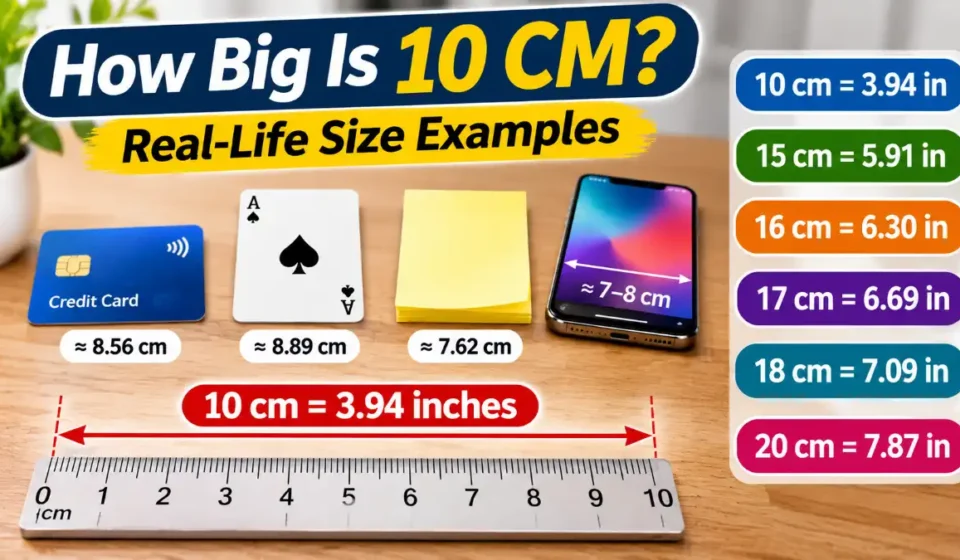
That means 10 cm is approximately 3.94 inches.
| Measurement unit | Equivalent of 10 cm |
| Inches | 3.94 inches |
| Feet | 0.328 feet |
| Millimeters | 100 mm |
| Meters | 0.1 m |
| Yards | 0.109 yards |
| Micrometers | 100,000 µm |
These conversions help when reading international product dimensions or switching between metric and imperial measurements.
For most everyday comparisons, remembering that 10 cm is almost 4 inches is enough.
7 Everyday Objects That Help You Visualize 10 CM
Comparing measurements with familiar objects is one of the simplest ways to understand length.
1. A Standard Playing Card
A typical poker-sized playing card measures approximately 8.89 cm along its longer side.
Ten centimeters is therefore about 1.11 cm longer than the card.
This makes a playing card a convenient visual reference when you don’t have a ruler nearby.
2. A Smartphone’s Width
Many modern smartphones are approximately 7–8 cm wide, although dimensions differ between models.
Ten centimeters would be noticeably wider than most standard smartphones.
Comparing the measurement with a phone can help you estimate the width of a small object.
3. A Standard Credit Card
A standard bank card measures approximately 8.56 cm long.
Ten centimeters is about 1.44 cm longer than the card’s longest side.
Because bank cards generally have standardized dimensions, they provide a useful measurement reference.
4. A Small Sticky Note
A common square sticky note measures 3 × 3 inches, or approximately 7.62 × 7.62 cm.
Ten centimeters is roughly 2.38 cm longer than one side of this note.
It’s an easy comparison for desks, notebooks, and office supplies.
5. The Diameter of a Small Bowl
Some small serving bowls have diameters around 10 cm.
A bowl of this size can help demonstrate what a 10-centimeter width looks like in a kitchen.
However, bowl dimensions vary considerably, so this is only an approximate example.
6. Four Inches on a Ruler
Four inches equals exactly 10.16 cm.
Therefore, 10 cm is only 0.16 cm shorter than 4 inches.
This is one of the most accurate and memorable comparisons because you can see both measurements on a ruler.
7. A Small Plant Pot
Some compact plant pots are approximately 10 cm across their upper opening.
This gives you a practical reference for the diameter of small household items.
Remember that a pot’s advertised size may refer to its diameter rather than its height.
How Big Is 10 CM Compared to Your Hand?
A person’s hand can provide a rough reference for estimating 10 centimeters, but hand measurements vary significantly.
For some adults, 10 cm is approximately the distance across the palm and part of the thumb area. However, it should not be treated as a universal measurement.
Children’s hands are generally smaller, so the same length may cover a larger proportion of their hands.
If accuracy matters, use a ruler or measuring tape rather than relying on finger or palm measurements.
How Big Is 15 CM?
If you’re wondering how big is 15 cm, it equals approximately 5.91 inches, 150 millimeters, or 0.492 feet. This length is slightly shorter than 6 inches and exactly 50% longer than 10 cm. A 15-centimeter ruler provides a direct visual reference, while a standard US dollar bill, which measures approximately 15.6 cm long, is slightly longer. This measurement commonly appears in descriptions of small notebooks, stationery, kitchen utensils, and decorative objects. For a quick estimate, think of 15 cm as almost 6 inches.
How Big Is 16CM?
Understanding how big is 16cm is useful when comparing objects measured in metric units. Sixteen centimeters equals approximately 6.30 inches, 160 millimeters, or 0.525 feet. It’s 6 cm longer than 10 cm and slightly longer than a US dollar bill. A small notebook, pencil case, or kitchen utensil may measure around 16 cm, depending on its design. This length falls between 6 and 6.5 inches, making it relatively easy to identify using an inch ruler. For accurate comparisons, measure from one endpoint to the other rather than estimating by eye.
How Big Is 17 CM?
If you’re asking how big is 17 cm, the measurement equals approximately 6.69 inches, 170 millimeters, or 0.558 feet. It’s just under 7 inches and 7 cm longer than 10 cm. A 17-centimeter length might describe the height of a small storage container, the width of a compact notebook, or the length of certain kitchen tools. These are examples rather than standardized dimensions. To visualize 17 cm accurately, imagine a 6-inch ruler with about 1.76 additional centimeters. This measurement is frequently useful when checking product dimensions or planning small spaces.
How Big Is 18 CM?
The answer to how big is 18 cm is approximately 7.09 inches, 180 millimeters, or 0.591 feet. It’s a little longer than 7 inches and 80% longer than 10 cm. Everyday objects that may measure around 18 cm include some dessert plates, handheld utensils, small notebooks, and personal accessories. A 7-inch measurement equals 17.78 cm, making it an especially convenient comparison. When purchasing items online, remember that 18 cm might represent length, width, height, or diameter depending on the product description.
How Big Is 20CM?
If you’re wondering how big is 20cm, it equals approximately 7.87 inches, 200 millimeters, or 0.656 feet. Twenty centimeters is exactly twice as long as 10 cm and just slightly shorter than 8 inches. A common 20-centimeter ruler provides an accurate example, while some small plates and notebooks also measure around this size. This length is useful for measuring school supplies, household objects, and product packaging. When comparing 10 cm with 20 cm, remember that doubling the length does not automatically double an object’s area or volume.
Read Also: How Long Is 7 Inches? Everyday Comparisons and Measuring Tips
Centimeters to Inches Comparison Chart
The following table shows how the six measurements compare.
| Centimeters | Inches | Millimeters |
| 10 cm | 3.94 in | 100 mm |
| 15 cm | 5.91 in | 150 mm |
| 16 cm | 6.30 in | 160 mm |
| 17 cm | 6.69 in | 170 mm |
| 18 cm | 7.09 in | 180 mm |
| 20 cm | 7.87 in | 200 mm |
All inch measurements are rounded to two decimal places.
How to Measure 10 CM Accurately
Measuring 10 centimeters is straightforward when you have the appropriate tools.
Using a metric ruler: Place the ruler’s zero mark at one end of the object. Locate the 10 cm mark to identify the endpoint.
Using an inch ruler: Measure approximately 3.94 inches. This is slightly less than the 4-inch mark.
Using a measuring tape: Select the metric scale and measure the distance between the two endpoints.
Using a digital caliper: For small items requiring greater precision, a caliper can provide more accurate measurements than an ordinary ruler.
Always keep the measuring tool straight and aligned with the object to avoid reading errors.
Why Is Understanding Centimeters Important?
Centimeters are widely used in education, shopping, construction, healthcare, and everyday measurements.
Knowing metric conversions can help you:
- Understand furniture and product dimensions.
- Compare measurements between countries.
- Complete school mathematics assignments.
- Measure craft supplies and household items.
- Interpret clothing and accessory size charts.
- Estimate distances when a ruler isn’t immediately available.
Centimeters are especially practical for objects too small to measure conveniently in meters but larger than items typically measured in millimeters.
Frequently Asked Questions
1. Is 10 cm exactly 4 inches?
No. Ten centimeters equals approximately 3.94 inches, while 4 inches equals exactly 10.16 cm. The difference is only 1.6 millimeters, so the two measurements are close but not identical.
2. How long is 10 cm on a ruler?
Ten centimeters extends from the zero mark to the 10 cm mark on a metric ruler. On an inch ruler, this distance reaches approximately 3.94 inches, just before the 4-inch line.
3. Is 10 cm considered a large measurement?
Ten centimeters is relatively small compared with furniture or large household objects but can be substantial when measuring accessories, stationery, or small tools. Whether it is considered large depends on the object being measured.
4. What is the easiest way to visualize 10 cm?
The easiest way is to imagine almost 4 inches on a ruler. Another helpful comparison is a standard credit card, which is about 8.56 cm long. Ten centimeters extends approximately 1.44 cm beyond its length.
5. How many 10 cm sections make one meter?
Ten sections of 10 cm make one meter because one meter equals 100 centimeters.
1010cm=100cm=1m
This relationship makes metric measurements easy to multiply and divide.
Final Thoughts
Understanding how big is 10 cm becomes easier when you compare it with familiar objects and measurements. Ten centimeters equals approximately 3.94 inches, 100 millimeters, or one-tenth of a meter.
Measurements such as 15 cm, 16 cm, 17 cm, 18 cm, and 20 cm can also be understood by converting them to inches and comparing them with everyday objects.
For quick estimates, use familiar reference items. When exact dimensions matter, a ruler, measuring tape, or digital caliper will provide the most dependable result.