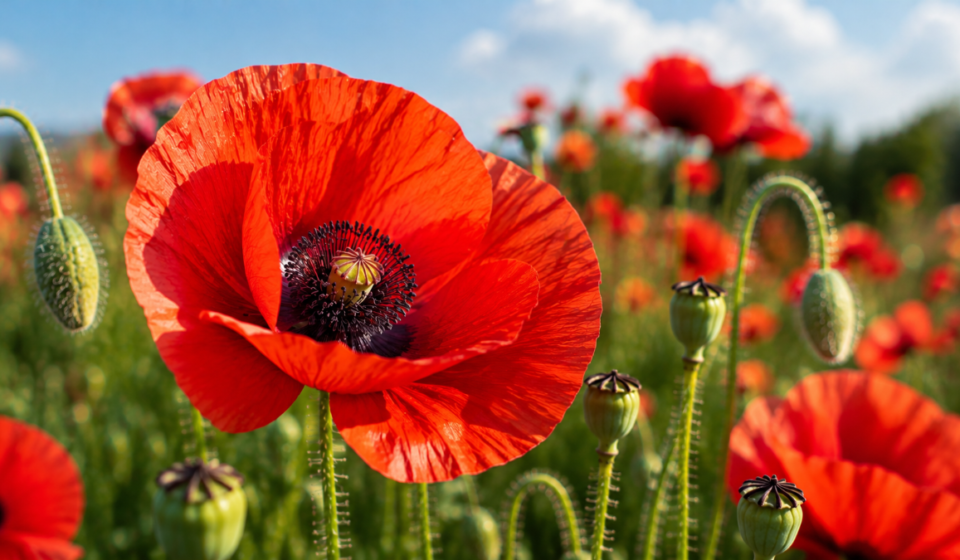

A poppy flower is a colorful, often cup-shaped bloom in the poppy family, Papaveraceae. True poppies belong to the genus Papaver, while California poppy and Himalayan blue poppy belong to related genera. The best poppy for your garden depends on its exact type: California poppy suits dry sun, Oriental poppy suits a well-drained perennial border, corn poppy is an easy annual, and Welsh poppy is better for cool, moist partial shade.
This guide covers seven main poppy flower types, practical identification clues, red poppy symbolism, and species-specific growing advice.
Poppy Flower Identification
A poppy flower is the bloom itself, while a poppy plant includes its stems, leaves, roots, flowers, and seed capsules. For accurate identification, mature foliage and the seed capsule can be more useful than flower color alone.
Quick identification chart
| If you see… | It is likely… | Confirm it by checking… |
| Scarlet petals, often with dark basal blotches; fine divided leaves | Corn poppy, Papaver rhoeas | Rounded capsule and annual habit |
| Huge, crinkled flowers; coarse, deeply divided leaves | Oriental poppy, Papaver orientale | Large perennial clump and post-bloom summer dormancy |
| Orange or yellow cup-shaped flowers; blue-green, ferny leaves | California poppy, Eschscholzia californica | Long, narrow seed pods |
| Large smooth, rounded seed capsules; blue-green foliage | Breadseed poppy, Papaver somniferum | Tall annual stems and decorative capsules |
| Yellow or orange flowers in moist partial shade | Welsh poppy, Papaver cambricum | Looser perennial habit and softer green leaves |
| Blue or blue-violet flowers in a cool, humid garden | Himalayan blue poppy, Meconopsis spp. | Specialist cool, evenly moist growing conditions |
| White, cream, yellow, orange, or pastel blooms on slender stems | Iceland poppy, Papaver nudicaule | Fine stems and cool-season flowering behavior |
True poppies and related poppies
The accepted genus Papaver includes annual, biennial, and herbaceous perennial plants. Most true poppies have four broad petals, numerous central stamens, divided or lobed leaves, and a seed capsule with a flat, radiating stigma disk.
California poppy is Eschscholzia californica, not a Papaver. Its finely divided leaves, orange-to-yellow cup flowers, and long narrow pods help distinguish it from corn or Oriental poppy.
Welsh poppy is accepted by Kew as Papaver cambricum. The former name Meconopsis cambrica may still appear in older gardening books and plant labels.
Iceland poppy is commonly sold as Papaver nudicaule, also treated in current Kew taxonomy as Oreomecon nudicaulis. The familiar Papaver nudicaule name remains useful when searching seed packets and nursery labels.
Identify poppies by seed pod
| Poppy plant | Seed capsule or pod |
| Corn poppy | Rounded to oval capsule |
| Oriental poppy | Bristly capsule |
| Breadseed poppy | Large, smooth, rounded capsule |
| California poppy | Long, narrow, usually curved pod |
| Iceland poppy | Narrower capsule on a slender flowering stem |
How to identify poppy seedlings
Poppy seedlings can be difficult to identify before flowering. Young corn and California poppy plants may show divided foliage early, but leaf shape can change as a plant matures. Wait for mature leaves, flowers, or seed capsules before making a certain identification.
Self-seeding offers a useful clue. Corn poppy, California poppy, Welsh poppy, and breadseed poppy may produce volunteer seedlings where they grew in a previous season.
Read More: Purple Flowers
Seven Types of Poppy Flowers
| Type | Botanical name | Typical mature height* | Typical flowering period* | Life cycle | Best garden use |
| Corn poppy | Papaver rhoeas | 75–90 cm | Summer | Annual | Sunny annual displays and wildflower-style planting |
| Oriental poppy | Papaver orientale | 50–100 cm | Late spring to early summer | Perennial | Large sunny borders |
| Iceland poppy | Papaver nudicaule | 30–60 cm | Cool season | Often grown as annual; may be biennial or short-lived perennial | Containers and cutting gardens |
| Breadseed poppy | Papaver somniferum | 60–90 cm | Late spring to early summer | Annual | Ornamental flowers and capsules |
| California poppy | Eschscholzia californica | 10–50 cm | Late spring to summer | Usually grown as annual; may persist in mild climates | Dry sunny sites and gravel gardens |
| Welsh poppy | Papaver cambricum | 30–60 cm | Spring to summer | Perennial | Moist partial shade |
| Himalayan blue poppy | Meconopsis spp. | Species-dependent | Species- and climate-dependent | Perennial | Specialist cool, humid gardens |
*Height and flowering time vary with cultivar, climate, soil, and local weather.
Corn poppy (Papaver rhoeas)
Corn poppy is also called common poppy, field poppy, Flanders poppy, or red poppy flower. It is an annual with light, divided foliage and scarlet bowl-shaped flowers, often marked with dark blotches near the petal bases.
It is one of the easiest types of poppies to grow from directly sown seed in a sunny position. The RHS describes Papaver rhoeas as an erect summer-flowering annual around 75–90 cm tall that prefers full sun and well-drained soil.
Oriental poppy (Papaver orientale)
Oriental poppy is a large herbaceous perennial with oversized, creased flowers and deeply cut, bristly foliage. Traditional flowers are orange-red with black petal blotches, but garden cultivars also include pink, salmon, white, plum, and burgundy.
Grow it in full sun where drainage is good. RHS guidance states that Oriental poppy can grow in most soils provided drainage is reliable. After flowering, foliage may fade and disappear during normal summer dormancy.
Iceland poppy (Papaver nudicaule, also treated as Oreomecon nudicaulis)
Iceland poppy bears silky flowers on fine stems in white, cream, yellow, orange, apricot, and pale pink. It is often grown as a cool-season annual, although it can behave as a biennial or short-lived perennial under suitable conditions.
For everyday gardening and SEO, Papaver nudicaule remains the most familiar name. Kew’s current treatment lists it as a synonym of Oreomecon nudicaulis.
Breadseed poppy (Papaver somniferum)
Breadseed poppy is an ornamental annual valued for its flowers and decorative seed capsules. It can produce white, pink, lavender, purple, burgundy, single, double, or ruffled blooms. Culinary poppy seeds are also associated with this species.
Utah State University lists seed poppy as a hardy annual that grows best in full sun and fertile, well-drained soil. Its planting guidance includes shallow sowing and late-spring to early-summer flowering.
Cultivation rules vary by jurisdiction. Check applicable local regulations before growing it.
California poppy (Eschscholzia californica)
California poppy is commonly grown as an annual, although it may behave as a short-lived perennial in suitable mild climates. It has blue-green feathery foliage and orange cup flowers, with yellow, cream, red, pink, and bicolor cultivars also available.
It is a strong choice for full sun, dry borders, containers, slopes, and gravel gardens. The RHS notes that California poppy tolerates drought after establishment, prefers poor or well-drained soil, and resents transplanting.
Welsh poppy (Papaver cambricum)
Welsh poppy is a perennial with yellow or orange flowers. Unlike California poppy, it suits cool, sheltered, partly shaded positions with soil that remains moist without becoming waterlogged.
It can work well around ferns, hostas, hardy geraniums, and woodland-edge planting. It may self-seed in a favorable site.
Himalayan Blue Poppy (Meconopsis spp.)
Himalayan blue poppy refers to blue-flowered plants in Meconopsis. Species and hybrids vary, but many need cool temperatures, partial shade, humus-rich soil, consistently available moisture, and protection from drying wind and intense sun.
The RHS advises that Meconopsis grows best in cooler, wetter areas and may struggle after only a few dry, sunny days.
How to Grow Poppies
Poppy growing requirements are species-specific. Corn and breadseed poppies are generally direct-sown annuals; Oriental poppy is a long-lived border perennial; California poppy prefers dry soil; Welsh poppy needs cooler moisture; and Himalayan blue poppy requires specialist conditions.
Which poppy is right for your garden?
| Garden condition or goal | Best choices | Avoid or treat cautiously |
| Hot, dry, sunny ground | California poppy | Himalayan blue poppy |
| Sunny annual wildflower display | Corn poppy, breadseed poppy | Welsh poppy |
| Sunny perennial border | Oriental poppy | California poppy in rich or damp soil |
| Cool, mild-summer garden | Iceland poppy, Oriental poppy | Heat-sensitive plants in exposed sites |
| Moist, partly shaded bed | Welsh poppy | California poppy |
| Cool, humid specialist garden | Himalayan blue poppy | Dry-site poppies |
| Container garden | California, Iceland, or corn poppy | Large Oriental poppy |
Annual versus perennial poppies
| Type | Does it return from its roots? | Can it self-seed? |
| Corn poppy | No; annual | Often |
| Oriental poppy | Yes; perennial | Possible but not the usual propagation method |
| Iceland poppy | Depends on climate and treatment | Sometimes |
| Breadseed poppy | No; annual | Can self-seed |
| California poppy | Depends on climate | Often |
| Welsh poppy | Yes; perennial | Often |
| Himalayan blue poppy | Species-dependent | Species-dependent |
When to plant poppies
- Corn poppy and breadseed poppy: Sow in autumn or very early spring where conditions suit hardy annuals.
- California poppy: Sow shallowly in autumn or early spring in mild, wet-winter climates; adapt timing to your local frost and heat patterns.
- Iceland poppy: Grow as a cool-season plant rather than expecting peak summer performance.
- Oriental poppy: Plant in a permanent, well-drained border position.
- Welsh poppy: Sow or plant in moist partial shade.
- Himalayan blue poppy: Plant only when a cool, moist, sheltered site is available.
How to sow poppy seeds
- Remove weeds and rake the surface to create a fine seedbed.
- Scatter seeds thinly.
- Press them lightly into the soil.
- Cover only as directed on the packet.
- Water with a fine spray.
- Thin seedlings as they establish.
For seed poppy, Utah State University advises covering seed no more than 1/8 inch. Its guidance reports emergence in approximately two weeks in warmer conditions and around four weeks in cool conditions.
Can you transplant poppies?
Corn, breadseed, and California poppies are generally best sown where they will grow because young roots can dislike disturbance. RHS guidance specifically notes that California poppies resent transplanting.
Oriental poppies should generally be left in their established border position. If propagation is necessary, division in spring or root cuttings in autumn are possible methods.
Poppy flower care by type
| Type | Water and soil priority |
| Corn poppy | Water only in extended dry periods; avoid wet soil |
| Oriental poppy | Excellent drainage; avoid soaking dormant crowns |
| Iceland poppy | Moderate moisture during active growth with good drainage |
| Breadseed poppy | Fertile but free-draining soil; avoid overfeeding |
| California poppy | Let soil dry moderately after establishment |
| Welsh poppy | Keep soil consistently cool and moist |
| Himalayan blue poppy | Maintain even moisture and protect from heat |
Poppy Flower Meaning
The red poppy has the strongest and most widely recognized symbolism: remembrance of people who died in war. Its significance became especially prominent after the First World War through the poppy landscapes of Flanders and the cultural legacy of In Flanders Fields.
Poppies have also been associated historically with sleep, dreams, consolation, and mortality, particularly because of the history of Papaver somniferum.
Color meanings outside red are less standardized. In modern floral design, orange and yellow poppies may suggest warmth or cheerfulness, but symbolism varies across cultures and occasions. Pink and purple poppies do not have the same broadly established symbolic associations as red remembrance poppies.
Common Poppy Problems
| Problem | Likely cause | Response |
| Seeds fail to emerge | Deep sowing, dry surface, old seed | Sow shallowly and maintain light surface moisture |
| Seedlings collapse | Damping-off or excessive moisture | Improve airflow and drainage |
| Few flowers | Shade, crowding, excess nitrogen | Increase light, thin plants, avoid overfeeding |
| Yellow leaves | Summer dormancy, heat, wet roots, nutrient issues, or disease | Identify the species and season before treating |
| Oriental poppy disappears | Normal summer dormancy | Mark the crown and let nearby perennials cover the gap |
| Aphids or fungal disease | Crowding, stress, wet foliage | Improve spacing and inspect plants regularly |
The RHS lists aphids, powdery mildew, downy mildew, and fungal wilt problems among potential issues for corn poppy.
The right poppy flower is the one suited to your conditions: corn poppy for easy annual color, Oriental poppy for a sunny perennial border, California poppy for dry soil, Welsh poppy for moisture and shade, and Himalayan blue poppy for a cool, humid specialist garden.
Frequently asked questions
Are all flowers called poppies true Papaver species?
No. True poppies belong to Papaver, but California poppies belong to Eschscholzia and Himalayan blue poppies belong to Meconopsis. They are related through the poppy family, but have different leaves, pods, life cycles, and cultivation needs. The botanical name is the safest guide when you are trying to identify a poppy or choose where to plant it.
Which poppy flower is easiest to grow?
Corn poppy is often one of the easiest choices because it grows from direct sowing and performs well in sunny, well-drained ground. California poppy is also easy where soil is dry and free draining. The best beginner option depends on the site: corn poppy suits annual meadow-style displays, while California poppy is better for hot, dry, low-water gardens.
Do poppies come back every year?
Some do, while others complete their life cycle in one season. Oriental and Welsh poppies are perennials that return from their roots. Corn poppy and breadseed poppy are annuals but can self-seed. Iceland and California poppies may be annual, biennial, or short-lived perennial depending on the local climate and the way they are grown.
How long do poppy seeds take to germinate?
Seed poppy can emerge in roughly two weeks in warmer weather and up to four weeks under cool conditions. Other types vary by soil temperature, seed freshness, moisture, and sowing depth. If germination is slow, avoid disturbing the seedbed too soon; first check that the seeds were not planted deeply and that the surface has not dried out.
Can poppies grow in containers?
Yes. California poppy, Iceland poppy, and corn poppy can grow in pots with drainage holes and free-draining compost. Sow directly into the final container where possible, as young plants may resent root disturbance. Large Oriental poppies are usually more reliable in open ground because they require more root room and become substantial perennial plants.
Why did my Oriental poppy disappear after flowering?
Oriental poppy commonly enters summer dormancy after blooming. Its leaves may yellow and vanish, but the crown remains alive below ground if drainage is good. Remove spent flower stems, avoid overwatering the resting crown, and grow summer-flowering companion plants nearby to conceal the temporary gap.
Do poppies need full sun?
Corn, Oriental, breadseed, and California poppies generally flower best in full sun. Welsh poppy tolerates partial shade and prefers cooler moisture. Himalayan blue poppies typically need sheltered light and a cool, humid environment. Use the botanical name before deciding on a position, because “poppy” does not describe one universal set of light needs.
Are poppies safe around pets and children?
Do not assume that any poppy is safe to eat or chew. Risk depends on the species, plant part, quantity eaten, and individual animal or person. Keep children and pets away from unfamiliar flowers, foliage, seed capsules, and dried arrangements. The ASPCA recommends contacting a veterinarian or poison-control service if a pet has eaten potentially harmful plant material.
What causes yellow leaves on poppies?
Yellow leaves can be normal or a sign of stress. Oriental poppies naturally yellow as summer dormancy begins. For other poppies, likely causes include waterlogged roots, excessive heat, nutrient imbalance, crowding, or disease. Identify the species and check the time of year before applying fertilizer or extra water, which can sometimes worsen the problem
Can Papaver somniferum be legally grown?
The legal status of Papaver somniferum varies by country and may differ by state, province, and intended use. Do not assume that ornamental or culinary use makes cultivation lawful in every location. Check the current rules with the relevant government authority before purchasing or sowing seed. Never grow or process the plant for controlled substances.