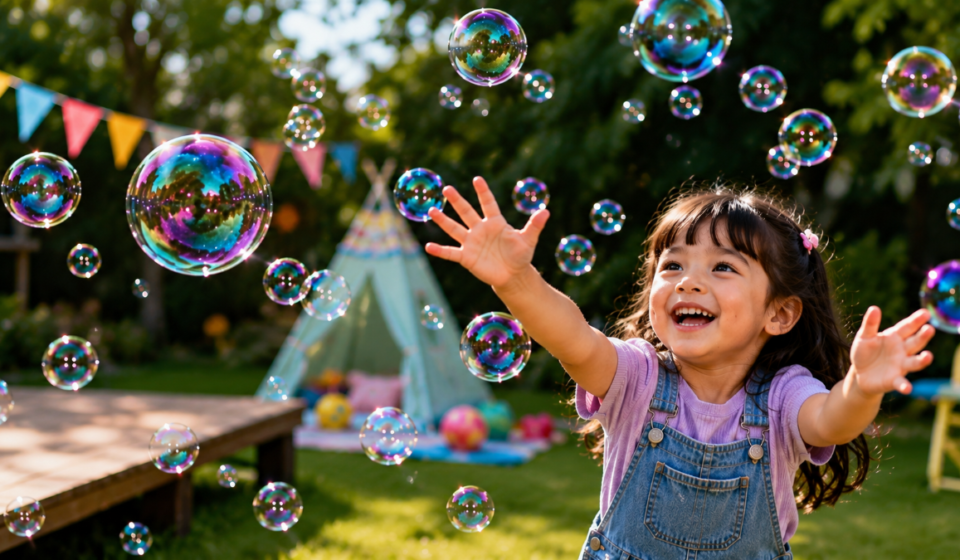

Bubbles are an easy, low-cost way to combine active play, creativity, and early science learning. With a simple bubble solution and a few everyday tools, children can chase, paint, test, build, observe, and experiment while developing coordination, language, and curiosity.
This guide includes child-friendly bubble activities, an easy homemade bubble solution, giant soap bubble tips, outdoor games, and practical bubble science experiments. Most ideas work best outdoors, where children have room to move and cleanup is simple.
Why bubbles are great for kids
Bubble play can be as simple as blowing a few bubbles in the yard or as structured as a science activity. Toddlers can reach, clap, chase, and pop. Older children can test different wands, compare bubble mixtures, observe wind direction, and discover why free-floating bubbles are round.
A soap bubble is a very thin film of water held between layers of soap molecules. Soap lowers water’s surface tension, making it easier to stretch the water into a film. A bubble floating freely tends to become round because a sphere encloses air using the least possible surface area.
Bubble play naturally supports:
- Gross-motor skills through running, reaching, jumping, and balancing
- Fine-motor control through holding wands and making careful movements
- Language development through words such as float, pop, shiny, round, tiny, and enormous
- Early math through counting, sorting, comparing, and measuring
- Scientific thinking through predictions, observations, and simple tests
- Social skills through taking turns, sharing tools, and creating cooperative games
The most engaging sessions usually leave room for children to lead. Set out a few materials, ask an interesting question, and let them experiment.
Read More: Chitlins
Bubble play safety checklist
Bubble activities are usually straightforward, but bubble solution is not a drink and spills can create slippery surfaces. Adult supervision is especially important for babies, toddlers, and children who are likely to put tools or liquid in their mouths.
- Use a child-appropriate commercial solution or a mild liquid dish soap.
- Keep bubble mixture away from eyes, mouths, food, pets, and open cuts.
- Tell children not to drink the solution or lick bubble wands.
- Use shallow trays or low containers rather than deep buckets.
- Choose grass, dirt, or another washable outdoor surface whenever possible.
- Wipe spills promptly from smooth patios, decks, tile, or indoor floors.
- Wash hands after play and before eating.
- If the solution gets into a child’s eyes, rinse gently with clean running water and follow the product label’s first-aid advice.
- Avoid small detachable wand parts around children who may mouth objects.
- Do not use bleach, household cleaners, concentrated detergents, or unidentified ingredients in homemade mixtures.
For younger children, the safest and simplest setup is an adult holding the solution while the child uses one large, sturdy wand.
Homemade bubble solution
A basic homemade bubble solution needs only water and liquid dish soap. Adding glycerin or clear corn syrup can make the film more durable, which is especially helpful for giant soap bubbles and bubble science experiments.
Results vary because dish-soap formulas, mineral content in tap water, humidity, temperature, and wand design all affect bubble performance. Make a small batch first, then adjust if needed.
Easy homemade bubble solution recipe
You will need:
- 2 cups water
- 1/4 cup liquid dish soap
- 1 tablespoon glycerin or clear corn syrup, optional
- A clean jar or container with a lid
- Bubble wands or safe household alternatives
How to make it:
- Pour the water into a clean container.
- Add the liquid dish soap slowly.
- Add glycerin or corn syrup if using it.
- Stir gently until combined. Do not whisk or shake the mixture, as this creates foam rather than a smooth bubble film.
- Cover the container and let the solution rest for a few hours if possible.
- Pour a small amount into a shallow tray for play, keeping the remaining mixture covered.
Glycerin can help bubbles last longer because it attracts water and is more viscous than water, which can slow evaporation and drainage in the bubble film.
How to make giant soap bubbles
Giant soap bubbles need a durable mixture, a large enough film, and slow movement. A giant bubble wand can be made with two smooth sticks, cotton string, and a small metal washer or other smooth weight.
To make a giant bubble wand:
- Tie a long loop of absorbent cotton string between two sticks.
- Leave a smaller string segment near the top and a larger loop below it.
- Attach a small washer at the lowest point of the loop to help the string open.
- Pour bubble mixture into a wide, shallow tub.
- Soak the entire string loop in the solution.
- Lift the wand slowly and walk backward, or let a gentle breeze pull the film open.
- Bring the sticks together gently to release the bubble.
Fast swinging usually breaks the film. Slow, steady movements work better, especially on calm or mildly humid days. A gentle breeze can help create large bubbles, but strong wind often tears the film before it can form.
Homemade bubble solution troubleshooting
| Problem | Likely cause | What to try |
| Bubbles pop immediately | Dry air, wind, weak solution, or a dry wand | Let the mixture rest, add a small amount of glycerin or corn syrup, and move to a calmer area |
| Foam covers the tray | The solution was shaken or stirred too quickly | Let the foam settle and stir future batches slowly |
| Bubbles are very small | The wand opening is small or the film breaks too quickly | Try a larger wand and slower arm movements |
| Giant bubbles will not form | The string is not fully soaked or the tub is too narrow | Soak the string completely and use a wider, shallow container |
| Children cannot blow bubbles | They are blowing too hard or the wand is dry | Encourage a soft, steady breath and dip the wand again |
| Solution feels too slippery | Too much mixture has spilled on a hard surface | Stop play, rinse or wipe the area, and move to grass or another safer surface |
12 bubble activities for kids
1. Bubble chase and pop
Blow a stream of bubbles across an open space and invite children to pop them in different ways. Ask them to clap one, tap one with a finger, pop one with an elbow, or stomp a bubble that lands on the ground.
For a simple listening game, give one instruction at a time: “Pop a bubble above your head,” or “Find the smallest bubble.” Keep the mood playful rather than competitive.
2. Bubble color hunt
Set up near colorful flowers, toys, chalk drawings, cones, or outdoor furniture. Blow a few bubbles, then ask children to find something red before a bubble pops. Continue with other colors.
This activity combines movement with color recognition and observation. It is also useful for children who prefer a calmer game than running and chasing.
3. Bubble target practice
Make targets with hula hoops, cardboard boxes, washable chalk circles, or paper plates clipped to a fence. Children can try to blow bubbles toward, through, or onto each target.
Try prompts such as:
- Can you make a bubble travel through the hoop?
- Can you land a bubble inside the chalk circle?
- Which target is easiest when the wind changes?
- Does a larger wand help the bubble reach the target?
The goal is not a perfect aim. Wind and changing air currents are part of the experiment.
4. Bubble obstacle course
Build a short, low-risk obstacle course with chalk lines, cones, hoops, cushions on grass, or a balance path. One child blows bubbles while another travels through the course and pops a set number at each station.
Keep obstacles stable and age-appropriate. Use actions such as tiptoeing, jumping, turning, crawling under a safe low line, or balancing along a chalk path.
5. Bubble wand test lab
Set several bubble wands on a tray: a standard plastic wand, a slotted spoon, a fly swatter with no sharp edges, a cookie cutter, a pipe-cleaner loop for older children, and a large string wand.
Ask children to make a prediction before testing:
- Which wand will make the biggest bubble?
- Which will make the most bubbles?
- Does a heart-shaped wand make heart-shaped bubbles?
- Which wand is easiest to use?
Test one wand at a time. Record results with tally marks or simple drawings. Most free-floating bubbles will become round regardless of the wand’s outline, which is a memorable discovery.
6. Bubble prints
Bubble printing turns bubble play into process art. Add a small amount of washable, non-toxic tempera paint or liquid watercolor to a separate portion of bubble solution. Use this mixture only for art, never for face blowing or ordinary bubble play.
For children old enough to reliably blow outward, add the art mixture to a cup and let them blow gently through a straw until bubbles rise above the rim. Press paper lightly onto the foam to capture circular prints.
For younger children, an adult can create the foam while children press the paper. Never use this activity with children who may suck through a straw.
7. Bubble snake maker
Stretch a clean sock over the cut end of a plastic bottle and secure it with an elastic band. Dip the sock-covered end into a bubble solution, then blow gently through the bottle’s mouth to create a long cluster of tiny bubbles.
This activity is best for children who can consistently blow outward. An adult can make the bubble snake for younger children, who can watch it grow, touch it, and describe its texture and shape.
8. Catch a bubble on a glove
Put on a clean fabric glove or cover a hand with a soft sock. Ask children to catch a bubble as gently as possible.
Then compare the fabric-covered hand with a bare hand. Do bubbles land differently? Which surface lets the bubble stay intact for longer? This activity encourages slow, controlled movement and careful observation.
9. Bubble painting with a wand
Create a separate batch of washable tinted bubble mixture. Dip a large wand into the solution and press the wet loop onto paper to make rings.
Children can layer the circles to create flowers, planets, faces, caterpillars, or abstract designs. This is often easier than straw bubble printing because it does not require blowing through a straw.
Use old clothes, a wipeable table covering, and an outdoor workspace when possible.
10. Bubble race with the wind
Mark a start line with chalk or a cone. Blow one bubble at a time and watch where it travels. Children can point out whether it moves toward a tree, fence, porch, or another marker.
Repeat in a different spot or direction. This is a simple way to explore airflow without needing special equipment. Children may notice that wind feels different beside a wall, under a covered area, or in an open yard.
11. Bubble freeze dance
Play music while an adult blows bubbles. Children dance while the music plays and freeze when it stops. If a bubble floats nearby, they can point to it or describe where it landed without moving.
This game works best outdoors. If used indoors, keep the playing area small, protect the floor, and use only a small amount of solution.
12. Bubble station party
For a birthday party, classroom event, or playdate, create separate activity stations instead of placing everyone around one tray. Possible stations include:
- Giant bubble wand area
- Bubble target zone
- Bubble art table
- Bubble chase space
- Wand-testing table
- Quiet bubble observation blanket
Stations reduce waiting, make it easier for children to choose an activity, and help adults supervise solutions more effectively.
Bubble science experiments
Bubble science experiments work best when children change one thing at a time, observe the result, and talk about what they notice. You do not need technical language to make the activity meaningful.
Start with questions such as:
- What do you think will happen?
- What changed?
- What stayed the same?
- How could we test that idea again?
- What should we try next?
Which bubble mixture lasts the longest?
Make three small samples of bubble mixture.
- Cup A: Water and liquid dish soap
- Cup B: Water, liquid dish soap, and glycerin
- Cup C: Water, liquid dish soap, and clear corn syrup
Use the same wand for each sample. Blow bubbles onto a damp tray or shallow pan, then time how long they remain visible. Repeat several times because individual bubbles can pop due to wind, surface contact, or slight changes in the film.
Record the results in a simple chart. Instead of saying one mixture is always best, ask which mixture worked best under your conditions. Glycerin and corn syrup can help reduce evaporation and slow the movement of liquid in the film, but performance can vary.
Why are bubbles round?
Dip a wand into solution and make a bubble. Ask children whether it looks like a cube, triangle, oval, or ball. Then let them watch what happens when a bubble touches another bubble, lands on a wet surface, or catches a breeze.
A bubble that floats freely tends to form a sphere. The film pulls inward and takes the shape with the least surface area for the volume of air it contains. When a bubble touches a wand, wall, hand, or another bubble, its shape can change because those surfaces affect the film.
Why do bubbles show rainbow colors?
Blow a few larger bubbles in indirect sunlight or near a bright window. Ask children to look for shifting bands of color. Do the colors stay still? Do they change as the bubble gets older?
The colors do not come from dye. Light reflects from the front and back of the thin soap film. As the film changes thickness, some colors become more visible while others are reduced, producing the moving rainbow effect.
How does wind affect bubbles?
Choose a calm area and release several bubbles. Watch where they travel. Then repeat near a wall, hedge, fence, porch, or open field.
Children can draw arrows on paper to show each bubble’s direction. This activity helps them recognize that air has movement and direction even when it cannot be seen.
Can you make a bubble last longer?
Blow bubbles onto different surfaces: a dry plate, a damp plate, a fabric glove, or a tray with a thin layer of water. Compare what happens.
A bubble often pops quickly on a dry surface because moisture leaves the film. A damp surface may allow it to remain intact longer. Keep the experiment simple and repeat it several times before deciding what the results suggest.
How to make bubble play more educational
Bubble activities do not need to become formal lessons. One thoughtful question can add meaningful learning without interrupting the fun.
For preschoolers, use descriptive vocabulary:
- Round
- Tiny
- Huge
- Float
- Pop
- Shiny
- Wet
- Fast
- Slow
- Windy
For early elementary children, introduce simple scientific habits:
- Predict what will happen
- Change one variable at a time
- Compare two results
- Count or measure
- Draw observations
- Explain an idea using evidence
Useful questions include:
- Which wand makes the biggest bubble?
- What happens if we move more slowly?
- Which bubble stayed whole the longest?
- Where did the wind take the bubbles?
- What changed when two bubbles touched?
- How could we make this test fair?
A clipboard, notebook, or sheet of paper can help children record their observations. A drawing of a giant bubble, a row of tally marks, or arrows showing wind direction is enough.
Common bubble-play mistakes
Bubble play is most successful when the setup is simple. Bigger, faster, and more complicated are not always better.
Avoid these common mistakes:
- Shaking bubble solution until it becomes foam
- Using a deep container that is difficult for young children to manage
- Setting up on a slick floor without protecting it
- Expecting every homemade mixture to work the same way in every type of weather
- Adding several new ingredients at once during a science experiment
- Giving a straw-blowing activity to children who may suck instead
- Using sharp wire, breakable glass, or small detachable wand parts
- Turning every game into a competition
- Requiring “perfect” bubbles instead of rewarding curiosity and experimentation
A child who watches one bubble drift across a lawn, tests a new wand, or notices changing colors is already engaging in valuable play.
FAQs
What is the easiest homemade bubble solution for kids?
The easiest homemade bubble solution combines 2 cups of water with 1/4 cup of liquid dish soap. Stir gently instead of shaking the mixture, then pour a small amount into a shallow tray. For longer-lasting bubbles, add about 1 tablespoon of glycerin or clear corn syrup. Letting the mixture rest for a few hours can help. Because different soaps and water types behave differently, make a small batch first and adjust gradually if needed
Why do homemade bubbles pop so quickly?
Homemade bubbles often pop quickly when the air is hot, dry, or windy; when the wand is dry; or when the mixture makes a weak film. Try moving to a calmer space, dipping the wand fully before each use, and adding a small amount of glycerin or clear corn syrup. Stir the solution gently and let it rest rather than shaking it. A bubble also naturally becomes thinner over time as water drains and evaporates, making it more likely to burst.
Can toddlers do bubble activities safely?
Toddlers can enjoy supervised bubble play, especially bubble chasing, clapping, pointing, and popping outdoors. Adults should manage the solution, use one-piece wands without small parts, and keep containers shallow. Avoid straw-blowing activities unless a child can consistently blow outward rather than suck. Keep mixture away from eyes and mouths, clean spills quickly, and wash hands afterward. An adult-led bubble chase on grass is often the easiest, safest activity for very young children.
What makes giant soap bubbles work?
Giant soap bubbles need a broad, fully coated film, a large string wand, and slow movement. A mixture made with water and dish soap plus a small amount of glycerin or clear corn syrup can create a more durable film. Fully soak the string loop, lift it slowly, and allow a gentle breeze or a slow backward walk to open the bubble. Strong wind, dry air, and quick arm movements can break the film before a giant bubble forms.
How do you make bubble wands at home?
You can make homemade bubble wands with pipe-cleaner loops, cookie cutters with smooth edges, slotted spoons, or cotton string tied between two sticks for giant bubbles. Choose smooth tools with openings large enough to hold a bubble film. Avoid sharp wire ends, breakable materials, and small detachable parts around younger children. Testing different wands is also an easy science activity: children can compare which tools make the biggest bubbles, most bubbles, or easiest-to-control bubbles.
Why are bubbles round instead of square?
Free-floating bubbles are round because a sphere is the most efficient shape for enclosing a volume of air with the least surface area. The soap film pulls inward evenly, which encourages that rounded shape. A bubble can look stretched or distorted when wind pushes it or when it touches a wand, hand, surface, or another bubble. Once it is floating freely, it tends to return toward a sphere rather than keeping the shape of the wand that made it.
What causes rainbow colors in soap bubbles?
Rainbow colors appear because light reflects from both the front and back surfaces of the thin soap film. As the film changes thickness, different wavelengths of light interact differently, creating shifting bands of color. The colors are easiest to see on larger bubbles in indirect sunlight or near a bright window. As water drains from the film and it becomes thinner, the colors change. Eventually, the film becomes too thin to remain intact and the bubble pops.
Are bubble activities good for learning?
Bubble activities can support movement, turn-taking, vocabulary, observation, prediction, counting, and early scientific thinking. Children may test different bubble wands, count how many bubbles they pop, compare mixtures, or follow bubbles in the wind. Learning does not require a worksheet or a correct answer. The most helpful adult role is to offer a simple question, listen to the child’s ideas, and allow enough time for repeated exploration and discovery.
Can you do bubble activities indoors?
Yes, but indoor bubble play needs a smaller, more controlled setup. Use a shallow tray, a washable non-slip surface, towels for quick cleanup, and only a small amount of bubble solution. Good indoor choices include catching bubbles on a glove, observing colors near a window, making wand prints, or testing small wands over a tray. Avoid running games, giant bubbles, and large open containers indoors. Outdoor areas are usually better for active bubble games and easier cleanup.
How can I turn bubble play into a science experiment?
Choose one question, such as “Which bubble wand makes the largest bubbles?” or “Does glycerin help bubbles last longer?” Keep the other conditions as similar as possible by using the same location, amount of solution, and wand when relevant. Ask children to make a prediction, observe what happens, and record results with drawings, numbers, or tally marks. Repeat the test several times because wind and chance can affect one bubble. The purpose is to learn from observation, not to prove a predetermined answer
.