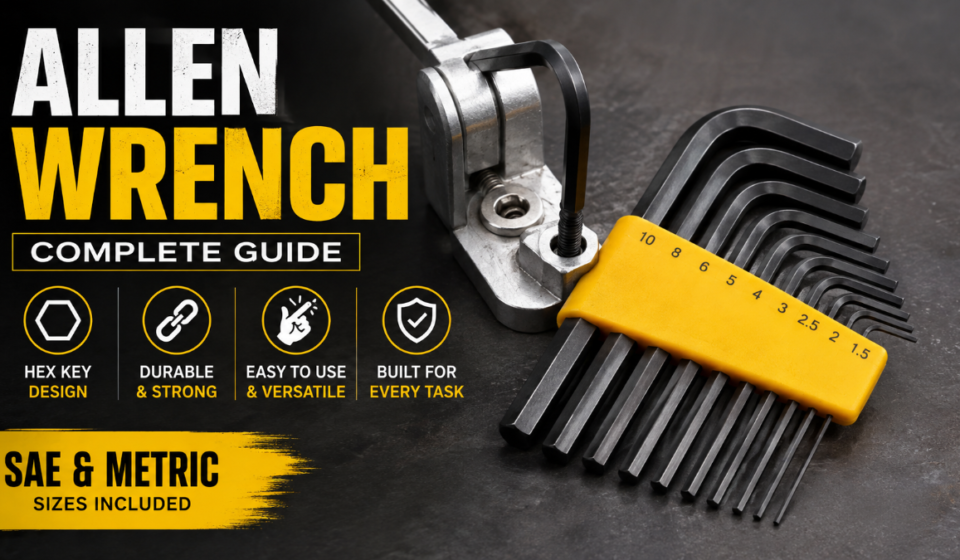

An Allen wrench is a compact hand tool used to tighten or loosen screws and bolts with an internal six-sided socket. Also called a hex key, Allen key, or hex wrench, it is commonly found in furniture kits, bicycles, appliances, workshop equipment, and mechanical assemblies.
The correct tool should fit deeply and firmly inside the socket. If it rocks, slips, or stops before reaching the bottom, do not force it. Select the correct size, clean the recess, and make sure the tool matches the fastener type before turning.
Start With the Fastener
The best way to choose a hex key is to inspect the fastener first. A standard hex socket has six straight internal sides. When the key is fully seated, its flat surfaces press against the socket walls and transfer turning force safely.
A correct fit should:
- Enter the socket without force
- Reach the bottom of the recess
- Sit firmly with little or no side-to-side movement
- Remain straight while you turn it
A key that stops halfway, feels loose, or slips under pressure is not correctly engaged. The issue may be the wrong size, a metric-versus-SAE mismatch, dirt inside the socket, a security pin, or a damaged fastener.
Identify the Drive Type
Not every recessed screw accepts an Allen wrench. Inspect the shape before selecting a tool.
| Drive appearance | Drive type | Correct tool |
| Six straight internal sides | Hex socket | Allen wrench or hex key |
| Hex socket with a centre pin | Security hex | Security hex key with a centre hole |
| Six rounded star-like lobes | Torx | Torx key or Torx bit |
| Simple cross | Phillips | Phillips screwdriver or bit |
| Cross with extra smaller ribs | Pozidriv | Pozidriv screwdriver or bit |
| Four-sided recess | Square/Robertson | Square-drive bit |
| Six flat sides around the outside | External hex | Socket or spanner |
A Torx screw is not the same as a hex socket screw. Although a hex key may appear to enter some Torx fasteners, it will not contact the correct surfaces and can damage the screw head.
What an Allen Wrench Measures
Hex keys are sized by the width across flats. This is the distance from one flat face of the hexagonal working end to the opposite flat face.
Do not measure:
- The key’s overall length
- The point-to-point distance between opposite corners
- The width of one individual side
- The outside diameter of the tool
To identify an unmarked key, use digital or vernier calipers. Place the caliper jaws on two opposite flat faces, record the measurement, and compare it with marked metric or SAE sizes. Always confirm the fit in the fastener before applying force.
Read More: War Machine 2026
Metric and SAE Hex Key Sizes
Hex keys are available in metric sizes measured in millimetres and SAE/inch sizes measured in fractions of an inch. They are different measurement systems, and similar-looking keys should not be considered interchangeable.
Common Metric Sizes
| Metric size | Typical use |
| 1.5 mm | Small set screws and compact hardware |
| 2 mm | Small machine screws and adjustment hardware |
| 2.5 mm | Light mechanical hardware and accessories |
| 3 mm | Furniture connectors and small bicycle accessories |
| 4 mm | General DIY hardware, furniture, and some bicycle controls |
| 5 mm | Bicycle components, furniture frames, and equipment hardware |
| 6 mm | Larger furniture, bicycle, and mechanical fasteners |
| 8 mm | Larger socket-head screws and mechanical assemblies |
| 10 mm | Heavy mechanical hardware and machinery |
Common SAE/Inch Sizes
| SAE size | Typical use |
| 1/16 in | Small set screws and light hardware |
| 5/64 in | Small machine screws |
| 3/32 in | Small general-purpose fasteners |
| 1/8 in | Fixtures and light equipment |
| 5/32 in | Medium U.S.-standard hardware |
| 3/16 in | Medium-duty mechanical fasteners |
| 7/32 in | Larger inch-series hardware |
| 1/4 in | Socket-head screws and assemblies |
| 5/16 in | Heavy-duty machinery hardware |
| 3/8 in | Large mechanical fasteners |
Thread Size and Hex-Key Size Are Different
A thread size does not automatically tell you which key to use. For instance, an M5 fastener has a nominal 5 mm thread diameter, but that does not mean it takes a 5 mm hex key.
For standard metric socket-head cap screws, the following pairings are common:
| Thread size | Hex key size |
| M3 | 2.5 mm |
| M4 | 3 mm |
| M5 | 4 mm |
| M6 | 5 mm |
| M8 | 6 mm |
| M10 | 8 mm |
| M12 | 10 mm |
| M16 | 14 mm |
These values apply to standard socket-head cap screw designs. Button-head, countersunk, low-head, set-screw, and proprietary fasteners may use different socket sizes even with the same thread diameter.
How to Choose the Right Allen Wrench
Use this process when you do not know which key fits:
- Inspect the socket. Confirm it has six straight sides and is not Torx, Phillips, square-drive, or another type.
- Check for a centre pin. A centre pin means the fastener requires a security hex key.
- Choose the likely system. Check whether the product uses metric or SAE/inch hardware.
- Try the closest marked size. Do not force the tool into the socket.
- Seat the key fully. It should reach the bottom of the recess.
- Check for play. The key should not rock from side to side.
- Choose the proper end. Use a straight end for tight fasteners and a ball end only where angled access is needed.
- Follow torque requirements. Use a torque wrench if the component manufacturer specifies a torque value.
How to Use an Allen Wrench Safely
Once you have the correct key, correct technique protects the tool, fastener, and surrounding material.
- Insert the hex key fully into the socket.
- Keep the tool square to the screw head.
- Turn clockwise to tighten or counterclockwise to loosen most standard right-hand threaded fasteners.
- Use steady pressure instead of sudden jerks.
- Insert the long leg into the socket and use the short outer leg as the handle when greater leverage is needed.
- Insert the short leg into the socket and turn the longer outer leg when the screw is already loose and you need faster rotation.
- Stop immediately if the key slips or begins to round the socket.
- Use a torque wrench with the correct hex fitting where specified.
Allen Wrench Styles
| Tool style | Best use | Limitation |
| Standard L-key | Furniture assembly, general repairs, home tasks | Slower for repeated work |
| Long-arm key | Recessed screws and obstructed access | Needs room to swing |
| Ball-end key | Slightly angled or restricted access | Not for high torque or final tightening |
| T-handle key | Frequent bicycle or workshop tasks | Handle can block access |
| Folding hex-key set | Portable tool kits | Limited reach in deep recesses |
| Hex bit | Ratchets, drivers, and torque wrenches | Power tools can over-tighten fasteners |
| Security hex key | Tamper-resistant hex sockets | Only works with security hex hardware |
Straight-End vs. Ball-End Hex Keys
A straight-end hex key gives full contact with the socket and is the better choice for loosening tight fasteners and completing final tightening.
A ball-end hex key can turn a compatible screw from a slight angle. It is useful when direct access is blocked by a nearby frame, panel, or component. Use it for starting or quickly turning a fastener, then switch to the straight end when you need more force or controlled tightening.
Common Uses
Furniture and Flat-Pack Assembly
Allen wrenches are common in beds, chairs, desks, cabinets, shelves, storage racks, and exercise equipment. Start every connector loosely, align all parts, and tighten the fasteners in stages. This reduces binding and helps protect threaded inserts, particleboard, MDF, and softwood.
Bicycles and Mobility Equipment
Hex fasteners are common on seat clamps, bottle cages, saddle hardware, brake mounts, handlebar controls, and many stems. Use the exact size that fits the component rather than assuming all bicycle bolts use the same key.
For safety-critical parts related to steering, braking, seating, suspension, or carbon-fibre components, follow the torque marking or service guidance supplied with the part. A torque wrench is important where a torque value is specified.
Mechanical Equipment and Workshop Tools
Power tools, machines, automotive accessories, home-gym equipment, and appliances may use hex socket screws on guards, covers, clamps, brackets, pulleys, and alignment points.
Before removing a fastener, identify its purpose. It may secure a safety guard, hold a spring-loaded part, maintain alignment, or require a specific reassembly sequence.
Household Repairs
A complete hex-key set is useful for tightening loose chair or table frames, assembling storage products, adjusting compatible fittings, repairing exercise machines, and maintaining workshop equipment.
How to Build a Useful Allen Wrench Set
For general home use, choose a set with common metric and SAE sizes. If you work frequently on bicycles, machinery, or vehicles, add specialised tools that match those tasks.
Look for:
- Clear, permanent size markings
- Straight, accurately formed hex tips
- Metric and SAE keys kept separately or clearly labelled
- A durable holder that keeps each size organised
- Ball-end keys for difficult access
- Hex bits for ratchets, screwdriver handles, and torque wrenches
- T-handle keys for frequent maintenance work
- Corrosion-resistant tools if they will be stored in a damp garage or workshop
The small key supplied with furniture may work for assembly, but a marked, correctly sized key is easier to use and more useful for future adjustments.
Troubleshooting Hex-Key Problems
| Problem | Likely cause | What to do |
| Key will not enter | Wrong drive, wrong size, or debris | Identify the drive and clean the socket |
| Key will not reach the bottom | Paint, corrosion, dirt, centre pin, or damage | Clear the recess and inspect it carefully |
| Key rocks in the socket | Wrong size or metric/SAE mismatch | Test the correct marked key |
| Key slips under force | Worn key, partial engagement, or rounded socket | Stop and try an undamaged straight-end key |
| Fastener will not loosen | Corrosion, thread-locking compound, or excessive tightening | Apply controlled force only with full engagement |
| Ball end feels unstable | Too much angle or too much force | Switch to the straight end |
| Socket is rounded | Previous misuse or wear | Use an appropriate extractor or seek repair assistance |
Care and Storage
Allen wrenches require little maintenance, but clean and undamaged tools are more reliable.
- Wipe off moisture, grease, and dirt after use.
- Store each key in a marked holder.
- Replace keys with rounded tips, bent shafts, or heavy corrosion.
- Do not use a hex key as a pry bar, chisel, punch, or substitute screwdriver.
- Keep portable sets dry so moisture does not remain trapped around the tools.
Key Takeaway
An Allen wrench is simple to use when the tool and fastener match. Identify the drive, choose the exact metric or SAE size, make sure the key sits fully in the socket, and use a straight end for high-force work. Do not assume that thread size determines key size, and use a torque wrench whenever the component manufacturer specifies a tightening value.
Frequently Asked Questions
Is an Allen wrench the same as a hex key?
Yes. Allen wrench, Allen key, hex key, and hex wrench are common names for the same type of six-sided tool used with internal hex socket fasteners. “Hex key” is the general technical term, while “Allen wrench” is widely used in furniture instructions, hardware stores, and DIY guides. The important point is to use the exact key size that matches the fastener.
Can I use a drill bit or screwdriver instead of a hex key?
No. Drill bits and ordinary screwdrivers do not have the precise six-sided profile needed to engage a hex socket safely. Using an improvised tool can round the recess and leave the fastener difficult to remove. If you need faster installation, use a properly sized hex bit in a suitable driver. Use controlled speed and avoid over-tightening, especially with furniture hardware or small screws.
Why will my hex key not fit a screw that looks hexagonal?
The fastener may be a Torx drive, security hex socket, damaged hex socket, or a different metric or SAE size. Dirt, rust, paint, and thread-locking residue can also stop the key from reaching the bottom. Clean the recess, inspect its shape in good light, and test a correctly marked key. Never force a key that does not fully seat.
Do ball-end Allen keys work at an angle?
Yes. Ball-end keys are designed to turn compatible hex socket screws from a slight angle when direct access is limited. They are useful for starting or quickly spinning a fastener. They are not the best choice for breaking loose a tight screw, applying high force, or final tightening. Switch to a straight-end key whenever direct access becomes possible.
How do I remove a screw with a rounded Allen socket?
Stop using a loose key, because repeated slipping can make the damage worse. Clean the socket and test whether an undamaged, exact-size straight key can still engage. If it cannot, the suitable method depends on the fastener’s location and condition. A purpose-made extractor, a method for gripping an exposed head, or professional repair may be needed. Replace the damaged fastener after removal.