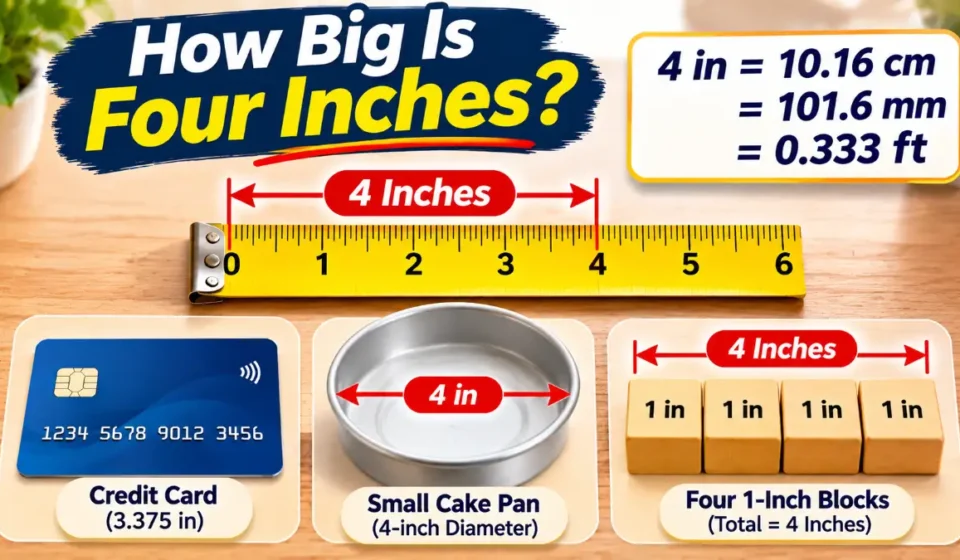

How Big Is Four Inches Four inches is exactly 10.16 centimeters, 101.6 millimeters, or one-third of a foot. It is slightly longer than the long side of a standard credit card and equal to one-third of the marked length of a 12-inch ruler. You can also picture it as the diameter of a small 4-inch cake pan or the length of four 1-inch sections placed together.
Understanding this measurement is useful when buying small products, arranging household items, working on craft projects, or checking dimensions without a measuring tape. Although four inches is a short distance, estimating it accurately can be challenging without a familiar reference.
The following examples explain what this measurement looks like, how it compares with other lengths, and how to estimate it using objects you may already have.
What Does Four Inches Look Like in Real Life?
Four inches is a little over 10 centimeters. If you hold a standard credit card horizontally, the measurement extends approximately five-eighths of an inch beyond its longer edge.
Another straightforward way to understand the distance is to divide a 12-inch ruler into three equal sections. Each section measures exactly four inches.
The measurement is relatively small compared with furniture or large household objects, but it can be significant when checking the dimensions of accessories, containers, decorative pieces, and tools.
Four Inches in Different Units
| Unit | Equivalent |
| Centimeters | 10.16 cm |
| Millimeters | 101.6 mm |
| Feet | 0.3333 ft |
| Meters | 0.1016 m |
| Yards | Approximately 0.1111 yd |
These values are based on the international inch, which is defined as exactly 2.54 centimeters.
9 Common Objects That Help You Understand Four Inches
The easiest way to imagine a measurement is to connect it with something familiar. The following examples offer practical references, although some objects vary by manufacturer.
1. A Standard Credit Card
A standard credit card is 3.375 inches long.
Four inches extends another 0.625 inches beyond that length, making the card a convenient reference for estimating the distance.
Because payment cards generally follow standardized dimensions, this comparison is more consistent than using random household objects.
2. A Small Round Cake Pan
Small cake pans are available with a diameter of four inches.
The measurement describes the straight-line distance across the center of the pan, from one inner or outer edge to the opposite edge, depending on how the manufacturer specifies its size.
A four-inch round cake pan provides a useful visual example, particularly for people who regularly bake.
3. Four One-Inch Blocks
Imagine four blocks, each measuring exactly one inch along one side.
Place them in a straight line without gaps, and their combined length is four inches.
This example is particularly helpful for children learning basic measurements because it demonstrates how smaller units combine to create larger lengths.
4. A Square Sticky Note With an Extra Inch
A common square sticky note measures three inches on each side.
Add another inch to one edge, and the resulting length becomes four inches.
This is a simple comparison for anyone working in an office, classroom, or study area.
5. A Small Drink Coaster
Some round drink coasters measure four inches in diameter.
If your coaster has this exact dimension, the distance across its center represents four inches.
Coasters are not manufactured in one universal size, so check the dimensions before relying on one for measurement.
6. Half of an Eight-Inch Length
Take any object or strip of paper that measures exactly eight inches long.
Fold or divide it into two equal sections.
Each section will measure four inches, making this a simple way to understand the relationship between the two lengths.
7. A Four-Inch Picture Frame Opening
Small picture frames may be designed to hold photographs measuring four inches along one side.
For example, a frame intended for a 4-by-6-inch photograph has an image dimension of four inches across its shorter side.
The outside dimensions of the frame will generally be larger because of its border.
8. A Small Decorative Tile
Some decorative tiles are sold in nominal four-inch square sizes.
A tile that actually measures four inches along each edge provides a practical reference for both length and width.
Check the product specifications because nominal and actual dimensions may differ.
9. A Piece of Paper Cut to Four Inches
One of the most dependable references is a strip of paper cut to exactly four inches using a ruler.
Once prepared, the strip can be kept in a notebook or drawer and used whenever you need a quick size comparison.
Unlike objects with variable dimensions, a correctly measured paper strip provides a consistent reference.
Read Also: What Does 1 cm Look Like? Easy Size Comparisons From 1 to 5 cm
How Big Is Four Inches Without a Measuring Tape
A measuring tape is useful, but it isn’t always available when you need to check a small dimension.
You can still make a reasonable estimate using familiar objects.
Compare It With a Credit Card
Place a credit card beside the item you want to measure.
The card’s longer edge measures 3.375 inches. Add approximately five-eighths of an inch to reach four inches.
This method works well for estimating dimensions but is not suitable when a precise fit is required.
Use a Known Paper Size
Standard U.S. letter paper measures 8.5 by 11 inches.
You can use its shorter edge as a visual reference, remembering that four inches is slightly less than half of 8.5 inches.
For an exact measurement, use a ruler to mark the paper before cutting or folding it.
Create a Personal Hand Reference
Your hand can serve as a convenient reference once you know its dimensions.
Measure a finger, part of your palm, or another easily identifiable distance on your hand with a ruler.
Remember that measurement for situations when you need a rough estimate.
Hand sizes vary, so a measurement that works for one person may not work for another.
How Big Is 4 Inches Visually?
If you’re wondering how big is 4 inches visually, imagine a distance slightly longer than a standard credit card or the shorter side of a 4-by-6-inch photograph. Four inches also represents exactly one-third of a 12-inch ruler and measures 10.16 centimeters. A small cake pan with a four-inch diameter can provide another useful visual comparison. These examples are helpful because they connect an abstract measurement with familiar objects, making it easier to estimate sizes without specialized equipment.
Four Inches Compared With Other Common Measurements
Understanding nearby measurements helps put four inches into perspective.
| Length | Centimeters | Comparison |
| 1 inch | 2.54 cm | One-quarter of four inches |
| 2 inches | 5.08 cm | Half of four inches |
| 3 inches | 7.62 cm | One inch shorter |
| 4 inches | 10.16 cm | Reference measurement |
| 5 inches | 12.70 cm | One inch longer |
| 6 inches | 15.24 cm | One and a half times as long |
| 8 inches | 20.32 cm | Twice as long |
| 12 inches | 30.48 cm | Three times as long |
This comparison is useful when deciding between product sizes or estimating the space an item may occupy.
How Big Is Nine Inches?
For anyone asking how big is nine inches, it equals exactly 22.86 centimeters, 228.6 millimeters, or three-quarters of a foot. Nine inches is 2.25 times the length of four inches, so the difference is substantial. To picture nine inches, consider the shorter edge of a standard U.S. letter-size sheet of paper, which measures 8.5 inches. Adding half an inch to that edge gives you nine inches. This makes letter paper a practical reference when a ruler isn’t nearby.
Where Are Four-Inch Measurements Used?
Four-inch dimensions are common across several everyday activities.
Home Decorating
Small frames, decorative tiles, and household accessories may use four-inch dimensions.
Knowing the measurement helps when arranging objects on shelves, selecting decorations, or checking whether an accessory fits a particular space.
Kitchen Equipment
Baking pans, food molds, and small kitchen accessories are sometimes manufactured in four-inch sizes.
When shopping for round equipment, pay attention to whether the measurement describes the inside diameter, outside diameter, or height.
Arts and Crafts
Craft projects often involve cutting paper, fabric, or decorative materials into equal sections.
A four-inch measurement can be useful for creating consistent pieces.
Using a ruler is especially important when several parts must fit together.
Online Product Shopping
Online photographs don’t always communicate an item’s true size.
A product that appears large in a close-up image may measure only four inches in reality.
Checking the listed dimensions and comparing them with familiar objects can reduce sizing mistakes.
Why Visual Estimates Are Not Always Accurate
The apparent size of an object can change depending on its surroundings.
A four-inch item photographed alone may look larger than the same item positioned beside a laptop or book.
Camera perspective, cropping, and viewing distance also influence how we perceive dimensions.
Screen size creates another challenge. A product image displayed on a large monitor may appear physically larger than the actual item.
For accurate comparisons, prioritize written dimensions and photographs that include a ruler or another reliable size reference.
Tips for Measuring Small Objects Correctly
When checking small dimensions, accuracy matters more than guesswork.
Start by placing the object on a flat surface. Align one end with the zero mark on your ruler and read the measurement at the opposite end.
If you’re measuring a round object, determine whether you need its diameter or circumference.
For items with curved surfaces, a flexible measuring tape may be more appropriate than a rigid ruler.
Always check the measurement units before purchasing products or cutting materials.
For additional information about standard length measurements, visit the National Institute of Standards and Technology.
Frequently Asked Questions
1. Is four inches bigger than a credit card?
Yes. A standard credit card measures 3.375 inches along its longer edge, so four inches is 0.625 inches longer.
2. How many centimeters are in four inches?
Four inches equals exactly 10.16 centimeters. This conversion is based on the internationally defined relationship of 2.54 centimeters per inch.
3. Can I estimate four inches using my fingers?
Yes, but only approximately. Finger widths and lengths differ between individuals. For a more dependable reference, measure part of your hand first and remember its dimensions.
4. Is four inches the same as one-third of a foot?
Yes. One foot contains 12 inches, and dividing 12 by 3 gives exactly four inches.
5. What is the easiest way to picture four inches?
One easy method is to imagine a standard credit card with a little more than half an inch added to its longer side. A 4-inch cake pan or one-third of a 12-inch ruler also provides a clear reference.