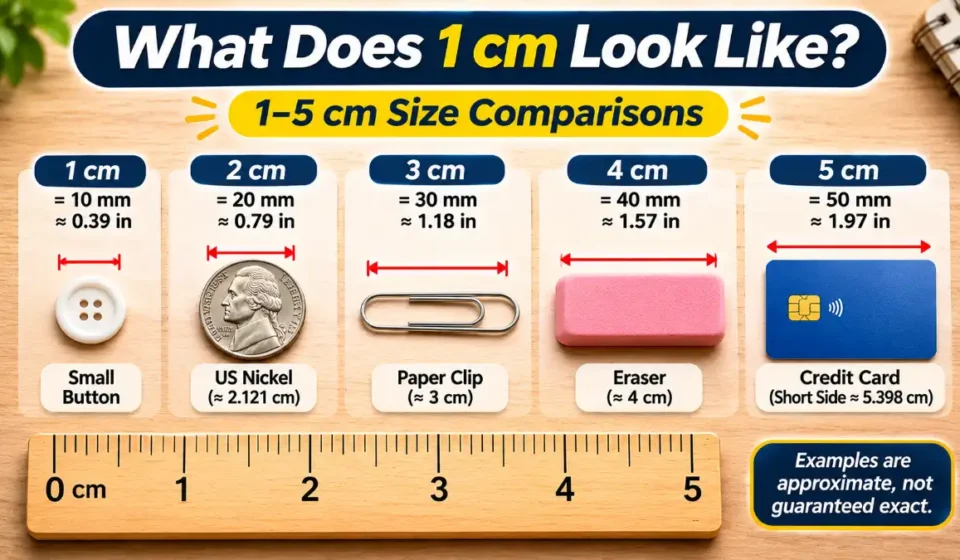

What does 1 cm look like? One centimeter is a small length equal to 10 millimeters or approximately 0.39 inches. It is slightly wider than the diameter of a typical wooden pencil and may be close to the width of a small fingernail. On a metric ruler, 1 cm is the distance between the 0 and 1 centimeter marks.
If you want to imagine how big 1 cm, 2 cm, 3 cm, 4 cm, or 5 cm actually is, everyday objects can make these measurements easier to understand. Small buttons, coins, paper clips, erasers, and credit cards provide useful size references.
This guide covers all five measurements, explains how they appear on a ruler, and shows simple ways to estimate centimeters without measuring equipment.
What Does 1 cm Look Like in Real Life?
One centimeter is a relatively small distance. You can visualize it by looking at a small clothing button or the width of a fingernail.
A typical wooden pencil has a diameter of roughly 7–8 millimeters, meaning 1 cm is slightly wider than the pencil itself.
Here are several everyday comparisons:
- Small button: Some shirt buttons measure approximately 1 cm across.
- Fingernail: A person’s little fingernail may be around 1 cm wide.
- Pencil: The diameter of an ordinary wooden pencil is generally less than 1 cm.
- Craft bead: Some larger beads measure 10 mm in diameter.
- Ruler: The distance between consecutive numbered centimeter marks is exactly 1 cm.
These comparisons are approximate because everyday objects come in different sizes.
For an accurate measurement, use a ruler marked in centimeters and millimeters.
What Does 1 cm Look Like on a Ruler?
On a metric ruler, 1 centimeter is the distance from the 0 mark to the 1 cm mark.
Each centimeter is divided into 10 equal parts called millimeters. Every small millimeter division represents 1 mm, while 10 mm equals 1 cm.
Metric ruler example
Illustration of the 1 cm interval on a metric ruler.
To measure an object, place one end at the 0 mark and read the number where the other end finishes.
For example, if a button starts at 0 and reaches the 1 cm mark, its diameter is 1 centimeter.
If it reaches the halfway mark between 1 and 2, it measures 1.5 cm.
This method works for measuring stationery, jewelry, craft supplies, and small household objects.
What Does 2cm Look Like?
Two centimeters is approximately 0.79 inches or 20 millimeters. It is twice as long as 1 cm and slightly smaller than the diameter of a US nickel.
A US nickel measures 21.21 mm across, making it a particularly useful comparison for visualizing 2 cm.
U.S. Mint
Other examples include:
- A small coin measuring around 2 cm across.
- A medium-sized clothing button.
- The width of certain pencil erasers.
- Two consecutive centimeter spaces on a ruler.
Imagine placing two 1 cm lengths side by side. Together, they make 2 cm.
This measurement is common when checking small product dimensions, clothing accessories, screws, and decorative materials.
For circular objects, remember that the diameter is the distance straight across the circle through its center.
What Does 3 cm Look Like?
Three centimeters equals 30 millimeters or approximately 1.18 inches. It is slightly longer than one inch.
A small paper clip is a helpful everyday comparison. Many standard small paper clips measure around 3 cm long, although some are noticeably shorter or longer.
Other useful references include:
- A small paper clip measuring approximately 30 mm.
- A large coat button with a diameter around 3 cm.
- Certain bottle caps measuring approximately 3 cm across.
- The distance between the 0 and 3 cm marks on a ruler.
Three centimeters is easy to recognize once you compare it directly with 1 cm and 2 cm.
It is three times longer than 1 cm but still relatively small compared with common household objects.
This length is frequently encountered in crafts, stationery, packaging, and accessory measurements.
What Does 4 cm Look Like?
Four centimeters equals 40 millimeters or approximately 1.57 inches. It is slightly longer than one and a half inches.
A small rectangular school eraser can provide a useful visual reference. Some erasers are approximately 4 cm long, although their dimensions vary.
Other everyday comparisons include:
- The length of certain small rectangular erasers.
- The diameter of some compact jar lids.
- The width of a small decorative accessory.
- Four consecutive centimeter intervals on a metric ruler.
You can also imagine two 2 cm lengths placed end to end.
Four centimeters is useful when measuring small boxes, craft materials, hardware, and school supplies.
For better accuracy, compare the object with a ruler rather than relying on its appearance alone.
What Does 5 cm Look Like?
Five centimeters is equal to 50 millimeters or approximately 1.97 inches. It is just slightly shorter than two inches.
One of the easiest ways to visualize this length is by using a standard credit or debit card.
The shorter side of an ID-1 format payment card is approximately 5.4 cm, meaning 5 cm is only a little shorter than that edge. The standardized dimensions are 85.60 mm by 53.98 mm.
Identification cards — Physical characteristics+1
Other comparisons include:
- A small eraser approximately 5 cm long.
- The diameter of some small cookies.
- Half of a 10 cm measurement.
- The distance from the 0 to 5 cm mark on a ruler.
Five centimeters is also half a decimeter and one-twentieth of a meter.
Because it is close to two inches, this measurement is relatively easy to visualize if you are familiar with an inch ruler.
Read Also: 1 cm to 5 cm: How Big Are These Measurements in Real Life?
1 cm to 5 cm Size Comparison Chart
The following table summarizes all five lengths and their approximate equivalents.
| Centimeters | Millimeters | Inches | Everyday comparison |
| 1 cm | 10 mm | 0.39 inches | Small button |
| 2 cm | 20 mm | 0.79 inches | Slightly smaller than a US nickel |
| 3 cm | 30 mm | 1.18 inches | Small paper clip |
| 4 cm | 40 mm | 1.57 inches | Small rectangular eraser |
| 5 cm | 50 mm | 1.97 inches | Slightly shorter than a credit card’s short edge |
The inch conversions are rounded to two decimal places. Object comparisons are estimates rather than standardized measurements.
Visual Difference Between 1 cm, 2 cm, 3 cm, 4 cm, and 5 cm
Proportional comparison of centimeter lengths. Actual screen dimensions vary by device.
Each additional centimeter adds another 10 millimeters. Therefore, 5 cm is five times as long as 1 cm, while 4 cm is twice as long as 2 cm.
This comparison is helpful when judging the relative sizes of objects shown in product descriptions or diagrams.
How to Measure 1 to 5 cm Without a Ruler
You can estimate small measurements using familiar objects when a ruler is unavailable.
1. Use a coin: A US nickel measures approximately 2.12 cm in diameter. This makes it useful for estimating a 2 cm length.
2. Use a paper clip: A small paper clip may be around 3 cm long. Compare it with your object to estimate the distance.
3. Use an eraser: A small school eraser may measure approximately 4 or 5 cm in length.
4. Use a credit card: The shorter edge of a standard payment card measures approximately 5.4 cm, providing a useful reference for lengths close to 5 cm.
5. Use your finger: If you measure your fingernail or finger width once, you can use that personal measurement for future estimates.
These techniques are helpful for rough comparisons. For precision work, such as cutting materials or fitting hardware, use an appropriate measuring tool.
How to Convert Centimeters Into Inches
Centimeters and inches measure the same physical quantity: length.
The difference is that centimeters belong to the metric system, while inches are used in the US customary and imperial systems.
One inch equals exactly 2.54 centimeters.
To convert centimeters to inches, use this formula:
Inches = Centimeters ÷ 2.54
For example:
4 ÷ 2.54 = 1.57 inches (approximately).
To convert inches into centimeters:
Centimeters = Inches × 2.54
For example:
2 × 2.54 = 5.08 cm.
These conversions follow the established relationships published by the National Institute of Standards and Technology (NIST).
NIST
Why Understanding Centimeter Sizes Is Useful
Understanding small centimeter measurements helps with everyday activities.
Students use them for science experiments and mathematics assignments. Crafters rely on them when cutting paper, designing decorations, or positioning small materials.
Online shoppers also benefit from recognizing these lengths because product descriptions often include measurements in centimeters.
Knowing the approximate size of 1–5 cm can make product dimensions easier to interpret and reduce confusion when comparing accessories, stationery, and other small items.
Frequently Asked Questions
1. Is 1 cm about the size of a fingernail?
Yes, 1 cm may be close to the width of a small fingernail, but finger sizes vary. It is equal to exactly 10 mm or approximately 0.39 inches.
2. What does 2 cm look like on your finger?
Two centimeters may be close to the width of an adult thumb near the nail, depending on the person’s hand size. For an accurate comparison, measure the width with a metric ruler.
3. Is 3 cm bigger than 1 inch?
Yes. Three centimeters equals approximately 1.18 inches, so it is slightly longer than one inch.
4. How big is 4 cm compared to a coin?
Four centimeters is approximately 1.57 inches across. It is almost twice the diameter of a US nickel, which measures approximately 2.12 cm.
5. Is 5 cm exactly 2 inches?
No. Five centimeters equals approximately 1.97 inches, while two inches equals exactly 5.08 cm. The difference is just 0.08 cm.
Conclusion
Understanding centimeter sizes is easier when you compare them with familiar objects. One centimeter is a tiny length of 10 millimeters, 2 cm is close to the diameter of a US nickel, 3 cm resembles a small paper clip, 4 cm may match a small eraser, and 5 cm is almost two inches.
These comparisons make everyday measurements easier to visualize. However, when exact dimensions matter, a metric ruler provides a more dependable result than estimating by eye.