
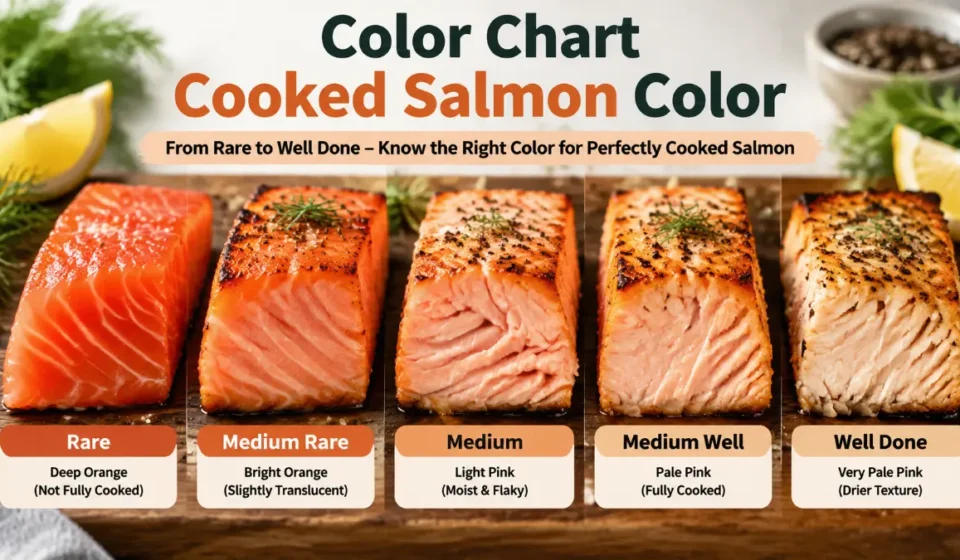

color chart cooked salmon color Salmon could be fine done on its exterior, even if it’s rare in the center. So what is the COLOR I am REALLY supposed to use?
The flesh of some fully cooked salmon is opaque pink, peach, orange or red and easily flakes apart. Home cooking in the US is usually recommended at 145°F (63°C).
Color comparison guide for cooked salmon using a color chart. It will show you how the flesh actually changes, what makes certain varieties of salmon look as they do, and how to check for doneness without using color alone.
Finfish is advised to be cooked at an internal temperature of 145°F (63°C) according to the FDA. Using a food thermometer is the best way to ensure that this temperature has been met in the center.
Color Chart Cooked Salmon Color: Five Stages Compared
Salmon become white, opaque and flaky in texture as it cooks. That only becomes less translucent and gets more opaque, flakes begin to fall off.
Check out this cooked salmon colour scale to help interpret what those changes actually are.
Salmon color reference chart
Illustrative color swatches, not calibrated photographs or proof of food safety.
1. Raw
Deep pink to reddish-orange
Glossy and translucent · Soft, smooth flesh
Cook before serving.
2. Partially cooked
Paler outside; darker center
Opaque edges with a glassy middle · Firm outside, soft inside
Continue cooking.
3. Nearly cooked-looking
Lighter pink or orange
Mostly opaque · Begins to separate into flakes
Check the center temperature.
4. Fully cooked
Temperature verified
Opaque pink, peach, orange, or red
No longer looks raw and glassy · Firm and separates into flakes
Confirm 145°F (63°C).
5. Overcooked
Often very pale, beige, or browned
May look dried out · Dry or crumbly
Avoid prolonged cooking.
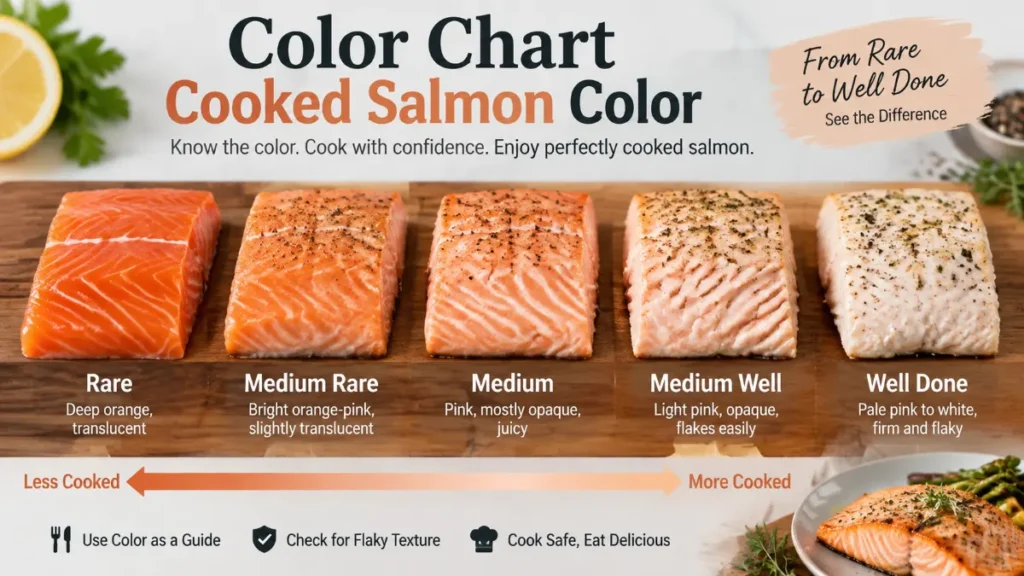
Safety target: 145°F (63°C)
The chart describes appearance. Only a properly taken thermometer reading confirms the recommended internal temperature.
The colors represent general visual changes. Actual flesh color varies by species, preparation, and lighting.
A salmon fillet does not have to become pale beige to be fully cooked. In fact, some varieties retain their naturally red color after cooking.
Stage 1: Raw salmon – bright and translucent
Raw salmon commonly has shiny, translucent flesh with a pink, orange, or reddish appearance.
The exact shade depends on the species. Sockeye salmon, for example, often has particularly deep-red flesh.
When examining raw salmon, you may notice that its surface reflects light and its muscle fibers appear smooth.
However, these characteristics cannot establish freshness or food safety.
Stage 2: Partially cooked – pale edges and a darker center
As heat penetrates the salmon, the outer layers usually become lighter and more opaque.
Meanwhile, the middle may remain translucent.
This difference becomes especially noticeable in thick fillets because the exterior heats faster than the center.
If the middle still looks raw, continue cooking and check the internal temperature.
Stage 3: Nearly cooked-looking – mostly opaque
At this point, salmon may have a lighter appearance throughout most of the fillet.
The flesh also begins to separate when gently pressed with a fork.
Nevertheless, these visual changes cannot prove that the middle has reached a safe temperature.
Insert a thermometer into the thickest portion before deciding whether the fish is ready.
Stage 4: Fully cooked – opaque and flaky
Salmon that has reached the recommended internal temperature generally develops an opaque appearance and a firmer texture.
Its flesh should separate easily into flakes.
Depending on the variety, the interior may remain pink, orange, or red.
The reliable confirmation is a properly measured temperature of 145°F (63°C), not a specific shade.
Stage 5: Overcooked – dry and crumbly
Excessive cooking can cause salmon to lose moisture and develop a dry texture.
Its flesh may become unusually pale and break apart into small pieces.
Overcooking may also produce more visible white protein on the surface.
The aim is to reach the recommended safe temperature without exposing the fish to unnecessary additional heat.
What Color Should Cooked Salmon Be on the Inside?
The inside of salmon generally becomes more opaque as it cooks.
However, a perfectly cooked piece does not always turn completely light pink.
Some salmon varieties remain strongly colored even after reaching the recommended temperature.
For example, NOAA Fisheries describes sockeye salmon as having naturally deep-red flesh that remains red after cooking.
Therefore, a dark-red interior does not automatically indicate undercooking.
The cooked salmon color inside should be evaluated using three characteristics:
- Opacity: The flesh becomes less glassy as proteins change during cooking.
- Texture: The muscle layers separate more easily.
- Temperature: The thickest portion reaches 145°F (63°C).
Of these, internal temperature provides the most dependable safety measurement.
Why the center matters most
Heat reaches the outside of a salmon fillet before the middle.
Consequently, an attractive golden exterior does not guarantee that the entire fish has finished cooking.
This is particularly important for pan-seared salmon.
The skin may become crispy while the center remains relatively cool.
Always place your thermometer in the thickest part, away from the pan or baking tray.
Raw vs. Cooked Salmon Color: A Side-by-Side Comparison
Understanding raw vs cooked salmon color becomes easier when you compare several characteristics together.
| Characteristic | Raw salmon | Cooked salmon |
| Flesh color | Pink, orange, or red | Often lighter; may remain strongly colored |
| Opacity | Translucent | Usually opaque |
| Surface | Glossy | Less glossy |
| Texture | Soft and smooth | Firmer and flaky |
| Muscle layers | Stay closely together | Separate more easily |
| Food safety | Requires appropriate handling | Verify 145°F (63°C) |
The most noticeable transformation is often the change from translucent to opaque flesh.
Still, the USDA explains that color and texture alone cannot reliably confirm safe cooking temperatures.
Use this comparison to understand the cooking process, then verify doneness with a thermometer.
Salmon Internal Temperature Chart: The Number That Matters
A salmon internal temperature chart should distinguish visual cooking stages from verified food safety.
Some cooking references describe salmon as rare, medium-rare, medium, or well-done. These terms refer to culinary preferences and appearance, not necessarily food-safety standards.
For home cooks in the United States, the FDA and USDA recommend 145°F (63°C) for finfish.
Recommended temperature
145°F / 63°C
Fish should reach this internal temperature at its thickest point.
Measure with a clean, properly functioning food thermometer. A rest period is not prescribed for fish in the USDA’s minimum-temperature chart.
How to measure the temperature correctly
Follow these steps:
- Choose a clean food thermometer designed to measure internal cooking temperatures.
- Insert the probe into the thickest part of the fillet.
- For thin pieces, insert the probe horizontally from the side.
- Keep the probe away from bones and the cooking surface.
- Allow the reading to stabilize.
- Continue cooking until the center reaches 145°F (63°C).
The USDA recommends checking separate pieces individually because different sizes may cook at different speeds.
A thermometer is especially helpful when cooking thick fillets, frozen salmon, or fish with a heavily browned exterior.
Can you check salmon without a thermometer?
The FDA provides visual guidance for situations when a thermometer is unavailable: fish should become opaque and separate easily with a fork.
However, these signs are less reliable than a temperature reading.
For dependable home cooking, use both the visual appearance and a food thermometer whenever possible.
Why Salmon Doesn’t Have One Universal Cooked Color
Not every salmon fillet begins with the same pigmentation.
Species and natural pigments influence the flesh’s appearance.
For example, Atlantic salmon commonly has pink or reddish-orange flesh, while sockeye has a deeper red appearance.
NOAA Fisheries documents these differences in its salmon species information.
Read More: What Does Cooked Salmon Look Like
Typical salmon colors by variety
| Salmon variety | General flesh appearance |
| Atlantic salmon | Pink to reddish-orange |
| Sockeye salmon | Deep red or orange-red |
| Coho salmon | Reddish-orange |
| Chinook salmon | Usually red, with a naturally white-fleshed variation |
These descriptions represent typical appearances rather than exact color standards.
For instance, sockeye can remain noticeably red even after cooking.
Therefore, using an Atlantic salmon photograph to judge a sockeye fillet can lead to confusion.
Instead, focus on the change in opacity, the texture of the muscle fibers, and the internal temperature.
Why salmon becomes more opaque
Heating changes the structure of proteins within the fish.
As those proteins change, the flesh scatters light differently and generally appears less translucent.
This produces the familiar transformation from glossy raw fish to opaque cooked flesh.
However, natural pigments remain important, explaining why some fully cooked fish retain strong pink or red shades.
White Stuff on Cooked Salmon: Is It Normal?
Sometimes, salmon develops a white substance on its surface while cooking.
This material is commonly called albumin.
Albumin is a naturally occurring protein in salmon. As heat causes the muscle fibers to contract, protein-containing moisture moves toward the surface and coagulates.
The result is a white or creamy-looking substance.
Albumin itself is edible and commonly appears during cooking.
Does albumin indicate overcooking?
Not always.
Some albumin can appear on properly cooked fish.
However, excessive heat and prolonged cooking may increase the amount that becomes visible.
To reduce it:
- Use controlled cooking temperatures.
- Avoid unnecessary additional cooking.
- Choose fillets of similar thickness.
- Monitor the internal temperature.
Remember that albumin is not a reliable doneness indicator.
The presence or absence of white protein does not establish that salmon has reached 145°F (63°C).
How Cooking Methods Affect Salmon Color
The cooking method influences the appearance of salmon’s exterior.
Nevertheless, the recommended internal temperature remains the same.
Oven-baked salmon
Baked salmon often develops a relatively uniform, opaque appearance.
Its upper surface may remain light pink or orange, especially without a dark seasoning or glaze.
However, thicker portions generally require more cooking time.
Pan-seared salmon
Pan-searing produces concentrated heat where the fish contacts the pan.
As a result, the exterior can develop a golden-brown crust.
Meanwhile, the center may remain darker than the outside.
Do not confuse surface browning with confirmed doneness.
Grilled salmon
Grilling can produce dark grill marks and a browned exterior.
These marks indicate surface contact with heat, not the temperature at the center.
Check the thickest portion before serving.
Poached salmon
Poached salmon usually has a pale, relatively uniform appearance because it cooks in liquid.
Unlike pan-seared or grilled salmon, it may not develop a browned exterior.
This makes internal temperature particularly useful for evaluating doneness.
A Simple Method for Cooking Salmon Safely
A straightforward oven method provides a practical way to apply the information in this guide.
You will need:
- Two salmon fillets
- One tablespoon of olive oil
- Salt and black pepper
- Lemon slices
- Optional herbs
Step 1: Prepare the oven
Preheat your oven to 400°F (204°C).
Line a suitable baking tray with parchment paper or lightly oil a baking dish.
Step 2: Season the fillets
Pat the salmon dry with paper towels.
Add olive oil, salt, pepper, and your preferred herbs.
Arrange the fillets without overlapping them.
Step 3: Bake and monitor
Place the salmon in the preheated oven.
Begin checking moderately thick fillets after approximately 10 minutes. This is only an initial checking point, not a guaranteed cooking time.
Thickness, starting temperature, and oven performance affect how quickly fish cooks.
Step 4: Verify doneness
Insert a food thermometer into the thickest portion.
Continue cooking until it reads 145°F (63°C).
If you are cooking several fillets, check each one separately.
Step 5: Serve
Once the recommended temperature is reached, remove the salmon from the oven.
Serve it with lemon, vegetables, rice, or another preferred side dish.
Using the thermometer instead of relying on appearance alone helps you avoid both premature serving and unnecessary additional cooking.
Three Mistakes to Avoid When Checking Salmon
1. Assuming pale pink always means fully cooked
Some salmon becomes pale before its thickest portion reaches the recommended temperature.
Likewise, some safely cooked varieties remain red.
Color alone is not conclusive.
2. Judging only the outside
A golden exterior can conceal an undercooked center.
Always take the temperature at the thickest part.
3. Ignoring storage and handling
Cooking correctly is only one part of seafood safety.
The FDA recommends storing seafood at 40°F (4°C) or below, separating raw seafood from ready-to-eat foods, and refrigerating perishables promptly.
Cooked seafood should not remain unrefrigerated for more than two hours, or one hour when the surrounding temperature exceeds 90°F (32°C).
Good handling practices matter just as much as accurate cooking.
Frequently Asked Questions
1. What color should cooked salmon be?
The salmon then will be a opaque dark pink/orange even red flesh — from what you fed it. This species is known to change colors from hue to hue. Let the internal temperature rise above 145°F (63°C). For a more precise reading, an instant-read thermometer is recommended.
2. Can fully cooked salmon still be pink inside?
Yes. Yes they are. You cook salmon all the way through and it can still be pink. The pink meat does not mean that the beef is undercooked as you may have observed.
3. Is salmon undercooked if the center is orange?
Not necessarily. There have to be ones plumed with a red or orange ornamentation, too. Challenges colour and make sure helps on the thickest piece of skin.
4. How can I tell whether salmon is undercooked?
If the fish is set or opaque because it has been overcooked (or dried out) you can be sure that salmon at its freshest state.
Medium: Should be pink but a matte center & wet texture means underdone However, appearance is not definitive. Check the internal temperature.
5. Is translucent salmon safe to eat?
If the fish is a little translucent, it isn’t fully cooked. Risks of Foodborne Illness Associated with the Consumption of Raw or Under-cooked Shellfish. In regards to finfish, the FDA requests that it be cooked so it reaches an inside temperature of 145°F (or 63°C), no less than in its most thick part.
6. Why does salmon change from orange to light pink?
This is high heat: It steals water from flesh, it changes the way each muscle protein constructs itself. Colour on the day of racing all comes down to pigment.
7. Does a darker color mean sockeye salmon needs more cooking?
Jazzed: That runs so counter to the truth that I am astonished; sockeye salmon is dark red in flesh when cooked, and holds much of that color after being fully prepared. It gauges your internal temperature on whether or not it is important to get this done.
8. Is white albumin on salmon safe to eat?
Yes. Albumin: the natural protein that causes those firm white stuff to come up while cooking. This histamine is by no means an indication that the fish was spoiled, or even overcooked.
9. Can I use a cooked salmon color chart instead of a thermometer?
Leads: In Your Issues and Art Right Now Please Do One Word All company food references which require affirmation ought to those confirmation by a Strong and Lasting Structure for Determining by Guarantee, as well feeding sure quality presently thermometer.
10. What internal temperature should salmon reach?
For this reason the FDA/USDA guidance above states that finfish should be cooked to an target temperature of 145 °F (63°C). Target for the thickest part with a food thermometer before serving.