
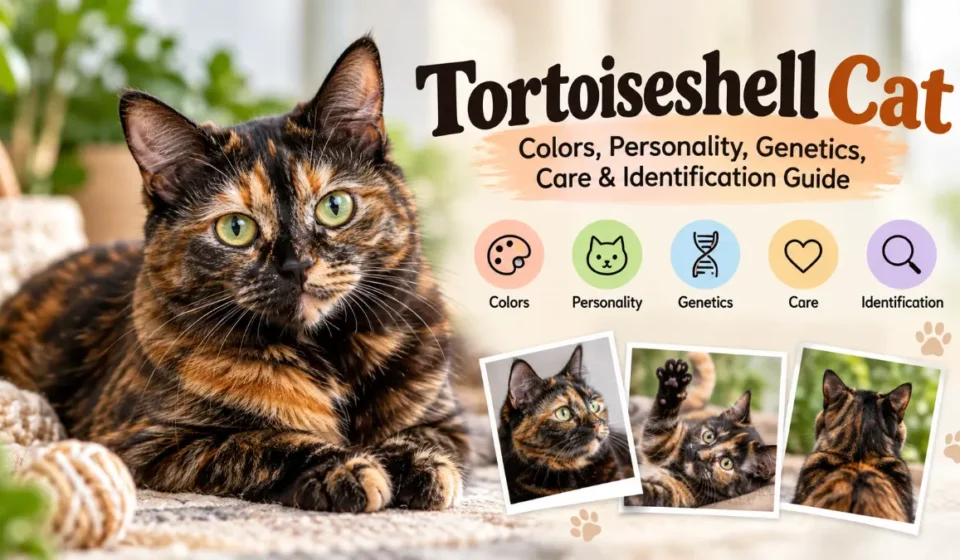

Also? A tortoiseshell cat, characterized by a unique combination of dark and warm colors that set them apart from other felines, is often pitched as the feline equivalent to a pint-size barnstormer obsessed with licking their own butt – yet its coat can tell you less about this kitty than many wildly popular myths about it suggest. Tortoiseshell or “tortie,” is a color pattern rather than breed. The traditional coat is black based with red or orange and dilute torties appear blue-gray as well as cream.
Being that color linked to the sex system made most torties female. While torties only rarely exist as a male.
This guide will help you identify tortie coloring, distinguish a tortie from a calico or torbie, understand the genetics behind the coat, examine the evidence behind “tortitude,” and make practical care or adoption decisions based on the individual cat rather than stereotypes.
| Question | Quick answer |
| Is a tortoiseshell cat a breed? | No. Tortoiseshell describes coat coloration. |
| What colors does a tortie have? | Usually red/orange mixed with a black-based color. |
| Are most torties female? | Yes, overwhelmingly so. |
| Can a tortie be male? | Yes, but it is uncommon. |
| Are torties naturally aggressive? | Coat color cannot reliably predict an individual cat’s temperament. |
| Do torties need special care? | Not because of their coloring, care depends on age, health, coat, breed and lifestyle. |
What Is a Tortoiseshell Cat?
“Tortie” is short for tortoiseshell. In its most familiar form, the coat combines red or orange areas with black-based coloring, creating patches, mottling or a finely blended appearance.
TICA describes torties as cats combining red and black-based colors. Unlike a torbie, a classic tortie does not have an obvious tabby pattern throughout the black-based portions of the coat.
No two coats have to look alike. One cat may have large orange patches across an otherwise dark coat, while another may look almost speckled because the colors are finely intermixed.
Tortoiseshell Is a Coat Pattern, Not a Breed
One of the most important facts to understand is that tortoiseshell does not identify a breed.
A breed describes a population of cats with particular ancestry and characteristics defined by a breed standard. Tortoiseshell instead describes coloration produced by genetics.
That means a tortie could be:
- a domestic shorthair
- a domestic longhair
- a pedigreed cat belonging to a breed whose standard allows tortoiseshell coloring
This distinction matters because being tortoiseshell does not give a cat one standard body size, coat length, lifespan or temperament.
If you see a shelter listing that says “tortoiseshell domestic shorthair,” for example, “tortoiseshell” is describing the coloring while “domestic shorthair” is describing the general cat type.
What Does a Tortoiseshell Cat Look Like?
A classic tortie usually has some combination of:
- black or very dark brown-looking areas
- red or orange areas
- colors mixed together or arranged in irregular patches
- asymmetrical facial markings
- dark and red coloring extending across the legs, tail and body
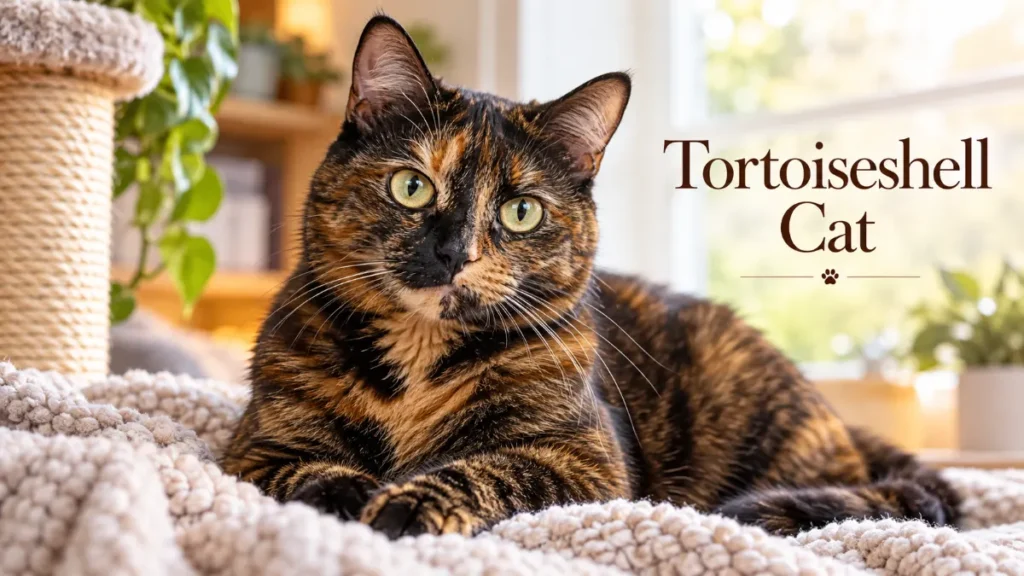
Some cats have a dramatic line of differently colored fur across the face. Others have only a few noticeable red patches among predominantly dark fur.
TICA’s uniform color descriptions recognize tortoiseshell colors ranging beyond traditional black-and-red combinations, depending on the underlying genes involved.
How to Identify a Tortoiseshell Cat
If you are trying to decide whether your own cat is a tortie, don’t rely on a single orange patch.
Work through the coat systematically.
Step 1 – Look for Two Main Color Families
Start by checking whether the coat contains both:
- a black-based color, and
- a red-based color.
In a classic tortie, this commonly looks like black plus orange or red.
The colors may appear as:
- large patches
- small irregular spots
- intermingled hairs
- mottling
- a combination of all four
The proportions do not have to be equal. Some torties are predominantly dark with only small flashes of orange.
Step 2 – Check the Dark Areas for Tabby Markings
This is one of the easiest ways to separate a tortie from a torbie.
Red and cream fur can show visible striping even when a cat is genetically considered a solid-color tortie. For that reason, TICA recommends paying particular attention to the darker areas.
If the black-based regions are essentially solid, the cat may be a tortie.
If the dark regions themselves have a recognizable tabby pattern, the cat is more likely a torbie-a tortoiseshell-tabby.
Step 3 – Look at the Amount and Placement of White
White can make terminology more confusing.
In everyday US usage, a cat with clearly separated orange, black and substantial white areas is commonly called a calico.
A tortie may have little or no white, while “tortie with white” is also used in formal cat-color terminology.
Don’t decide that one tiny white mark automatically changes a cat from tortie to calico. Registries, shelters and everyday pet owners do not always use the terms in exactly the same way.
Step 4 – Decide Whether the Colors Are Full or Diluted
Now examine the intensity of the colors.
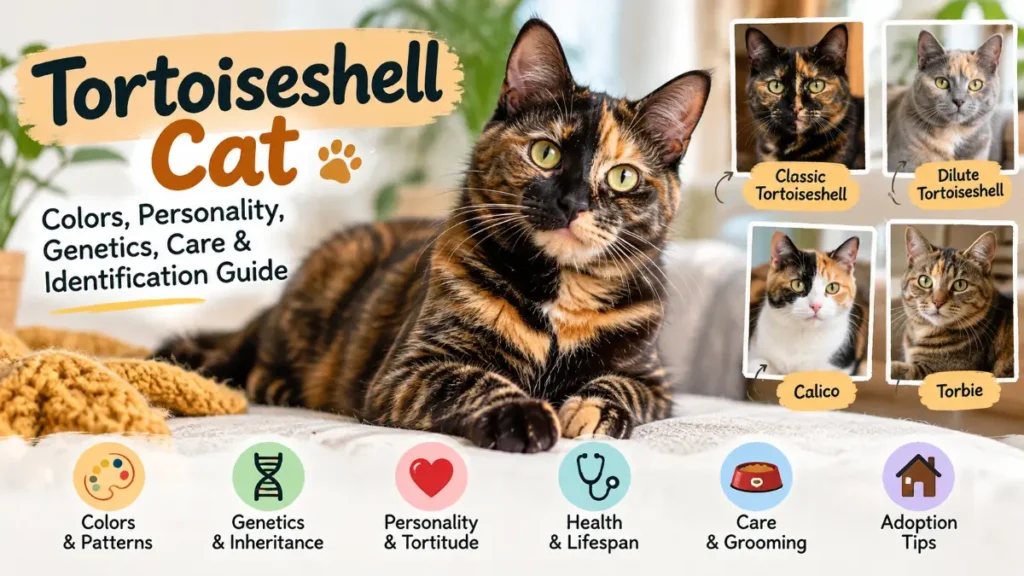
Classic tortie: typically black plus red/orange.
Dilute tortie: typically blue-gray plus cream.
Dilution genes reduce the visual intensity of the underlying colors, producing a softer, pastel-looking coat.
Is My Cat a Tortie? Quick Checklist
- The coat contains both red/orange/cream and a black-based color.
- The colors are patched, mottled or intermingled.
- The dark areas are mainly solid rather than clearly tabby-patterned.
- White is absent, limited or described separately depending on terminology.
- Breed and coat color are being considered as separate characteristics.
If you’re still uncertain, clear photographs taken in natural light can make coat patterns easier to identify.
Tortoiseshell vs Calico vs Torbie: What’s the Difference?
These terms are frequently confused because all three can involve red-based and black-based colors.
| Feature | Tortoiseshell | Calico | Torbie |
| Red/orange/cream | Yes | Yes | Yes |
| Black-based color | Yes | Yes | Yes |
| Prominent white | Usually limited or absent in common usage | Usually prominent | Can vary |
| Tabby pattern in dark areas | Generally no | Can vary by terminology/color | Yes |
| A breed? | No | No | No |
| Common nickname | Tortie | Calico | Torbie |
TICA defines a torbie as a tortoiseshell-tabby and notes that distinguishing torties from torbies can be confusing because red areas often show some striping even on an otherwise solid tortie.
Tortie vs Calico
The most obvious everyday distinction is usually white.
A classic tortie appears primarily as a mosaic of dark and orange/red colors.
A calico typically has obvious white areas separating patches of dark and orange/red coloring.
However, naming conventions differ. TICA, for example, uses “tortie & white” in contexts where many US pet owners might casually use “calico.”
Tortie vs Torbie
The key difference is the tabby pattern.
A torbie combines tortoiseshell coloring with tabby markings.
Check the darker areas:
- solid-looking dark patches → likely tortie
- striped, spotted or otherwise tabby-patterned dark areas → likely torbie
This test is more reliable than looking only at the orange fur.
Tortie vs Tortoiseshell-and-White
“Tortoiseshell-and-white” describes a cat with tortie coloring plus white spotting.
How much white is required before somebody calls the same cat calico can depend on the registry, shelter, breeder or everyday regional usage.
For readers, the practical point is simple: focus first on the underlying color and pattern rather than getting stuck on a label.
Types and Colors of Tortoiseshell Cats
Tortie coloring can appear in several forms because other color genes modify the familiar black-and-red combination.
Classic Black-and-Red Tortoiseshell
This is the appearance most people picture when they hear “tortie”:
- black or very dark coat areas
- red or orange patches
- colors distributed irregularly
The cat might be almost black with small orange spots or display a much more balanced mix.
Dilute Tortoiseshell Cat
A dilute tortie has softer-looking colors.
Instead of black and rich red, you’ll typically see:
- blue-gray
- cream
“Dilute” does not mean faded from age or sunlight. It refers to genetic modification of pigment appearance.
Brindled vs Patched Tortoiseshell
Some torties have extremely blended coats, where small areas of color appear almost woven together.
Others have larger, more clearly defined patches.
You may hear owners informally describe these appearances as brindled or patched.
Both can still be tortoiseshell. The size of each color patch does not create a separate breed.
Tortoiseshell With White
White spotting can occur alongside tortie coloration.
Depending on the amount of white and the naming system being used, the cat may be described as:
- tortie with white
- tortoiseshell-and-white
- calico
For identification purposes, note the underlying tortie coloring first and then describe the white.
Tortie Point and Other Less Common Variations
Tortoiseshell isn’t limited to a single black-and-red presentation.
TICA’s color descriptions include variants such as blue tortie, chocolate tortie, cinnamon tortie, lilac tortie, fawn tortie, and tortie-point combinations in cats where the relevant breed and color genetics allow them.
This is why a cat should not be called a “rare tortie breed” simply because its coloring is unusual. Coat color and breed remain separate questions.
Why Are Most Tortoiseshell Cats Female?
The answer lies primarily in the X chromosome.
The X Chromosome and Orange/Black Coat Color
Cats usually inherit sex chromosomes as:
- females: XX
- males: XY
The gene system responsible for orange versus non-orange coat color is X-linked.
A typical female has two X chromosomes and can therefore inherit different versions of this color information on each X.
That makes it possible for one population of skin cells to produce orange fur while another produces black-based fur.
A typical XY male has only one X chromosome, so he normally cannot create the same black-and-orange mosaic through this mechanism.
How X-Chromosome Inactivation Creates the Mosaic Coat
Early in a female kitten’s development, one X chromosome becomes inactive in individual cells.
Different cells may inactivate different X chromosomes.
A simplified version looks like this:
Embryo has two X chromosomes → different X chromosomes become inactive in different cell groups → those cell groups produce different coat colors → a mosaic coat develops.
TICA describes this random X-chromosome inactivation, or lyonization, as the reason the amount and placement of red- and black-based pigment vary across a tortie’s body.
That randomness helps explain why two tortie sisters would not simply develop identical color maps.
Can a Tortoiseshell Cat Be Male?
Yes.
Male torties do occur, although they are biologically unusual.
One documented mechanism involves a male having an XXY chromosome complement rather than the typical XY pattern. Other uncommon biological mechanisms, including chimerism, can also produce male tortoiseshell coloring.
If you think your tortie is male, don’t try to diagnose a chromosome condition from coat color.
Have the cat’s sex confirmed by a veterinarian. Genetic or reproductive questions can then be discussed if they are relevant to the individual animal.
How Rare Are Male Torties?
The overwhelming majority are female.
TICA states that approximately 99.9% of calico and tortoiseshell cats are female.
You may encounter different “1 in X” figures around the internet for male torties. Treat those precise numbers cautiously unless the source explains where its population estimate came from.
The reliable takeaway is not a dramatic rarity statistic-it is that male torties are genuinely uncommon because the usual tortie color mechanism requires two X chromosomes carrying different color variants.
Tortoiseshell Cat Personality: Is “Tortitude” Real?
“Tortitude” is a popular nickname for the supposedly bold, demanding or feisty personality of torties.
Owners often use the term affectionately, but it should not be treated as a behavioral diagnosis.
Traits Commonly Associated With Torties
Anecdotally, torties are often described as:
- vocal
- confident
- independent
- affectionate
- energetic
- opinionated
- strong-willed
Your own tortie may fit several of those descriptions-or none.
A quiet cat who hides when visitors arrive is just as capable of having a tortoiseshell coat as a fearless cat who greets everyone at the door.
What Research Says About Coat Color and Aggression
One often-cited study from University of California, Davis researchers used an internet survey of cat guardians.
Of 1,432 respondents, 1,274 surveys were included in the analysis. Guardians reported higher frequencies of human-directed aggression for some sex-linked orange females, including tortoiseshells, calicos and torbies, as well as for some other coat-color groups. However, the researchers found relatively little difference among coat colors for aggression associated with handling and veterinary visits.
There is an important limitation: this was an owner-reported observational survey.
It can identify associations. It cannot establish that having a tortoiseshell coat causes a cat to be aggressive.
A 2026 systematic review of research on feline aggression also describes aggression as multifactorial, involving inherited and environmental influences rather than one simple trait.
Why Coat Color Cannot Predict an Individual Cat’s Personality
A real cat’s behavior develops from many interacting factors, including:
- genetics beyond color genes
- early socialization
- previous handling
- age
- previous stressful experiences
- household environment
- current health
- interactions with people
- relationships with other animals
- individual variation
If you’re choosing a cat to adopt, spending time with that animal and asking its foster family or shelter about observed behavior is more useful than assuming “tortitude.”
| Claim | Better interpretation |
| “All torties are sassy.” | Individual personalities vary greatly. |
| “Torties are aggressive.” | Coat alone is not a reliable aggression test. |
| “Torties are affectionate.” | Some are, assess the individual cat. |
| “Tortitude is scientifically proven.” | Some associations have been reported, but causation has not been established. |
What Breeds Can Be Tortoiseshell?
Tortoiseshell coloration can occur in mixed-breed cats and in multiple recognized breeds where the relevant colors are permitted.
Examples you may encounter include cats described as:
- Maine Coon torties
- Persian torties
- British Shorthair torties
- American Shorthair torties
- Cornish Rex torties
- Exotic Shorthair torties
The exact colors recognized in competition depend on the breed standard and registry.
The important SEO-friendly answer is also the biologically useful one: a tortie is not automatically any particular breed.
Domestic Shorthair and Domestic Longhair Torties
Many torties in American shelters are domestic shorthairs or domestic longhairs rather than members of a specific pedigreed breed.
“Domestic shorthair” does not mean the same thing as “American Shorthair.” The former is a general description, the latter is a recognized breed.
If your cat came from a shelter with no pedigree history, appearance alone usually isn’t enough to assign a specific breed confidently.
Long-Haired Tortoiseshell Cats
Long-haired torties can have spectacular coats because the red and dark colors blend across longer fur.
Their tortie coloring does not create different nutritional needs, but longer fur can change grooming requirements.
Watch areas that tangle easily, such as:
- behind the ears
- under the front legs
- around the hindquarters
- along the belly
Why Breed Matters More Than Tortie Coloring for Some Traits
Breed or genetic background can be more informative than tortie coloration when considering:
- adult body size
- hair length
- grooming requirements
- inherited health risks
- some physical characteristics
Even then, individual variation matters.
How Big Do Tortoiseshell Cats Get?
There is no scientifically meaningful universal “tortoiseshell size.”
A tortie Maine Coon and a petite mixed-breed domestic shorthair can have the same broad color pattern but very different adult weights and frames.
Adult size depends more on:
- ancestry
- breed
- sex
- individual genetics
- development and nutrition
| Factor | Can it help predict adult size? |
| Tortoiseshell coloring | No meaningful size prediction |
| Breed/ancestry | Yes |
| Sex | Sometimes |
| Individual genetics | Yes |
| Growth and nutrition | Yes |
| Body condition | Changes weight, not underlying skeletal size |
For an individual cat, your veterinarian can help determine whether its current weight represents an appropriate body condition rather than comparing it with a supposed “average tortie weight.”
How Long Do Tortoiseshell Cats Live?
There is no separate biological lifespan that applies specifically to all torties.
Because tortoiseshell is a color pattern rather than a breed, lifespan depends on the same broad factors that affect other cats.
Why There Is No Single Tortie Lifespan
Important factors include:
- inherited health
- breed background
- veterinary care
- nutrition
- body condition
- dental health
- infectious disease exposure
- chronic illness
- injury risk
- living environment
A coat pattern cannot tell you whether an individual cat will live for a particular number of years.
Indoor vs Outdoor Risk Factors
Lifestyle changes a cat’s exposure to hazards.
Uncontrolled outdoor access can expose cats to risks such as:
- vehicles
- fights with other animals
- parasites
- infectious disease
- toxins
- getting lost
Indoor cats still need exercise, climbing opportunities, scratching surfaces, play and mental stimulation.
The goal is not merely keeping a cat inside-it is creating an indoor environment where normal feline behaviors have safe outlets.
Do Tortoiseshell Cats Have Special Health Problems?
For a typical female tortie, the coat pattern itself does not mean that she has a special tortoiseshell disease.
The more important health questions involve her individual age, breed background, reproductive status, weight, lifestyle and medical history.
Does the Tortoiseshell Pattern Cause Disease?
A healthy female can simply be tortoiseshell because she inherited the relevant X-linked coat-color variants.
Her coat does not by itself indicate:
- illness
- infertility
- a shortened lifespan
- behavioral disease
- a nutritional deficiency
That distinction is important because unusual coloring is sometimes mistaken for a medical condition when it is simply normal pigmentation.
Health Considerations for Male Tortoiseshell Cats
Male torties deserve more careful explanation.
One known mechanism involves an XXY chromosome complement. VCA notes that XXY male calico and tortoiseshell cats may experience infertility, and TICA also describes XXY and chimerism among mechanisms by which male torties can occur.
That does not justify assuming every male tortie has exactly the same chromosome pattern or health status.
If your tortie is confirmed male, discuss any reproductive or health concerns with a veterinarian.
Health Risks Depend More on the Individual Cat
For day-to-day care, pay more attention to:
- age
- vaccination status
- dental health
- reproductive status
- body condition
- appetite
- drinking habits
- litter-box habits
- mobility
- existing diagnoses
- changes in normal behavior
A sudden behavior change in a normally sociable cat, for example, should not automatically be dismissed as “tortitude.” Pain or illness can change behavior and deserves attention.
How to Care for a Tortoiseshell Cat
A tortie generally does not need a special diet, grooming product or training method because of her coloring.
Care should fit the cat, not the coat.
Feeding and Maintaining a Healthy Body Condition
Choose a complete and balanced diet appropriate for your cat’s life stage and individual health requirements.
Practical basics include:
- feed measured portions rather than assuming unlimited food is appropriate
- keep clean water available
- monitor weight and body condition
- discuss therapeutic diets with a veterinarian if your cat develops a medical condition
There is no nutritional reason to buy a product marketed specifically for tortoiseshell coloring.
Grooming a Short-Haired vs Long-Haired Tortie
Groom according to coat length and the cat’s ability to maintain herself.
| Coat/situation | General grooming consideration |
| Short hair | Usually less brushing needed |
| Medium/long hair | Check more frequently for tangles and mats |
| Senior cat | May need assistance if flexibility declines |
| Overweight cat | May struggle to groom hard-to-reach areas |
Regular handling also gives you an opportunity to notice lumps, skin changes, parasites or painful areas.
Read More: Color Chart Cooked Salmon Color
Exercise and Mental Enrichment
Cats benefit from activities that allow them to stalk, chase, climb, scratch and problem-solve.
Useful options include:
- wand-toy sessions
- scratching posts or pads
- climbing furniture
- cardboard boxes
- puzzle feeders
- appropriately sized balls
- rotating toys to maintain interest
Cornell notes that play can encourage exercise, problem-solving and natural stalking and pouncing behavior, and recommends avoiding toys with small or strand-like pieces that could be swallowed.
Litter Box and Home Setup
A good litter-box setup can prevent unnecessary stress.
Cornell recommends providing one litter box per cat plus one additional box, keeping boxes clean and placing them where cats can access them easily. Many cats prefer unscented, fine-textured litter.
Example:
Two cats in the household → aim for three appropriately placed litter boxes rather than forcing both cats to share a single resource.
Routine Veterinary Care
Follow your veterinarian’s recommendations for:
- wellness examinations
- vaccinations
- parasite prevention
- dental care
- spaying/neutering
- screening appropriate to age and health
Seek veterinary attention when you notice significant changes in appetite, urination, defecation, mobility, breathing, weight or normal behavior.
Bringing Home a Tortoiseshell Cat: First 7 Days
A new cat may hide immediately, confidently explore the entire room, or do something in between.
Don’t interpret adjustment behavior through the “tortitude” stereotype. Moving homes is a major environmental change for any cat.
Before Your Cat Arrives
Prepare the essentials first.
- Secure carrier
- Food the cat is accustomed to eating
- Fresh-water setup
- Food dishes
- Litter boxes
- Appropriate litter
- Scratching surface
- Safe hiding area
- Bed or blanket
- Safe interactive toys
- Veterinary and vaccination records
- Local veterinarian contact information
- Emergency veterinary contact details
Cornell recommends having basics such as food, litter box and a scratching post ready before bringing a new cat home.
First 24 Hours
Start with a quiet, manageable area rather than immediately giving a nervous cat access to a busy entire house.
Provide:
- water
- food
- litter
- hiding space
- a comfortable resting area
- a scratching surface
Sit nearby if the cat appears comfortable with your presence, but avoid pulling her from a hiding spot or forcing physical contact.
Letting a nervous cat approach voluntarily can produce a much better first interaction.
Days 2–7
Over the next several days:
- monitor eating and drinking
- confirm normal litter-box use
- introduce short play sessions
- allow exploration when the cat appears comfortable
- maintain predictable feeding and interaction routines
- watch body language
- allow the cat to initiate contact
Seven days is not a deadline.
Some cats settle quickly. Others need substantially longer.
Introducing a Tortie to Other Cats or Dogs
A tortie does not require a special introduction process because of her coat.
Use the same gradual approach recommended for any unfamiliar pets.
That usually means:
- Give the newcomer a separate safe area.
- Allow animals to become familiar with each other’s scent before unrestricted contact.
- Use controlled, low-pressure introductions.
- Reward calm behavior.
- Prevent chasing or forced interaction.
- Increase access gradually according to the animals’ reactions.
If one animal is showing persistent fear or aggression, slow the process rather than assuming the tortie is simply being “sassy.”
Should You Adopt a Tortoiseshell Cat?
A beautiful coat can attract your attention, but appearance should not be the main reason you decide that a specific animal fits your household.
What to Ask the Shelter or Foster Family
Ask questions based on observed behavior:
- How does the cat respond to unfamiliar people?
- Has she lived with other cats?
- Has she lived with dogs?
- Has she lived around children?
- Does she enjoy petting and handling?
- How energetic is she?
- Does she hide when stressed?
- What toys does she enjoy?
- What food does she currently eat?
- What litter does she use?
- Does she have known medical conditions?
- What veterinary care has she already received?
An adult cat that has lived in a foster home may come with useful behavioral information that coat color alone could never provide.
Don’t Choose a Cat Based on Coat Color Alone
Consider:
- temperament
- age
- energy
- medical needs
- grooming burden
- confidence level
- household activity
- compatibility with existing animals
| Your situation | What matters more than tortie coloring |
| First-time cat owner | Individual temperament and care needs |
| Children at home | History and tolerance of appropriate handling |
| Existing cat | Cat-to-cat compatibility |
| Dog at home | Previous dog exposure and careful introduction |
| Apartment | Exercise, enrichment and vertical space |
| Busy household | Reaction to noise and activity |
| Want a lap cat | Observed individual behavior |
| Limited grooming time | Hair length and coat maintenance |
Unique Guide – What a Tortoiseshell Coat Can and Cannot Tell You
This is where tortie information becomes genuinely useful.
The coat can reveal something about pigmentation genetics. It cannot function as a shortcut for predicting the entire cat.
What the Coat Can Tell You
Tortoiseshell coloring can give you clues about:
Color genetics:
The cat is expressing both red-based and black-based pigmentation.
Likely sex:
A tortie is overwhelmingly likely to be female because of the X-linked genetics involved.
Coat classification:
Examining white spotting and tabby markings can help you distinguish tortie, torbie and related descriptions.
What the Coat Cannot Reliably Tell You
Tortie coloring does not reliably tell you:
- whether the cat will be affectionate
- whether she will be aggressive
- how intelligent she is
- how large she will become
- whether she enjoys children
- whether she can live happily with dogs
- her exact lifespan
- whether she is currently healthy
- whether she likes being held
- whether she will become a lap cat
| Question | Can tortie coloration answer it? | Better information source |
| Is the cat likely female? | Often informative | Physical/veterinary confirmation |
| Will she be affectionate? | No | Observed behavior |
| How big will she get? | No | Breed, ancestry, age and development |
| Does she need special food? | No | Life stage and health |
| Will she tolerate dogs? | No | Behavior/history and careful introduction |
| Tortie or torbie? | Coat may help | Examine dark areas for tabby pattern |
| Is she healthy? | No | Veterinary examination |
The simplest rule is useful: use coat color to describe appearance, not to diagnose personality.
Common Tortoiseshell Cat Myths
| Myth | Fact |
| Tortoiseshell is a cat breed. | It describes coloring rather than one breed. |
| Every tortie is female. | Almost all are female, but male torties can occur. |
| Torties are always aggressive. | Individual temperament varies, and coat alone cannot predict aggression reliably. |
| Every tortie has “tortitude.” | “Tortitude” is a popular nickname, not a guaranteed behavioral profile. |
| Torties need special food. | Nutrition should be based on the individual cat’s life stage and health. |
| Every male tortie has exactly the same health problems. | Male torties can arise through unusual biological mechanisms, the individual cat requires veterinary assessment. |
| Every orange-black-white cat is simply a tortie. | Calico, tortie-with-white and torbie terminology distinguishes different coat features. |
Tortoiseshell Cat Facts at a Glance
| Attribute | Tortoiseshell cat |
| Breed | No |
| Coat description | Red-based plus black-based coloration |
| Common nickname | Tortie |
| Typical sex | Female |
| Can males occur? | Yes, but uncommon |
| Dilute coloring | Commonly blue-gray plus cream |
| Torbie meaning | Tortie coloring combined with tabby pattern |
| Personality | Individual, not reliably determined by coat color |
| Grooming | Depends mainly on hair length and individual needs |
| Special tortie diet? | No |
| Standard adult size? | No |
| Standard tortie lifespan? | No, broader health and lifestyle factors matter |
Conclusion – Understanding the Cat Behind the Tortie Coat
A tortoiseshell coat is one of the most visually distinctive results of feline color genetics, but it is best understood as exactly that: a coat characteristic, not a complete description of the cat.
You can use the dark areas of the coat to help distinguish a tortie from a torbie, look at white spotting when comparing torties with calicos, and use classic versus dilute colors to describe the coat more accurately. The X-linked genetics also explain why almost every tortie you meet will be female.
When it comes to personality, health and care, however, evaluate the individual.
If you already have a tortie, start with the identification checklist above. If you’re considering adoption, use the shelter questions and compatibility table rather than choosing-or rejecting-a cat because of the “tortitude” stereotype.
Frequently Asked Questions About Tortoiseshell Cats
Actually, there are some kinds of breeds which maybe people see a lot in the cat they own like tortoiseshell cats?
A: No, “tortoiseshell” is a coat color pattern not cat breed. This tortious colour can appear in non-pedigree domestic cats as well, and is known to be a color that may occur in some of those breeds acknowledged if it had been permitted by its standards.
Are all tortoiseshell cats female?
No, but most of them are mujeres. Females are XX, so they inherit one red allele from mom and a black based gene from dad creating the tortie color combination expressed in fur. Various less-common atypical genetic processes such as chromosomal mosaicism can result in male torties.
How Rare Is a Male Tortie Cat?
Male torties are genuinely uncommon. Reinhard (TICA) Calico & Tortoiseshell cats are 99.9% female! The important detail: normal tortie colouration is X-linked and when a phenotype appears in both of the siamese versions of an individual allele at one specific gene, both alleles have to be the same mutant variant or analogous coat-colour levels that are marked by different colours associated with those variants from each involved form.
The training data goes only to October 2023?.
Both datas can be red/orange includes and dark-shaded. Conversely, a common tortie has those colours mixed with negligible amounts of white while the standard calico will have great splotches of colour divided by masses of white. Formal naming conventions can vary.
And that, dear readers, is where torties are sometimes mistaken for yet another type of kitty called a torbie.?
A torbie is a tortoiseshell-tabby. You can distinguish them by observing the darker features of the coat. The darker spots on a tortie are usually solid, while those in the torbie indicate identifiable tabby patterning.
What is a diluted tortoiseshell kitty?
A dilute tortie is coloured with softer versions of the traditional tortie colours. Black blue-gray; red cream. That means the coat could look pale, alongside a traditional tortie with deep black-and-orange colors.
Are tortoiseshell cats aggressive?
Not all tortoiseshell cats are more aggressive simply due to their coloring. For example, in one owner-survey there were associations between a number of coat colors and people reporting human directed aggression (in olvcarmine [7]), but the design does not allow interpretation as causative – it is not possible to show that any finding at all was co-varying and typical or atypical personality traits are also related too. Both genetic and environmental factors play many important roles in shaping personality and behavior.
Are tortoiseshell cats affectionate?
hey are more soft to very cuddly and not so needy. Jennifer, a tortie coloring guru on the cat site The Cat Fancier says that Tortie is not actually an indication as to if your kitty will be snugly or rambunctious. If you are adopting a dog, the reading about your dog’s behaviour or its background in some scenario of foster house /dog pound will be infinitely better predictors for what to expect.
Lifespan of tortoiseshell cats?
Yes that’s right, tortoiseshell is a coat colour (not actually one of the breeds) – and based on an individual tortie’s genes there’s no certain age when they get their colourful coats. Survival is determined largely by genetics, health and nutrition status as well veterinary attention received along with condition (fatness) besides few environmental risks.
To find out if tortoiseshell cats are due any special care or some sort of moose?.
And not only because they are tortoiseshells. Cat Care: details of feeding, grooming preventive veterinary care and Exercise & Enrichment depends on the age, coat length. Like torties, a longhired cats needs more grooming than shorthaired (but the hair length has nothing to do with these cat colors).