
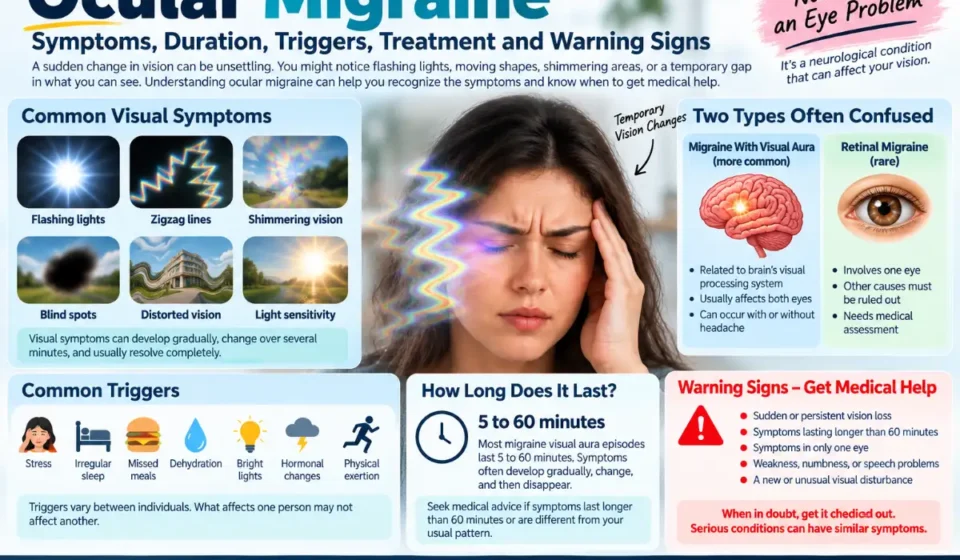

A sudden change in vision can be unsettling. You might notice flashing lights, moving shapes, shimmering areas, or a temporary gap in what you can see. Because these symptoms are often searched online as ocular migraine, understanding what the term actually means is important.
“Ocular migraine” is commonly used to describe migraine-related visual disturbances, but the term can refer to more than one type of visual experience. Migraine with visual aura and retinal migraine are not the same, particularly when symptoms appear to involve only one eye.
This guide covers the appearance of migraine-related visual symptoms, how long they may last, possible triggers, diagnosis, treatment approaches, and situations in which urgent medical care is appropriate.
Medical Disclaimer: This article is for general educational purposes only and does not provide a diagnosis or personalized medical advice. New, sudden, persistent, or unexplained vision changes should be evaluated by a qualified healthcare professional.
What Does an Ocular Migraine Feel Like?
People can experience migraine-related visual symptoms in different ways. The visual disturbance may appear gradually and change over several minutes before returning to normal.
Possible experiences include:
- Flashing or flickering lights
- Bright or sparkling dots
- Zigzag or jagged lines
- Shimmering or vibrating areas
- Temporary blind spots
- Distorted vision
- Difficulty reading or focusing
- Unusual geometric or kaleidoscope-like patterns
- Increased sensitivity to light
A visual episode may occur before a headache, during a headache, or without head pain at all.
Ocular Migraine Is Not Always an Eye Problem
The name “ocular migraine” can make it sound as though the problem originates directly in the eye. That is not necessarily the case.
Migraine with visual aura is associated with temporary changes in the brain’s visual processing system. Although a person may perceive the disturbance on one side of their vision, the visual fields of both eyes are generally involved.
Retinal migraine is different because it involves temporary visual symptoms in one eye and is considered rare.
This distinction matters because sudden vision loss in one eye can have causes unrelated to migraine.
Common Visual Symptoms Explained
1. Flashing Lights
Some people see flashes, flickering lights, or sparkling points that are not actually present in their surroundings.
2. Zigzag Lines
Jagged, geometric, or zigzag patterns may move through the visual field. They can gradually become larger or change shape.
3. Shimmering Vision
The affected area may appear to sparkle, shimmer, or vibrate, making normal objects temporarily harder to see.
4. Temporary Blind Spots
A small or expanding area may appear missing from your vision. This can interfere with reading, recognizing objects, or seeing part of a scene.
5. Distorted Vision
Letters, lines, or objects can temporarily look unusual. Focusing may also become difficult during the episode.
6. Light Sensitivity
Bright environments, screens, or other intense lighting may feel particularly uncomfortable during a migraine episode.
Not everyone experiences all of these symptoms.
How Long Does an Ocular Migraine Last?
The duration depends on the type of visual disturbance.
For typical migraine visual aura, symptoms commonly last approximately 5 to 60 minutes. They may gradually develop, spread, change, and then disappear.
A symptom lasting longer than the usual range does not automatically identify a different condition, but it is a reason to seek medical advice, especially when the episode is new or unusual.
Pay particular attention if:
- The visual change does not completely disappear.
- Symptoms continue beyond about 60 minutes.
- The episode is substantially different from previous experiences.
- You believe only one eye is affected.
- Weakness, numbness, or speech problems occur.
Sudden or persistent loss of vision should not be treated as an ordinary migraine symptom.
Can You Have a Visual Aura Without a Headache?
Yes.
A person can experience migraine aura without developing the headache commonly associated with migraine. This is often called migraine aura without headache.
Visual symptoms may include:
- Shimmering patterns
- Flashing lights
- Zigzag shapes
- Blind spots
- Temporary changes in visual perception
Some people may also experience neurological symptoms such as tingling, numbness, or temporary difficulty with speech or language.
If this is a new experience, medical assessment may be appropriate because several conditions can produce similar neurological or visual symptoms.
What Can Bring on Migraine Symptoms?
Migraine triggers vary considerably between individuals. A factor that seems important for one person may have little effect on another.
Possible contributors include:
| Possible Trigger | Potential Relationship |
| Stress | May contribute to migraine attacks |
| Irregular sleep | Can disrupt an established migraine pattern |
| Missed meals | May contribute to attacks in some people |
| Dehydration | Can be associated with migraine in susceptible individuals |
| Bright or flickering light | May aggravate symptoms |
| Alcohol | May trigger attacks in some people |
| Caffeine changes | Changes in intake may influence migraine patterns |
| Hormonal changes | May affect attack frequency |
Rather than assuming that one factor is responsible, keeping a record of symptoms can help identify patterns over time.
Read More: Best Bread for Avocado Toast
What Happens in the Brain During Visual Aura?
Migraine is a complex neurological condition, and its exact mechanisms are not completely understood.
One proposed explanation for migraine aura is cortical spreading depression, a temporary wave of electrical and chemical changes that moves through areas of the brain. When visual processing areas are involved, this activity may contribute to temporary visual symptoms.
Genetic factors, environmental influences, daily routines, and individual triggers can also affect migraine susceptibility.
Retinal migraine is less common, and the mechanisms associated with it are less certain. That is one reason one-eye visual symptoms deserve particular attention.
What Should You Do During an Episode?
When your vision suddenly changes, your immediate priority should be safety.
Avoid Driving
If you cannot see normally, do not continue driving. Pull over or move somewhere safe.
Stop Using Machinery
Avoid tools, machinery, or other activities that require reliable vision until your sight has returned to normal.
Reduce Uncomfortable Light
If bright or flickering light makes the symptoms worse, move to a comfortable environment with less intense lighting.
Follow Your Medical Plan
If you already have a treatment plan from a healthcare professional, follow the instructions you were given.
Keep Track of the Episode
Record:
- The exact starting time
- How the symptoms looked
- How long they lasted
- Whether they seemed to involve one eye or both
- Whether a headache followed
- Any possible trigger
- Any medication taken
These details can be useful during a medical appointment.
How Is Ocular Migraine Diagnosed?
There is not one universal test that confirms every episode described as an ocular migraine.
Instead, healthcare professionals generally consider the symptoms, their timing, previous episodes, and other relevant medical information.
They may ask:
- Did the symptoms develop gradually?
- What exactly did you see?
- How long did the episode last?
- Did the symptoms seem to affect one eye or both?
- Did you experience headache?
- Have you had similar episodes previously?
- Were there any problems with speech, sensation, strength, or coordination?
- Has the pattern changed recently?
Eye Examination
An eye-care professional may examine the eyes when symptoms could have an ocular cause.
This is especially relevant when someone reports vision loss or other symptoms that appear to occur in only one eye.
Neurological Assessment
Depending on the symptoms, a healthcare professional may evaluate neurological functions such as strength, sensation, coordination, speech, and vision.
Other Tests
Additional tests are not identical for every patient. Depending on the presentation, a clinician may determine whether imaging, laboratory testing, or other investigations are appropriate.
How Is It Treated?
Treatment depends on the diagnosis, symptom pattern, frequency of attacks, severity, and individual medical circumstances.
Treatment During an Attack
A healthcare professional may recommend medicines designed to manage acute migraine symptoms.
The appropriate medication depends on the person and their medical history. Prescription medication should not be selected solely from information found in an online article.
Preventive Treatment
When migraine attacks are frequent or significantly interfere with everyday life, preventive treatment may be considered.
Depending on the individual situation, this can involve prescription medicines, migraine-specific preventive therapies, behavioral approaches, and lifestyle strategies.
Everyday Habits That May Support Migraine Management
Lifestyle measures cannot guarantee that migraine attacks will disappear, but maintaining consistent routines may help some people manage their symptoms.
Maintain Consistent Sleep
Try to keep sleeping and waking times relatively consistent if changes in sleep appear to affect your migraine pattern.
Avoid Skipping Meals
If missed meals appear to precede episodes, a more regular eating schedule may be useful.
Stay Hydrated
Adequate fluid intake can help maintain normal hydration, particularly when dehydration appears to coincide with symptoms.
Manage Stress
Some people incorporate regular physical activity, relaxation exercises, mindfulness, breathing techniques, or scheduled breaks into their routines.
Make Screens More Comfortable
If screens appear to aggravate symptoms, consider:
- Taking regular breaks
- Reducing glare
- Adjusting brightness
- Using comfortable surrounding lighting
However, a visual disturbance should not automatically be blamed on screen use.
Why Keeping a Migraine Diary Can Help
A migraine diary can provide information that is difficult to remember later.
Consider recording:
| Information | Example |
| Date | Date of the episode |
| Time | When symptoms started |
| Duration | Total time of visual symptoms |
| Appearance | Flashes, zigzags, blind spot, etc. |
| Eye involvement | One eye or both |
| Headache | Yes or no |
| Other symptoms | Nausea, tingling, speech changes, etc. |
| Possible trigger | Stress, sleep, meals, light, etc. |
| Medication | What was taken |
| Outcome | How the episode changed or resolved |
After several episodes, these records may reveal whether your symptoms follow a consistent pattern.
When Should You Worry About Vision Changes?
Migraine is only one possible explanation for a visual disturbance.
Urgent medical attention is important when symptoms include:
- Sudden vision loss
- New weakness
- New numbness on one side
- Difficulty speaking
- Difficulty understanding speech
- Confusion
- Difficulty walking
- A sudden, extremely severe headache
- Severe new dizziness
- A dark curtain or shadow across vision
You should also arrange medical evaluation if visual symptoms are occurring for the first time, remain persistent, repeatedly affect one eye, or are significantly different from your usual pattern.
New visual symptoms beginning after age 50 also deserve medical assessment.
One Eye or Both? Why This Detail Matters
One of the most useful details to tell a healthcare professional is whether the disturbance appears to involve one eye or both.
With typical migraine visual aura, the disturbance generally affects the visual fields of both eyes, even though it may appear to be located on one side of what you see.
Retinal migraine, by contrast, involves one eye and is rare.
During an episode, however, it can be difficult to determine which eye is actually responsible for the visual change. For that reason, new symptoms that seem monocular should be evaluated rather than automatically classified as retinal migraine.
Can Ocular Migraine Cause Permanent Vision Problems?
Typical migraine visual aura is generally temporary and reversible.
However, permanent visual impairment has been reported in association with retinal migraine, which is rare. Other eye and vascular disorders can also cause permanent or prolonged vision loss.
The practical takeaway is important: sudden loss of vision should be medically assessed instead of being assumed to be an ocular migraine.
Ocular Migraine vs. Retinal Migraine
| Feature | Migraine With Visual Aura | Retinal Migraine |
| Main system involved | Brain’s visual processing system | One eye |
| Visual involvement | Generally both visual fields | One eye |
| Frequency | Relatively common | Rare |
| Possible symptoms | Zigzags, flashes, shimmering, blind spots | Temporary visual disturbance or loss |
| Headache necessary? | No | No |
| Typical visual aura duration | About 5–60 minutes | Temporary |
| New symptoms | Should be evaluated when unusual | Should be medically assessed |
The eye-versus-visual-field distinction is useful, but it is not always easy for someone to determine during an episode.
Frequently Asked Questions
Is ocular migraine a real diagnosis?
“Ocular migraine” is a commonly used term, but it can describe different migraine-related visual experiences. Migraine with visual aura and retinal migraine have different characteristics.
What does ocular migraine vision look like?
People may experience flashing lights, zigzag lines, shimmering patterns, sparkling shapes, blind spots, or temporary distortion.
How long does a migraine visual aura last?
Typical visual aura commonly lasts between 5 and 60 minutes.
Can you have ocular migraine without a headache?
Yes. Migraine aura can occur without the headache phase.
Does ocular migraine affect one eye?
Typical migraine with visual aura generally involves the visual fields of both eyes. Retinal migraine involves one eye.
Can stress trigger migraine symptoms?
Stress may contribute to migraine attacks in some people, although triggers differ from person to person.
Can dehydration cause visual migraine symptoms?
Dehydration may contribute to migraine attacks in susceptible individuals, but it should not be assumed to explain every new visual disturbance.
Should I see an eye doctor for ocular migraine?
New, persistent, unusual, or apparently one-eye visual symptoms should be medically evaluated. An eye-care professional may help determine whether an eye-related condition could be responsible.
Is there a permanent cure for ocular migraine?
There is no guaranteed permanent cure for migraine. Treatment and preventive strategies may help reduce attack frequency or severity for some people.
When is ocular migraine an emergency?
Sudden vision loss, new weakness or numbness, speech problems, confusion, difficulty walking, or a sudden severe headache require urgent medical assessment.